
"OO, did you get into Lete?"

"I'm in the Harvard class, what class are you in?"

"Mother, according to the Lete (Level Test) results, XX is assigned to the preparatory class."
"However, our center does not have a preparatory class... It seems you need to study more and come back for a retest."
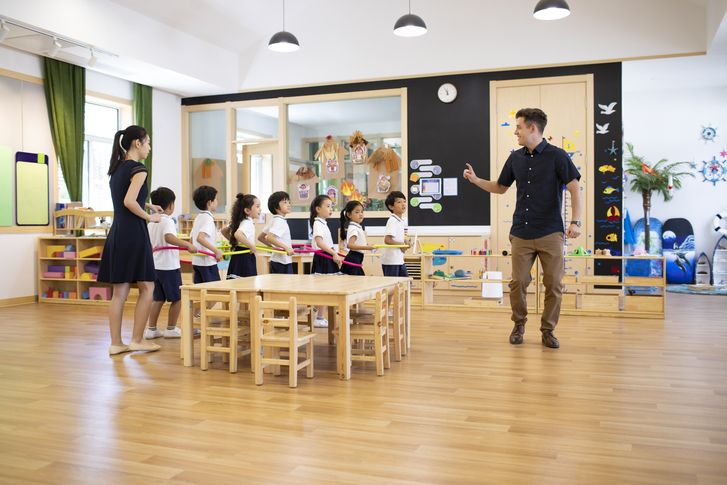
"Mom, all my kindergarten friends are going to XXX Language Academy. Please send me too."
"Jamie and Tammy are in the top class, but I'm the only one in the Stanford class. What should I do?"
Editor's NotePrivate education is casting a shadow over Korea's educational system. In the 'CSAT system,' where every point counts, children start attending English academies as soon as they are out of diapers, and even after graduating from high school, many continue to retake the exam for years. Over the past two months, Asia Economy visited educational sites, meeting students, parents, teachers, and experts to understand the reality and seek alternatives. People expressed concerns that this misguided education system could have negative effects on our lives, economy, and future, saying, "Things can't go on like this."
The 'Exam' for 7-Year-Olds
The 'Exam' Taken at Age Seven
When children complete English kindergarten at age 7, they take entrance exams for well-known language academies around October to maintain and improve their skills. The level test conducted during this process is commonly referred to among parents as the '7-year-old exam.'
"Preparatory class? That basically means the academy won't accept you."

A building in the academy district of Mokdong, Yangcheon-gu, Seoul. Various academies are densely packed inside.
원본보기 아이콘On May 23, at an English academy in Mokdong, Yangcheon-gu, Seoul, a staff member was consulting with a parent over the phone. This English academy, which offers English writing, intensive reading of original texts, English debates, and native speaker classes, divides students into seven levels.
When the staff says 'preparatory class' or 'not offered,' it is another way of saying the academy cannot accept the student. If a student scores low, they cannot attend the academy even if they want to.
A person who previously worked as an instructor at a well-known language academy, referred to as A, said, "The academy deliberately makes the test difficult." They added, "The test is designed so that even students who have studied a fair amount cannot pass, and there's a business motive behind it."
They explained, "From the academy's perspective, it is a way to show off that 'students at our academy can solve even these kinds of problems,' and it makes parents feel pressured to enroll their children no matter what."
Harvard, Yale, Stanford... The Class Name Is a Status Symbol

The more difficult it is to pass the level test, the higher the 'prestige' of the academy. Academies that are harder to get into are perceived as more advanced. The name of the class a student attends effectively becomes a status symbol.
B, a real estate agent in Mokdong, said, "Here, it's common to see children asking each other, 'Did you pass the Lete?' or 'Which class are you in?'" They added, "Famous language academies divide classes into 'top class,' 'Harvard class,' and so on, based on students' abilities. According to parents, children compete with each other and sometimes beg to be sent to these academies."
'Private Tutoring' Just to Pass the Level Test

A banner related to medical school entrance exams is posted on the exterior wall of an academy located in the Daechi-dong academy district, Gangnam-gu, Seoul.
원본보기 아이콘This strategy by academies is proving effective. Among the parents who brought their children to take the level test, some muttered, "Is my child really that far behind?" while others advised, "Get private tutoring for the Lete." There were also parents blaming themselves, saying, "My child is good at speaking, but lacks in other areas."
Why are things pushed this far?
In the end, parents said it was all because of the 'CSAT,' 'college admissions,' and the hope of getting into medical school.
"A 6th Grader Could Score Top Marks in English on the CSAT Right Now"
At another English academy in Mokdong, a parent orientation held at 7:30 p.m. was so crowded there was barely room to stand. The session was led by a native English speaker, and parents nodded to show they understood.
The academy director said, "There are students in 6th grade and 1st year of middle school who are on the 'master track' (the highest level at the academy). At this level, they could already achieve a top score on the CSAT." One parent in their 40s who attended the orientation frowned and said, "My child is only at the basic level. What should I do?"
The reason is that English, which is graded on an absolute scale, should be completed in advance so that students can focus entirely on other subjects like math once they move on to middle and high school.
Is English the End? "You Have to Finish Middle School Math Early, Too"

In math academies in Daechi-dong and Mok-dong, the curriculum was designed so that students could complete the high school math course twice before graduating from middle school.
원본보기 아이콘
A franchise math academy headquartered in Daechi-dong, Gangnam-gu, Seoul, claims that its students complete the three-year middle school math curriculum in just 1 year and 2 months. The material that is normally covered in a semester at school is finished in just two months. Moreover, the 1st and 2nd year middle school curriculum is completed in eight months, and from the ninth month, students move on to the 3rd year curriculum.
According to the civic group "World Without Worries About Private Education," there are academies where students, starting from 5th grade in elementary school, finish the high school senior (3rd year) science track math curriculum by the time they are in 2nd year of middle school.
An academy official said, "In elementary school, it's possible to finish a semester's worth of material every two months, but starting in middle school, you have to prepare for internal assessments, so it takes longer."
"These Days, There's Even a Waiting List for Essay Academies"

The chain of advanced study continues with Korean language. Because there is not enough time in middle and high school, elementary students become the main target for reading and essay academies. To prepare for the CSAT Korean section, which now includes discussion-based and descriptive assessments, and as the reading passages on the CSAT get longer, essay, reading, and debate academies that emphasize literacy are thriving.
On top of this, rumors that the CSAT could switch to essay and descriptive formats starting with the 2032 academic year (for current 6th graders) have made parents and academies even busier.
In January this year, the Presidential National Education Commission (NEC) proposed introducing essay and descriptive assessments to the CSAT in its discussions on the reform of the college admissions system from 2028 onward. This is a huge opportunity for essay academies.
These days, even small tutoring centers in apartment complexes, as well as famous essay academies, have waiting lists. Jo Jungok (age 60), who runs an essay tutoring center, said, "All class slots are full," adding, "If needed, I can arrange one-on-one tutoring."
The Reasons Why Entrance Exams Are Becoming More Extreme

Shim Mincheol, Director of Talent Policy Planning at the Ministry of Education, is explaining the reform details at the 2028 College Entrance Examination System Reform Draft Public Hearing.
원본보기 아이콘There are many reasons, but experts point to frequent changes in the admissions system as the main culprit.
Last year, spending on private education for elementary, middle, and high school students reached 29.2 trillion won, the highest ever. The proportion of students attending academies was also at an all-time high. Eight out of ten (80.0%) elementary, middle, and high school students were found to be receiving private education. In the academy industry, the main reason cited was the changes in the admissions environment following the expansion of medical school quotas last year.
The more the admissions system changes, the more anxiety grows among parents and students, and academies exploit this anxiety for profit.
Park Namki, Professor Emeritus at Gwangju National University of Education, said, "In Korea's winner-takes-all society, even if universities selected students by jump rope, the private education market would grow to teach more advanced jump rope skills." He emphasized, "Solutions such as addressing income gaps and polarization by company, occupation, and region need to be approached from multiple angles."
Lee Yejin, Research Fellow at the Busan Institute of Future Strategy, said, "We cannot simply blame parental ambition or competitiveness," adding, "It is the result of a public education and social system that cannot absorb this anxiety." She said, "Rather than having the courage not to provide private education, it is safer to choose it to relieve anxiety."
![[Education in Korea Has Lost Its Way] ① "Aiming for Top English Scores in Elementary School"... The Spreading Chain of Pre-learning](https://cwcontent.asiae.co.kr/asiaresize/251/2025052709051174647_1748304311.jpg)
![[Education in Korea Loses Its Way]②"Kindergarteners Ask, 'Can I Really Play?'"](https://cwcontent.asiae.co.kr/asiaresize/251/2025052317171171434_1747988230.jpg)





![[Report] "A Culinary Destination with a View of Gyeongbokgung"... Kim Dong-sun's High-End Dining Takes Over Gwanghwamun](https://cwcontent.asiae.co.kr/asiaresize/304/2026042114562634571_1776750985.jpg)

![[Gallery Stroll] Red Robe, Black Lines... Danjong Returns with the Face of Wounds](https://cwcontent.asiae.co.kr/asiaresize/304/2026042014183532691_1776662315.jpg)