
This is not the first time that KOSPI 5000 has been proposed as a presidential campaign promise. Former President Lee Myung-bak once said, "It is normal for KOSPI to reach 5000 within the 5-year term." Candidate Lee Jae-myung also pledged to boost the stock market with the same slogan in the last presidential election. Simply put, for KOSPI to reach 5000, it must rise more than 100% from the current level. Among past administrations, the only time KOSPI rose more than 100% was during the 16th presidency of Roh Moo-hyun.
Editor's NoteWith the presidential election coming up in June, the topic of "KOSPI level-up" has resurfaced. Following Democratic Party candidate Lee Jae Myung's pledge to usher in the era of KOSPI 5000, People Power Party candidate Kim Moonsoo has also made "escaping Boxpi (the boxed-in KOSPI)" a key campaign promise. Both candidates are calling for measures to boost the stock market, and they agree on the need to resolve the "Korea Discount"?the undervaluation of the Korean stock market?through improvements in corporate governance, among other reforms. However, their specific approaches differ somewhat. Based on a survey and interviews with 20 domestic and international capital market experts, Asia Economy will present a three-part series diagnosing the current state and problems of the Korean stock market, exploring what policies the next administration should pursue to shed the Korea Discount label, and examining the key variables and obstacles that will determine whether the "dream number" of 5000 can be achieved.
[KOSPI Level-Up ①] The Era of 5000: Dream or Reality? 20 Experts Weigh In
[KOSPI Level-Up ②] "What the New Administration Must Do": Policy Proposals to Boost Stock Prices
[KOSPI Level-Up ③-1] "A Strong Value-Up Commitment Like Japan Is Needed... Clear Incentives and Penalties Required"
[KOSPI Level-Up ③-2] Achieving the Dream Number Depends on Three Factors
[KOSPI Level-Up ③-1] "A Strong Value-Up Commitment Like Japan Is Needed... Clear Incentives and Penalties Required"
[KOSPI Level-Up ③-2] Achieving the Dream Number Depends on Three Factors
"It's still too early. Many aspects of the stock market must change." "It's not impossible, but the likelihood is not high." "The symbolic meaning is more important than the number itself. The index can certainly rise to a sufficiently high level."
With the KOSPI index currently hovering around 2,600, is it possible for it to reach 5,000 within the next five years? Domestic and international capital market experts are divided in their assessments of the presidential campaign promises for the June election. While many are skeptical, believing it will be difficult in practice, there are also optimistic views that say it is not impossible if reforms are implemented in areas such as Korean corporate governance, which has been criticized by foreign investors.
30% Say "Low Feasibility"... 10% Say "Possible with Legal and Institutional Reforms"
Asia Economy conducted an anonymous survey and interviews with 20 capital market experts?including research center heads at securities firms, academics, and investment banking professionals?between May 12 and May 21, ahead of the presidential election. The results showed that 6 respondents (30.0%) said achieving KOSPI 5000 would be "difficult." Only 2 respondents (10.0%) said it would be "possible," provided there are reforms such as amendments to the Commercial Act and other institutional improvements. Nearly half, 8 respondents (40%), maintained a "neutral" stance, refraining from expressing a political preference even though the survey was anonymous, citing the fact that KOSPI 5000 is a campaign promise of a specific candidate. The remaining 4 did not respond.
The head of a securities firm research center who participated in the anonymous survey commented, "If the Korean economy does not fall into deflation, I believe the era of KOSPI 5000 will eventually come, but is it achievable within five years? Considering both the global macroeconomic environment and the growth trajectory of domestic companies, it is not an easy issue." Another research center head said, "For KOSPI to reach 5000, the size of the economy would also need to double. It is hard to see this happening in the short term." A partner at the foreign asset management firm C Investment noted, "Even leading stocks like Samsung Electronics are not in a favorable cycle, so the likelihood is not high."
However, there were also responses that said it would be possible to enter the era of KOSPI 5000 if factors contributing to the Korea Discount?such as amendments to the Commercial Act and improvements in corporate governance?are resolved. Professor D stated, "If you calculate on a compound interest basis, it is not an impossible number," but emphasized that "fundamental improvements in corporate governance and shareholder returns must be prerequisites." Even among those who said achieving KOSPI 5000 would be difficult, about half believed that the KOSPI index could structurally rise to a higher level under the next administration. The head of research at securities firm E pointed out, "If institutional improvements are made, accompanied by economic policies that enhance long-term growth potential and a favorable global environment is maintained over the long term, the feasibility could increase."
Resolving the Korea Discount Is Key... Dependent on Next Administration's Policies
Candidate Lee Jae Myung: "I Will Open the Era of 5000"
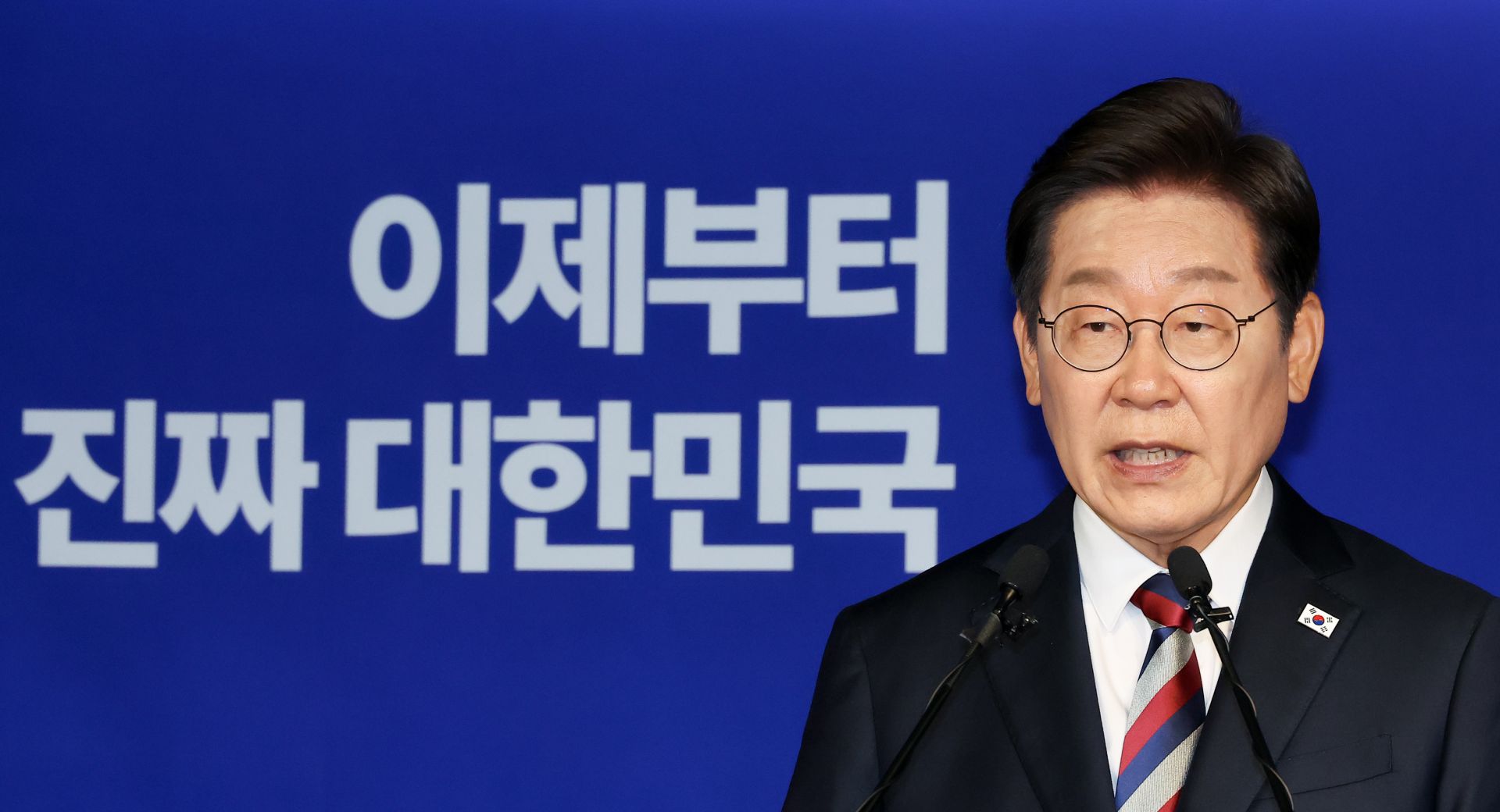
Democratic Party presidential candidate Lee Jae-myung is speaking at a press conference held at the party headquarters in Yeouido, Seoul, on the 25th. Photo by Yonhap News
Accordingly, many believe that the key issue is whether the chronic problem of the Korea Discount in the Korean stock market can be resolved. In this survey and interviews, most capital market experts identified the main factors behind the Korea Discount as: ▲corporate governance, ▲relatively low shareholder returns, and ▲an increase in spin-off listings.
Candidate Kim Moonsoo: "I Will Shed the Boxpi Label"

Kim Moonsoo, the People Power Party's presidential candidate, is conducting a back briefing after touring the promotional center at the on-site meeting of the Central Election Countermeasures Committee held at the Korea Exchange in Yeouido, Seoul, on the 22nd. Photo by Kim Hyunmin
원본보기 아이콘F, a foreign investor in charge of Asian investments at a Hong Kong-based asset management company, said in a separate interview that the biggest problem with the Korean capital market from an overseas perspective is "corporate governance." This encompasses corporate governance structures, low dividends, and spin-off listings. He said, "There are many good companies in Korea, but the link to the market is broken," and emphasized, "Only when independent boards of directors are established will foreign investment funds take a more optimistic view of Korea." He specifically cited the example of Apple, where even Steve Jobs, the founder, was ousted and later returned, saying, "That is the role of the board. The purpose of corporate governance is to maximize company value."

Duplicate listings are also cited by foreign investors as a representative factor behind the Korea Discount. According to IBK Investment & Securities, as of November last year, the duplicate listing rate in the Korean stock market was 18.4%. This is significantly higher than Japan (4.38%), China (1.98%), and the United States (0.35%). The head of research at securities firm G pointed out, "The export dependence of domestic corporate earnings remains unchanged, and in fact, it is becoming even more pronounced. While shareholder-friendly policies at domestic companies are being strengthened compared to before, the increase in the number of shares supplied due to spin-off listings by large companies remains a problem." The main issues arising from duplicate listings are double counting (overlapping profit effects) and the formation of pyramid ownership structures. In addition, the rise of "Seohak Ants" (Korean retail investors investing overseas) and the growth of the virtual asset market are also causing concern as the Korean stock market is being neglected by investors.
Hwang Sewoon, Senior Research Fellow at the Capital Market Research Institute, said, "The main factors behind the Korea Discount, as discussed in academia, are relatively poor corporate governance, insufficient shareholder return policies, and many shortcomings in terms of taxation (policy). If policies are introduced to address these issues, there is ample room for stock prices to rise." Lee Namwoo, Chairman of the Korea Corporate Governance Forum, emphasized, "The Korea Discount is a disaster on par with the low birthrate. The next administration must resolve it through institutional reforms that meet global standards."

IndexCospi Level Up
- Will the Era of 5000 Arrive Within Five Years? Dream or Reality?
-
Reporter Cho Seulkina seul@asiae.co.kr
-
Reporter Ryu Hyunseok guspower@asiae.co.kr
-
Edit Kim Yumi ymkim91@asiae.co.kr
© The Asia Business Daily(www.asiae.co.kr). All rights reserved.
!["Please Help Us": How Much Do Those Bowing 90 Degrees These Days Actually Earn? [Data Pick]](https://cwcontent.asiae.co.kr/asiaresize/323/2026052010120870131_1779239528.png)