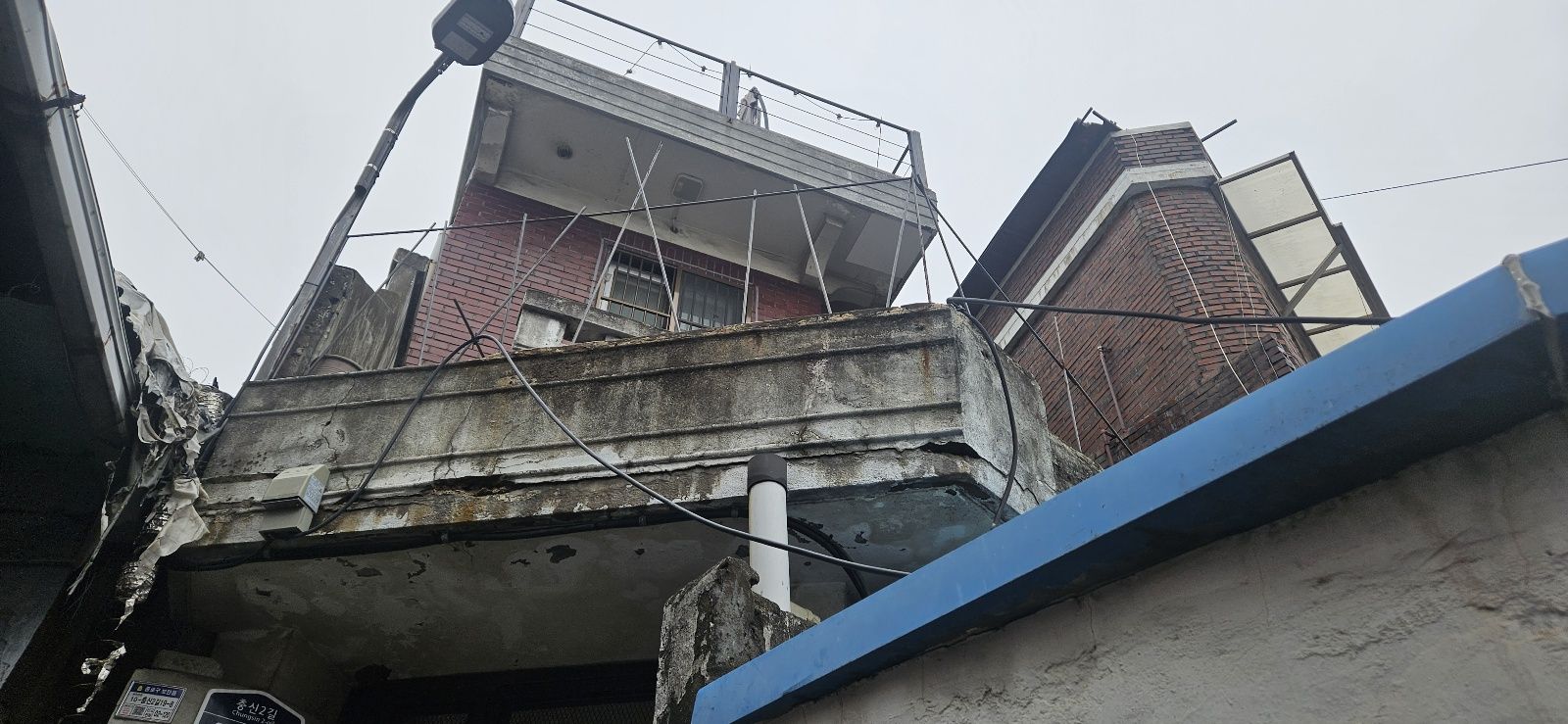
On the 8th, I visited Chungshin 1 District in Chungshin-dong, Jongno-gu, Seoul. As I entered the village entrance, a detached house with cracked walls caught my eye. Faded utility bills were tucked into the gaps of the entrance door.
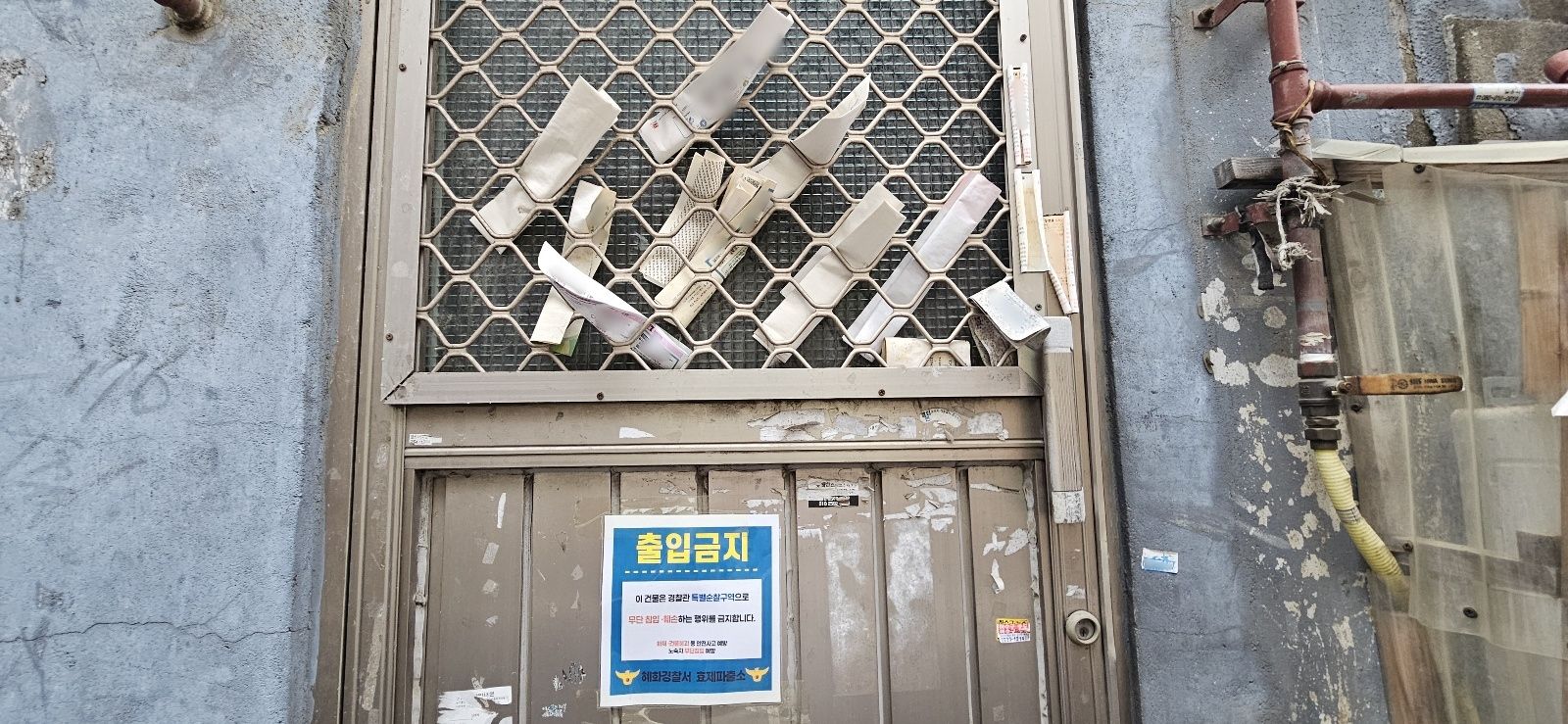
Inside the broken entrance door, trash melted by wind and rain and faded by light was scattered around. The traces of people had disappeared amid the marks of time. As I moved further into the village, many such houses appeared in clusters.
This area is located below the Naksan Fortress Wall Trail of Hanyangdoseong,
and is one of Seoul's most well-known hillside villages.
As vacant houses began to appear, the area soon turned into an empty village.
This stands in stark contrast to Dongdaemun Station, located within a 500-meter radius,
which is bustling with crowds.
Park Sucheol (84, alias), whom I met halfway up the village,
"At one time, the neighborhood was filled with the laughter of children,"
"Kids used to play jump rope and run around in every alley," he recalled.
Park has been a long-time resident here, having settled in the area 50 years ago.
He explained, "Chungsin 1 District used to be an area densely packed with sewing factories,"
"and workers who had settled here with their families lived in every house."

High-rise buildings are visible between old two-story houses located in Chungsin 1 District, Jongno-gu, Seoul. Photo by Lee Jieun
원본보기 아이콘However, the village began to decline rapidly.
The root cause was the development boom that swept through in the 2000s.
In 2005, the Seoul Metropolitan Government established a redevelopment plan
to build 545 households on approximately 29,601 square meters in the Chungshin-dong area.
As redevelopment fever swept the village,
real estate agents and speculators began to appear in the alleys.
After that, housing prices soared without limit.
Park said, "Even in the mid to late 1990s, the price per pyeong (3.3 square meters) of detached houses in this neighborhood
was only 3 million to 5 million won,"
"but as news of possible redevelopment started to spread in the early 2000s,
the price per pyeong jumped to nearly 8 million won."
Eventually, the village became divided between those who left and those who stayed.
Strangers moved in as tenants to the houses sold by original residents who had left.

It seemed as if apartments would be built at any moment,
but that dream was shattered in an instant.
The city government, citing the need to preserve historical and cultural value,
revoked Chungsin 1 District's redevelopment status by administrative order in 2017.
With hopes for rising property values dashed, transactions came to a halt.
Outsiders who had purchased homes for a premium
found themselves unable to sell at the prices they wanted.
It also became impossible to find tenants willing to live in aging houses where redevelopment had been delayed for over a decade.
For these reasons, the number of vacant houses gradually increased.
The proliferation of vacant houses in the wake of the redevelopment boom
is not unique to Chungsin 1 District.
Other areas, such as Ogin 1 District and Sajik 2 District in the same district, as well as Seongbuk 4 District in Seongbuk-gu,
were also hit by the aftermath of administrative cancellations of redevelopment zones.
According to a survey by the Seoul Institute, as of 2019,
a total of 125 vacant houses were counted across these four districts.

Vacant houses have become ticking time bombs threatening the safety of neighbors.
Kim Sunrye (76, alias), who walks slowly due to a stooped back,
only takes walks within ten steps of her house for safety reasons.
If debris falls while she is walking through the narrow alleys, she cannot avoid it,
and even if she shouts for help, no one will come.
Park Sucheol also avoids going out on windy days.
This is because the wooden panels piled up on the rooftop of the vacant house across the street
shake violently every time strong winds blow.
Park said, "Whenever a typhoon comes, I worry that the panels might fly off
and hit someone."
Residents say they fear that vacant houses could become crime-prone areas.
Kang Mija (76, alias), who has lived in Chungsin 1 District for 60 years,
installed a double lock on her door three years ago.
She took this measure after realizing that, since the neighboring house became vacant,
no one was managing or taking care of it.
Kang said, "When the sun goes down, I worry that someone might be hiding in the vacant house,"
she confessed with anxiety.
As Naksan Park's fortress wall trail became a popular tourist attraction,
the number of outsiders visiting Chungsin 1 District increased,
which further heightened Kang's anxiety.
Tourists who visited the area began
to throw cigarette butts into vacant houses or loiter near them.
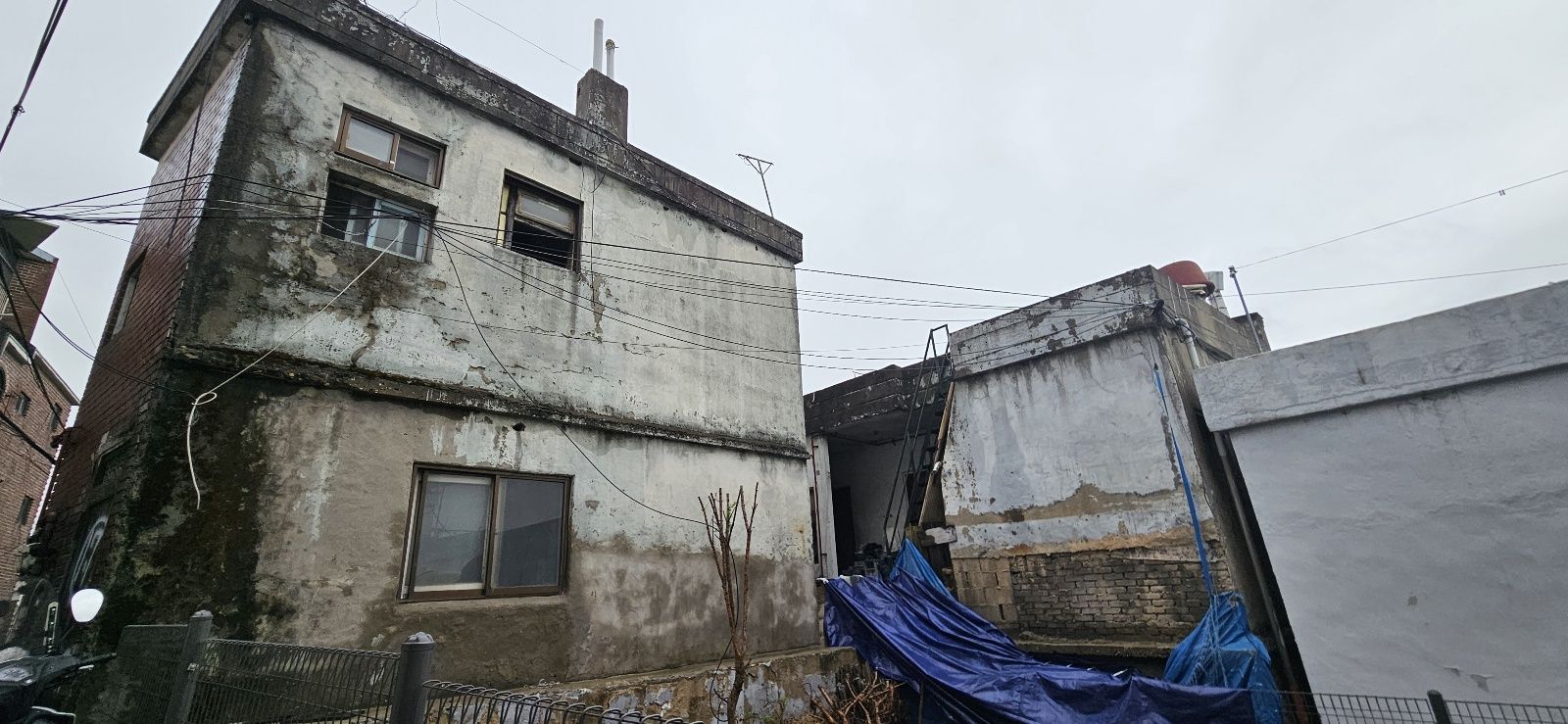
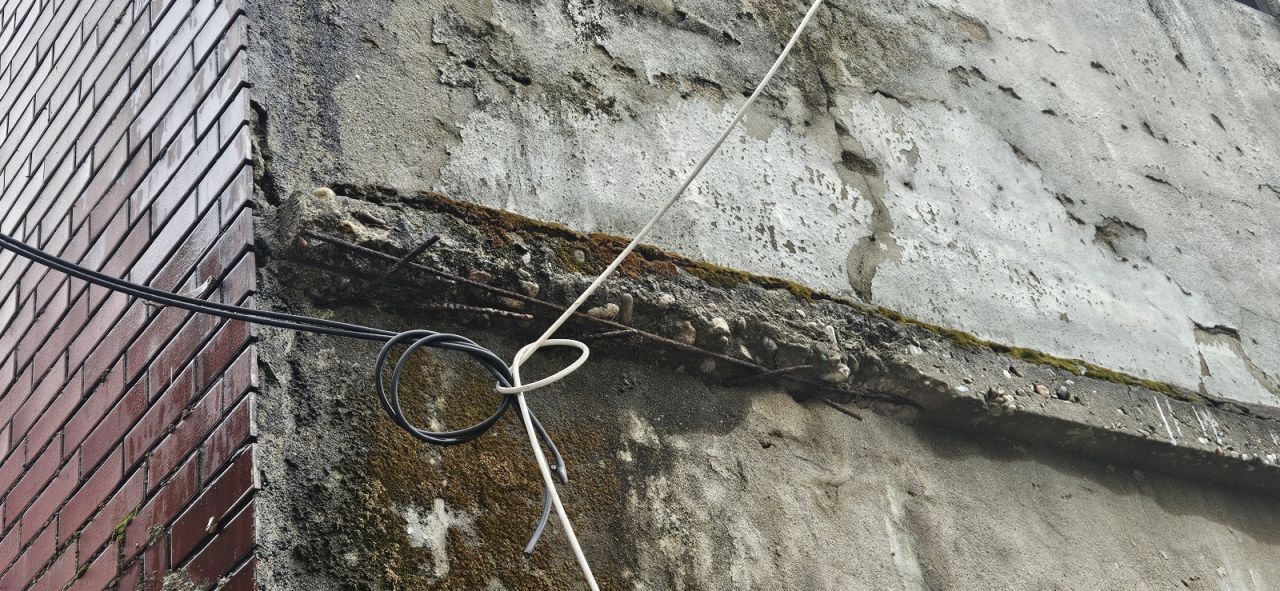
In reality, the vacant houses here were left unattended with exposed rebar and concrete.
In the two-story row house located halfway up the village, cement powder crumbled off even when the wall was lightly brushed by hand.
Vacant houses have not only changed the appearance of the village, but also destroyed the community itself.
Chungsin 1 District is no exception.
As vacant houses were left unattended and the residential environment deteriorated,
the number of residents leaving the village increased one by one.
According to residents, these days, except for foreign workers,
it is now rare to see anyone coming to the village to rent a room.
Existing rental houses, after their contracts expired,
remained vacant because new tenants could not be found.
As residents scattered, interactions between neighbors disappeared.
Park said, "In the past, every summer, neighbors would gather on benches,
share watermelon, and hold talent shows,"
"Now, I don't even know who lives in the village.
The only neighbor I know is Kim," he said.
Not only Park, but all three residents I met in the village that day
said they did not know any neighbors other than those living next door.

In Japan, where research on vacant houses began earlier than in Korea,
this phenomenon is explained by the concept of 'Tonari (隣り)'.
Tonari is a word meaning "neighbor,"
and refers to the point when one of two neighboring houses becomes vacant,
signaling the gradual collapse of the community as it loses its communal function.
Park, who is approaching ninety, has only one wish:
that no more vacant houses appear among his neighbors.
Park said, "I miss the days when I could start and end each day
by exchanging greetings with my neighbors,"
he said, his eyes brimming with tears.
-

Reporter Lee Jieun jelee0429@asiae.co.kr
-
Edit Maeng Jiae mjiae@asiae.co.kr
© The Asia Business Daily(www.asiae.co.kr). All rights reserved.
!["Please Help Us": How Much Do Those Bowing 90 Degrees These Days Actually Earn? [Data Pick]](https://cwcontent.asiae.co.kr/asiaresize/323/2026052010120870131_1779239528.png)