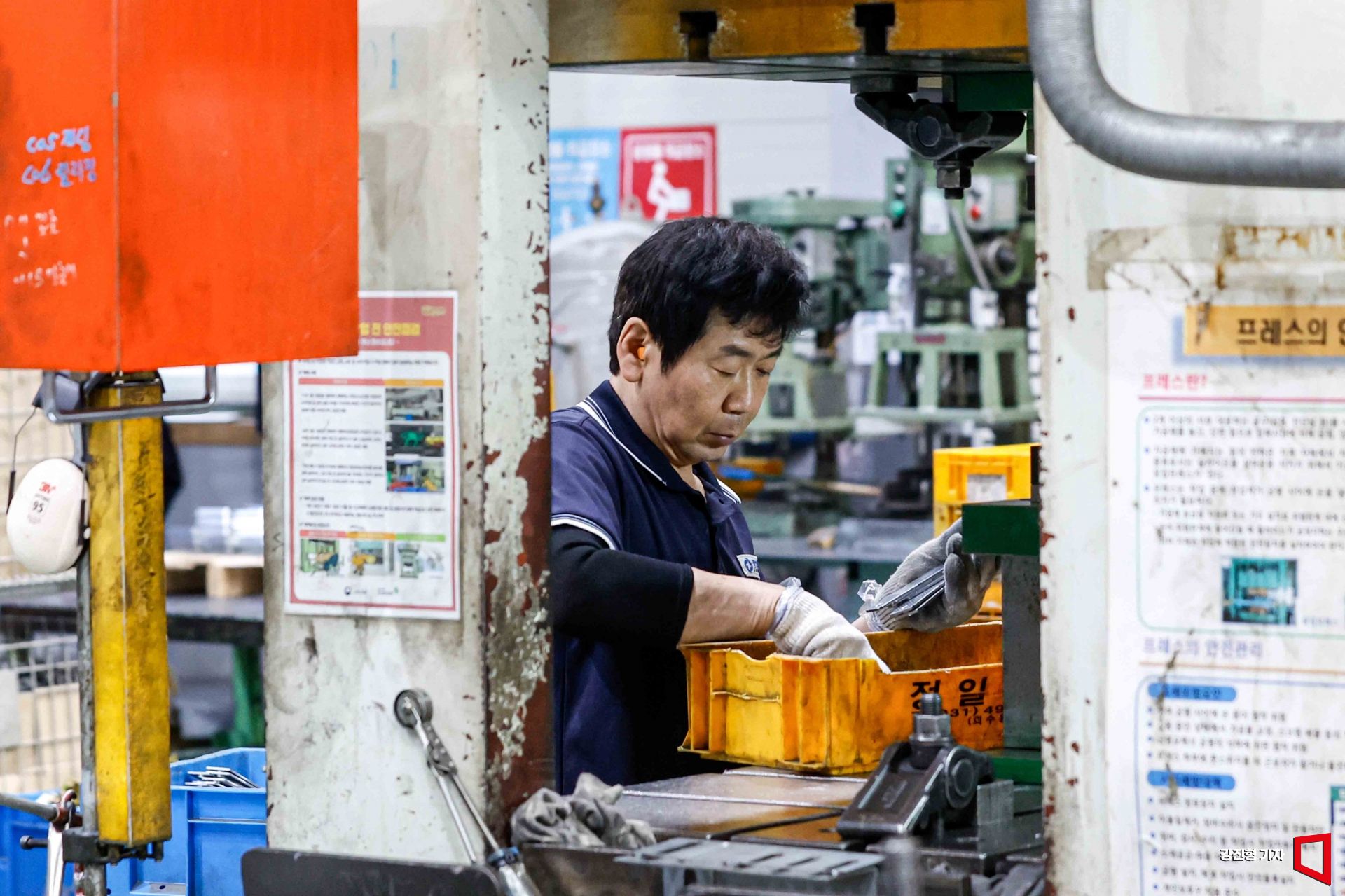
Jeongil Industry does not place any significance on the age limit called retirement.
On-site Report from Siwha Industrial Complex
The heavy press machine operates with a resounding "thud." Shin Songnam, working swiftly in front of this massive equipment that never stops moving, cannot afford to let his guard down for even a moment. The machine, which stamps out parts for elevators with a deafening roar that drowns out even the voices of those nearby, leaves no room for complacency?any lapse in attention could lead directly to a major accident. When visiting Jeongil Industry's factory in Siwha Industrial Complex, Gyeonggi Province, on May 12, the first scene encountered was Shin, age 61, absorbed in his work with earplugs in place to block out the noise. He performs the most demanding tasks here, and although he has already passed the retirement age, he is not even among the most senior employees.
Even After Age 60 Retirement, Still 'Core Personnel' at SMEs
Jeongil Industry employs about 110 people across its Siwha Industrial Complex and Chungbuk Chungju plants, of whom 18 continue to work even after passing the official retirement age. Kim Daehwan, the factory manager overseeing the entire production process at the Siwha plant, is 66 years old?well past retirement. Kim Dooyeon, who handles rubber press work at another factory, was born in 1954 and, at age 71, is even older than Kim Daehwan. Bang Gwangho, the forklift driver transporting elevator parts throughout the factory, is a "youthful" 60 this year. Including these employees, all staff who have passed the retirement age continue to handle key responsibilities in production, after-sales service, and maintenance, just as they did before retirement.
"Hiring young employees? That's like trying to catch a star in the sky. Even hiring people in their 40s and 50s is not easy." Jeong Kwangyong, CEO of Jeongil Industry, told the reporter at the factory. While the positive influence of experienced workers, who have spent many years with the company, is invaluable?helping the company overcome both major and minor crises together?there is also an unavoidable, practical reality underlying this situation.
For these reasons, Jeongil Industry does not place any significance on the age limit called retirement. There is no specific system in place, but if the individual's will and conditions match, employment is maintained as is, and that too as a full-time position. Salaries are not reduced. On the contrary, salaries are increased annually, and the work that has been done so far continues to be assigned. In some cases, when severance pay settlements are required, employees have been allowed to resign and then be rehired. The scene observed here is a snapshot of continued employment for retirees, a reality that has already taken root ahead of the broader societal debate on "retirement extension." It is also a vivid argument that, in order for both companies and workers to benefit, the business community, industry, and government must face this reality and work together to provide institutional support.
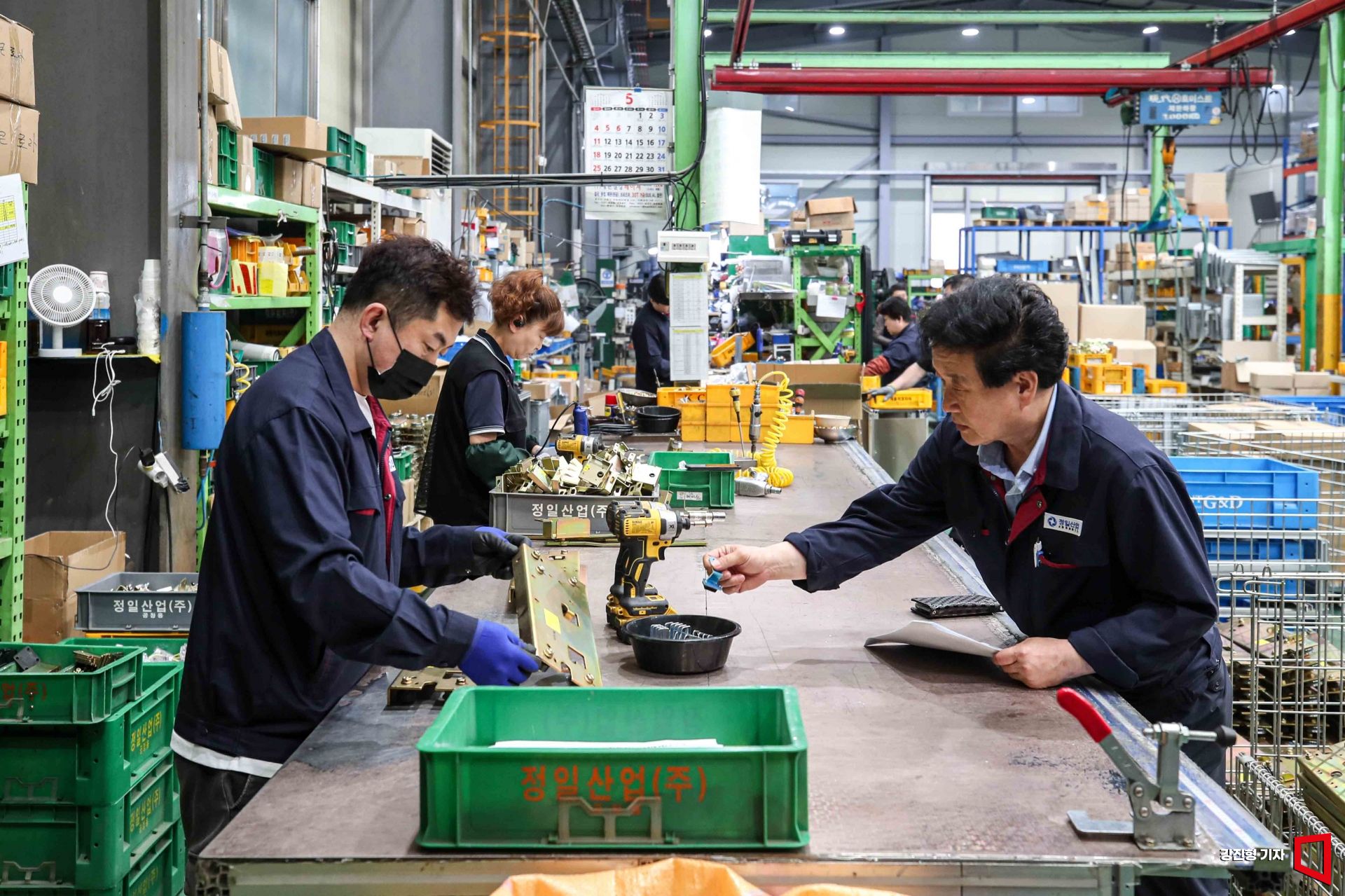
If the individual's will and conditions align, employment is maintained as is, and that too as a full-time position.
Salaries are not reduced. On the contrary, salaries are increased annually, and the work that has been done so far continues to be assigned.
The CEO's policy and its background may seem simple, but they encapsulate the deep challenges faced while running a small or medium-sized enterprise. As Jeong Kwangyong confided, "In 40 years of running a company, I've never felt such a sense of despair as I do now." The company is directly hit by the sluggish construction market, but what is especially painful is the inability to attract and retain young employees despite their best efforts. Even Jeongil Industry, which has maintained competitiveness in the elevator manufacturing sector for nearly 40 years since its founding in 1987, cannot avoid the employment challenges faced by SMEs.
At Jeongil Industry's Chungju plant, a wide range of housing benefits such as dormitory accommodation are provided, but few people are willing to work there simply because it is located in a provincial area. Even when young employees are hired with great difficulty, they tend to avoid rough and demanding work, so they do not stay long, according to both the CEO and on-site staff. The fact that Jeongil Industry continues to offer work opportunities to employees past retirement age is largely a reaction to these complex difficulties.
For SMEs Facing Labor Shortages, Continued Employment Is Essential
According to the Korea Small Business Institute on May 14, 28.9% of small and medium-sized enterprises report labor shortages. Only 3.2% say they have sufficient manpower. This means that most SMEs are suffering from chronic staff shortages. Meanwhile, as of last year, 12,364,000 SME employees were aged 50 or older, accounting for 48.6% of all SME workers. In 2014, this figure was 38%, but it has increased by 10.6 percentage points over the past decade.
Now, nearly half of SME workers are so-called "older workers." This reality is even more pronounced when compared to large companies. Last year, only 26.4% of employees at companies with more than 300 employees were aged 50 or older. The proportion at SMEs is 22.2 percentage points higher.
Although demand for older workers and continued employment at SMEs is high, and government programs such as the Continued Employment Incentive and Senior Employment Subsidy exist, there are clear limitations in terms of eligibility requirements and the amount of support. Under the current Restriction of Special Taxation Act, the tax credit for employing older workers is only about 4 million to 15 million won per person, and the senior employment stability subsidy is limited to 1.2 million to 3.6 million won per person per year.

Given the relatively high wages of skilled workers eligible for employment, it is difficult for companies with limited size and financial resources to implement continued employment, perpetuating the vicious cycle of labor shortages. Statistics show that the number of companies applying for the continued employment incentive has dropped by 26% over the past two years, highlighting this reality.
Jo Juhyun, president of the Korea Small Business Institute, said, "It is more important than anything else to expand the scope of tax support for companies hiring older workers, thereby strengthening incentives." He also suggested, "Currently, tax support for SMEs hiring older workers is limited to those aged 60 and over, but lowering this age threshold to broaden the benefits is also necessary." Industry insiders and experts agree that, in addition to this, a detailed analysis of employment conditions in the SME sector and the broader social environment is needed, and that economic and social discussions should be accelerated so that companies can find new ways to manage their workforce through the employment and continued employment of older workers.
IndexElderly Years, Time of Choice
- For SMEs, Even Hiring Workers in Their 40s and 50s Is Difficult: "Now Is Not the Time to Worry About Retirement Age"
-
Reporter Kim Chulhyun kch@asiae.co.kr
-
Edit Choi Yujeong yjchoi@asiae.co.kr
© The Asia Business Daily(www.asiae.co.kr). All rights reserved.
!["Please Help Us": How Much Do Those Bowing 90 Degrees These Days Actually Earn? [Data Pick]](https://cwcontent.asiae.co.kr/asiaresize/323/2026052010120870131_1779239528.png)