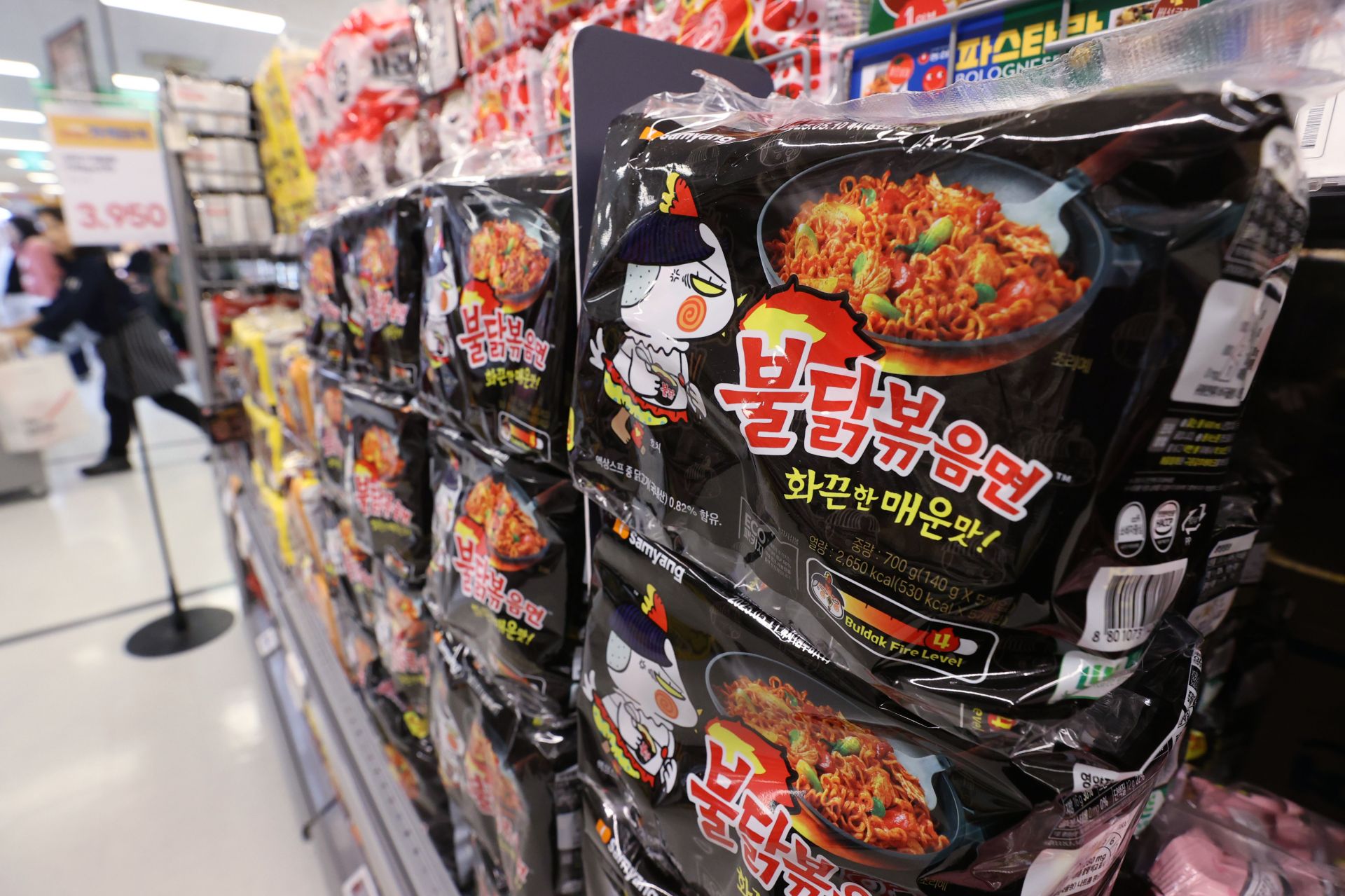
#Buldak Bokkeummyeon, produced by Samyang Foods and a key driver of the global K-food craze, has sparked a flood of 'me-too products' with similar flavors and packaging. The addictive spiciness has captured the palates of people around the world, prompting both domestic and international food companies to jump on the Buldak bandwagon and release similar products. For example, Harim Industrial launched 'Yonggari Bulbokkeummyeon' in September last year. This ramen features a strong spicy flavor using Vietnamese chili peppers and habanero in its sauce, and its packaging?with a black background and red product name?closely resembles Buldak. In March of this year, the company introduced 'Yonggaribulbokkeummyeon Carbonara' (cup), which comes in the same pink package as Samyang Foods' Carbo Buldak Bokkeummyeon. Earlier, in January, Paldo also released 'Volcano Carbonara.'
Buldak Bokkeummyeon was created when Samyang Foods Vice Chairman Kim Jungsoo, after seeing young people in Myeong-dong enjoying spicy food with his daughter in 2011, decided to bring 'intense spiciness' to ramen. Vice Chairman Kim personally visited famous Buldak, Bulgopchang, and Dakbal restaurants across the country with marketing and research staff, using 2 tons of spicy sauce and 1,200 chickens for R&D over the course of a year to develop the product. However, most Buldak me-too products have easily replicated the spicy flavor and simply ridden the 'Buldak trend.'
Flood of 'Me-too Products' from Harim, Paldo, and Others Following Samyang's Buldak Bokkeummyeon Success

Last year, major domestic food companies spent less than 1% of their sales revenue on R&D. Although they have steadily increased their R&D budgets over the past ten years, the absolute scale remains small compared to global food companies. In particular, most of the product development has focused on imitating or renewing existing products rather than developing innovative products or technologies.
Only 2 Out of 11 Domestic Food Companies with Sales Over 3 Trillion Won Exceed 1% R&D Ratio
On May 6, Asia Economy analyzed the R&D status of 11 domestic food companies with sales exceeding 3 trillion won as of last year. The average R&D-to-sales ratio for these companies was 0.68%. This is an increase from the average of 0.56% ten years ago. The combined R&D expenditure of these 11 food companies last year was 437.5 billion won, more than double the 190.8 billion won spent ten years ago.
However, only two companies?CJ CheilJedang and Daesang?had an R&D ratio exceeding 1%. CJ CheilJedang invested 218 billion won in R&D last year, but even this was a slight decrease from 233.7 billion won in 2023.
Next were ▲Daesang at 1.09% (47.9 billion won), ▲Pulmuone at 0.9% (30 billion won), ▲Nongshim at 0.9% (29.6 billion won), ▲Lotte Chilsung Beverage at 0.74% (29.6 billion won), ▲Lotte Wellfood at 0.7% (28.5 billion won), ▲Ottogi at 0.7% (20.4 billion won), ▲Orion at 0.52% (5.8 billion won), ▲Dongwon F&B at 0.31% (13.3 billion won), and ▲SPC Samlip at 0.25% (9.7 billion won).

The R&D scale of domestic food companies is far below the average for the manufacturing industry. The average R&D-to-sales ratio for domestic manufacturing companies is around 4-5%, while food companies are only at about one-sixth of that level.
While Nestle Spends 2 Trillion Won a Year, Domestic Food Companies Only Spend 437.5 Billion Won
Compared to global companies, domestic R&D investment is also extremely small in scale. Nestle, the world's largest food and beverage company, invested $16.67 billion (about 2.391 trillion won) in R&D last year. This accounts for 1.8% of its 2024 sales of $91.354 billion (131.029 trillion won). Over the past five years, Nestle has consistently invested about 2 trillion won annually in R&D. Even the combined R&D expenditures of all domestic food companies do not match Nestle's.

Chronic Practice of 'Copying Competitors' Hinders R&D Investment
An even bigger problem is that the chronic practice of 'copying competitors' in the food industry is blocking the need for R&D investment. The industry has long entered the market by creating 'me-too products' similar to top-selling items. About 300 new products are launched every year in the domestic food market, but truly innovative products recognized by the market are rare.
For example, Dongwon F&B, which has the lowest R&D investment ratio among comprehensive food companies, developed 186 general food products last year, including 13 types of canned tuna and 34 types of frozen foods. The company also introduced 44 types of dairy products, 671 types of sauces, and 974 types of seasoning products. However, none of these have become recognized as innovative products by consumers.
Meanwhile, CJ CheilJedang, the industry leader, has invested billions of won in R&D over the years and used its developed technologies to launch new products such as Hetbahn Seoritae Black Rice, Sobaba, Spam Single Chicken Breast, and Bibigo Boneless Grilled Flatfish.
Within the food industry, low operating margins are cited as a reason for stingy R&D spending. In fact, the average operating margin for these 3-trillion-won club food companies was 5.6% last year. Excluding Orion, which has a high overseas share (17.5%), the figure drops to 4.3%. This falls short of the average operating margin for the manufacturing industry, which is 6.2%.
The food industry is considered a typical low-margin sector. The burden of labor costs on raw materials is increasing, and as the industry has grown based on domestic demand, it is sensitive to price increases, making it difficult to generate significant profits. Most raw materials are imported, and when prices of key ingredients such as cocoa and coffee rise and the won-dollar exchange rate increases, costs rise further. An industry insider said, "Recently, companies that have succeeded in overseas markets have improved their operating margins, but for most companies, breaking the 10% barrier is like reaching for the stars," adding, "When allocating budgets for new businesses or products, this reality cannot be ignored."
Reliance on Monopoly and Long-Selling Products Like Hetbahn, Dongwon Tuna, and Shin Ramyun

However, there is still criticism that food companies are neglecting R&D by relying on products that already dominate the market. Long-selling items such as CJ CheilJedang's Hetbahn, Dongwon F&B's tuna, Nongshim's Shin Ramyun, and Binggrae's Banana Flavored Milk continue to generate steady sales due to their overwhelming market share, leading companies to become complacent. An industry insider said, "It is true that the idea that companies can generate sufficient sales without special R&D, and therefore do not need to develop new products, is widespread in the industry," adding, "If anything, it seems to have eliminated the spirit of challenge."
An analyst at a securities firm, who requested anonymity, said, "In the early days of the domestic food market, companies unconditionally copied foreign products from Japan or the United States, and that culture still persists. Launching new products requires significant R&D investment and time, and the probability of success is low. In contrast, renewing existing products or copying competitors' products provides immediate stable sales, so there is an implicit atmosphere of acceptance." He pointed out, "As R&D concentration decreases, product diversity also declines, resulting in fewer choices for consumers."
-

Reporter Han Yeju dpwngks@asiae.co.kr
-
Edit Lee Kijae happylee17@asiae.co.kr
© The Asia Business Daily(www.asiae.co.kr). All rights reserved.




![[Report] "A Culinary Destination with a View of Gyeongbokgung"... Kim Dong-sun's High-End Dining Takes Over Gwanghwamun](https://cwcontent.asiae.co.kr/asiaresize/304/2026042114562634571_1776750985.jpg)

![[Gallery Stroll] Red Robe, Black Lines... Danjong Returns with the Face of Wounds](https://cwcontent.asiae.co.kr/asiaresize/304/2026042014183532691_1776662315.jpg)