Okpo Shipyard: The Site of Growing Interest in K-Shipbuilding
It has been reported that John P. Phelan, Secretary of the US Navy, is expected to visit South Korea as early as this week, with a visit to Hanwha Ocean included in his itinerary. There is also speculation that Donald Trump Jr., the eldest son of US President Donald Trump, who will be visiting Korea around the same time, may join the schedule. As the US has been showing increasing interest in K-shipbuilding since the start of the Trump administration's second term, Secretary Phelan appears to be personally inspecting domestic special ship facilities.
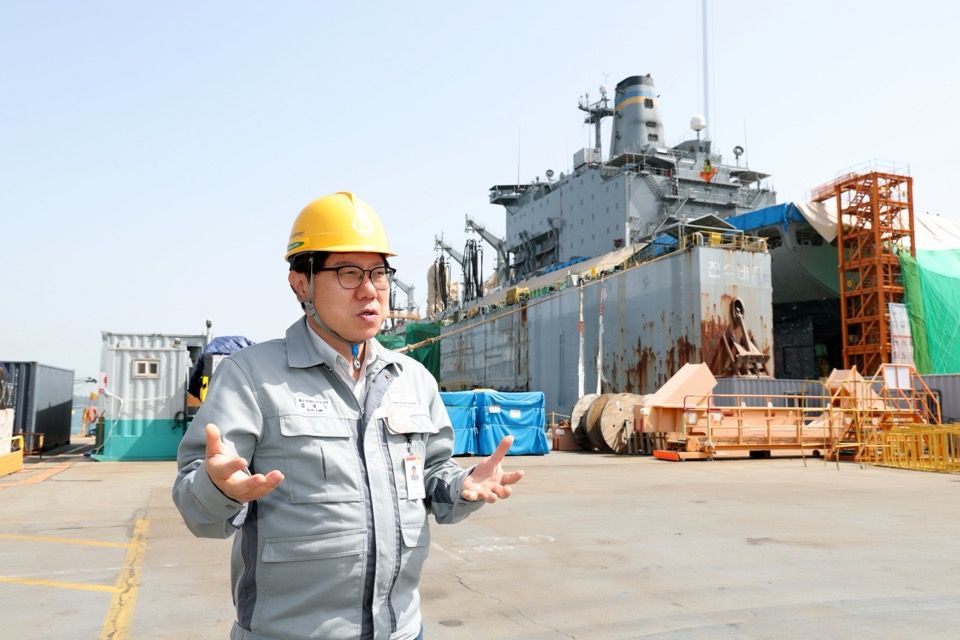
In August last year, Hanwha Ocean became the first Korean shipyard to win a maintenance, repair, and overhaul (MRO) contract for the US Navy's logistics support vessel, the Wally Shirra. Three months later, the company secured an additional MRO contract for the US Navy 7th Fleet's replenishment oiler, the USS Yukon (USNS YUKON). After six months of maintenance, the Wally Shirra departed from Hanwha Ocean's Okpo Shipyard in March. The Yukon is scheduled to be repaired and delivered to the US Navy by next month. To witness the maintenance process of the Yukon, which was disclosed to Korean media for the first time, I visited Hanwha Ocean's Okpo Shipyard.

Securing the Yukon MRO Contract Just Three Months After Wally Shirra
The Yukon is the sixth vessel of the Henry J. Kaiser-class large replenishment oilers. It was built by Avondale Shipyard in New Orleans, Louisiana. Commissioned in March 1994, it was deployed to the US Pacific Fleet and is operated by the US Navy's Military Sealift Command (MSC). At the shipyard dock, maintenance work on the Yukon was underway. Ship maintenance is divided into three stages: voyage repair (VR, annual, two-week process), mid-term availability (MTA, every 18 months, 1.5-month process), and overhaul (every 5 to 7 years, three-month process). This is the first time a Korean shipyard has been entrusted with the overhaul of a US Navy vessel, signifying US recognition of the technological capabilities of the Korean shipbuilding industry.
Strict security measures are in place for those wishing to see the Yukon. The interior of the Yukon is considered US territory. There is a guard post outside the ship, and armed US Navy personnel are stationed inside, maintaining a 24-hour watch.
First Disclosure to Korean Media... Armed Security on Duty 24 Hours
Up close, the Yukon is overwhelming in size, measuring 206 meters in length. The vessel carries up to 160,000 barrels of fuel for resupplying other ships and can also transport 31,200 tons of various cargo. The vessel’s full-load displacement is 42,382 tons. At the stern, there is a deck for helicopter takeoff and landing.
Hanwha Ocean employees lifted the Yukon and began cleaning the ship’s exterior. For the first time at a Korean shipyard, a high-pressure washing robot was deployed. Previously, workers would blast the surface with metal particles to remove contaminants, resulting in significant dust. In contrast, the high-pressure washing robot uses water jets to strip away debris and vacuums it up. This process alone takes two weeks. The areas cleaned by the robot were visibly free of contaminants, as if wiped clean. Unlike container ships, which have flat bottoms to maximize cargo capacity, the Yukon must maintain the same speed as US aircraft carriers. It achieves a speed of 20 knots (37 km/h) via two massive diesel engines and propeller shafts. Due to its streamlined shape, curved areas must be cleaned manually rather than by robot.
First Use of High-Pressure Washing Robot: Two Weeks to Remove Surface Contaminants
Internal maintenance is even more demanding. As the vessel is over 30 years old, the US specified 82 maintenance items. However, after four months of internal work, the list grew further, with more than 120 additional maintenance items identified. The repair period was also extended, ending up one month behind the original schedule. Technical experts from various foreign parts manufacturers had to be called in. Within a month of the Yukon entering the Geoje shipyard, technical staff from over 40 companies across 10 countries, including Japan, the US, and Germany, arrived. Some parts manufacturers no longer existed, and certain parts were discontinued. Hanwha Ocean provided solutions by visiting over 20 domestic companies with experience supplying naval vessels, sourcing each replacement part individually.
Kim Daesik, Executive Director of Hanwha Ocean Special Ship MRO Business TFT, said, "The US Navy pays more attention to the operation of equipment for mission performance than to the ship's outer surface," adding, "While repairing parts is important, the US Navy is even more satisfied when we find substitutes." According to those involved, there were more difficulties than with the Wally Shirra, which was built 15 years ago.

Previously, the Yukon had been serviced at shipyards in Southeast Asia, such as Singapore and Thailand. The US military was not satisfied with the results. When Steve Koehler, Commander of the US Navy Pacific Fleet (Admiral), visited Hanwha Ocean in October last year, he stated, "We are reassured that Korean shipyards are handling US Navy MRO."
Discontinued Internal Parts Sourced One by One
After signing the Master Ship Repair Agreement (MSRA) with the US in July last year, Hanwha Ocean won the Wally Shirra MRO as its first project. Hanwha Ocean aims to establish Korean shipyards as key players in the global naval MRO market, with the US as its first target market. The US naval MRO market alone is worth about 20 trillion won annually. The US is strengthening its naval power to counter China. Notably, most of China's major warships have been built since 2010, meaning they are mostly state-of-the-art vessels. Chinese state-owned shipyards built more than 80 warships in just eight years at an unprecedented pace. As of March 2021, the Chinese Navy had 360 combat ships, surpassing the US Navy's 297. The US Navy is also expediting maintenance. Since the end of the Cold War, defense budget cuts have limited investment in maintenance facilities, resulting in only about 40% of scheduled combat ship maintenance being completed on time.
Global 80 Trillion Won Market... Preparing to Expand from the US to Europe
In September last year, US Chief of Naval Operations Lisa Franchetti announced "Project-33," a naval buildup plan to counter China's military threat. The top priority in the plan is addressing delays in the maintenance of ships, submarines, and aircraft. The core objective is to maximize operational rates of all types of combat vessels. Hanwha Ocean plans to expand its MRO business from the US to Asia, the Middle East, and Europe. The global naval MRO market is estimated at about $8 billion (11.63 trillion won).
-

Reporter Yang Nakgyu if@asiae.co.kr
-
Edit Lee Kijae happylee17@asiae.co.kr
© The Asia Business Daily(www.asiae.co.kr). All rights reserved.
!["Please Help Us": How Much Do Those Bowing 90 Degrees These Days Actually Earn? [Data Pick]](https://cwcontent.asiae.co.kr/asiaresize/323/2026052010120870131_1779239528.png)