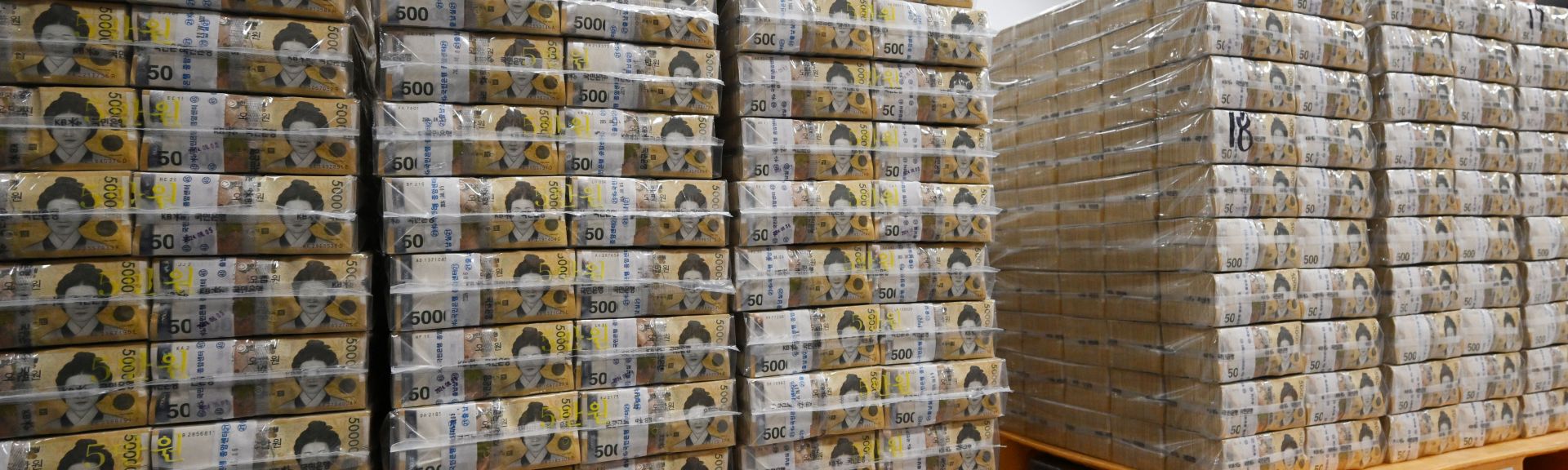
'Investment Standby Funds' Unusually Large Outflow
It has been found that over 42 trillion won in demand deposits have flowed out of the five major commercial banks (KB Kookmin, Shinhan, Hana, Woori, and NH Nonghyup) in just two weeks. Compared to the usual monthly fluctuation of 5 to 10 trillion won, this is an exceptional change within less than a month. Analysts attribute this to two main factors: the appeal of deposits and savings accounts as investment destinations is declining due to the start of a full-scale interest rate cut cycle, and more investors are turning to other investment options such as stocks, following the tariff shock triggered by Trump.
According to the financial sector on the 23rd, the combined demand deposits (including MMDA, as of the 18th) at the five major commercial banks stood at 607.3011 trillion won. This represents a decrease of 42.823 trillion won from the previous month (650.1241 trillion won). Demand deposits, which offer a minimal interest rate of around 0.1%, serve as a main source of low-cost funds for banks and are classified as 'investment standby funds' by investors due to their liquidity. Typically, demand deposits fluctuate by 5 to 20 trillion won per month, but a change of over 42 trillion won in just two weeks is highly unusual.
Tariff Shock Increases Stock Market Volatility... Observations of Bottom Fishing
The prevailing assessment is that the massive outflow of demand deposits in two weeks is largely due to increased stock market volatility caused by the tariff shock triggered by Trump, prompting investors to engage in bottom fishing. According to the Korea Securities Depository, as of the 19th of this month, the net purchase amount of U.S. stocks by Korean retail investors (so-called 'Seohak Ants') reached about $3.7 billion (about 5.2528 trillion won). This is about 90% of March's net purchase amount ($4.1 billion) and exceeds February's net purchase amount ($3.0 billion). Net purchases are also continuing in the domestic stock market. From the 1st to the 18th of this month, individual investors have recorded net purchases totaling 5.5818 trillion won. This contrasts sharply with March, when individual investors were net sellers of more than 3 trillion won in KOSPI stocks alone.

Declining Appeal of Deposit and Savings Rates Due to Interest Rate Cuts Also a Factor
The declining attractiveness of deposit and savings account interest rates, as the interest rate cut cycle begins in earnest, is also analyzed as a factor encouraging the outflow of demand deposits. According to the Korea Federation of Banks, the upper and lower limits of 12-month deposit interest rates (simple interest basis) at the five major commercial banks are between 2.15% and 2.73%. This is a decrease of 0.46 percentage points and 0.21 percentage points, respectively, from last month's average rates (2.61% to 2.94%). The interest rate for ultra-short-term, one-month fixed deposits has already fallen to the 1% range. For example, Shinhan Bank's 'Solpyeonhan Fixed Deposit' and KB Kookmin Bank's 'KB Star Fixed Deposit' both offer about 1.80% for a one-month term.
There are also concerns that the rapid outflow of demand deposits in a short period could prompt an increase in bank lending rates. This is because a higher volume of demand deposits reduces banks' funding costs for loans. If the large-scale outflow of demand deposits leads to higher funding costs for banks, it could result in an increase in the COFIX (Cost of Funds Index), which serves as the benchmark for variable-rate loans such as mortgage loans and jeonse (lump-sum lease) loans. The COFIX reflects changes in the interest rates of deposit and savings products, as well as bank bonds handled by banks.

Concerns Over Funding Cost Increases and Lending Rate Hike Pressure
A banking sector official said, "Typically, in March, which is the end of the fiscal quarter, companies temporarily park funds in demand deposits for settlement purposes, so there is a seasonal increase in demand deposits in March, followed by a slight decrease in April." The official added, "However, even after considering these seasonal factors, the increase in not only demand deposits but also household credit loans suggests that funds are moving to investment destinations outside of banks."
-

Reporter Kwon Jaehee jayful@asiae.co.kr
-
Edit Lee Kijae happylee17@asiae.co.kr
© The Asia Business Daily(www.asiae.co.kr). All rights reserved.



![[Culture Interview] "Unifying the Fragmented Music Market... Super Fans Are the Next Competitive Edge"](https://cwcontent.asiae.co.kr/asiaresize/304/2026042817051344090_1777363513.jpg)