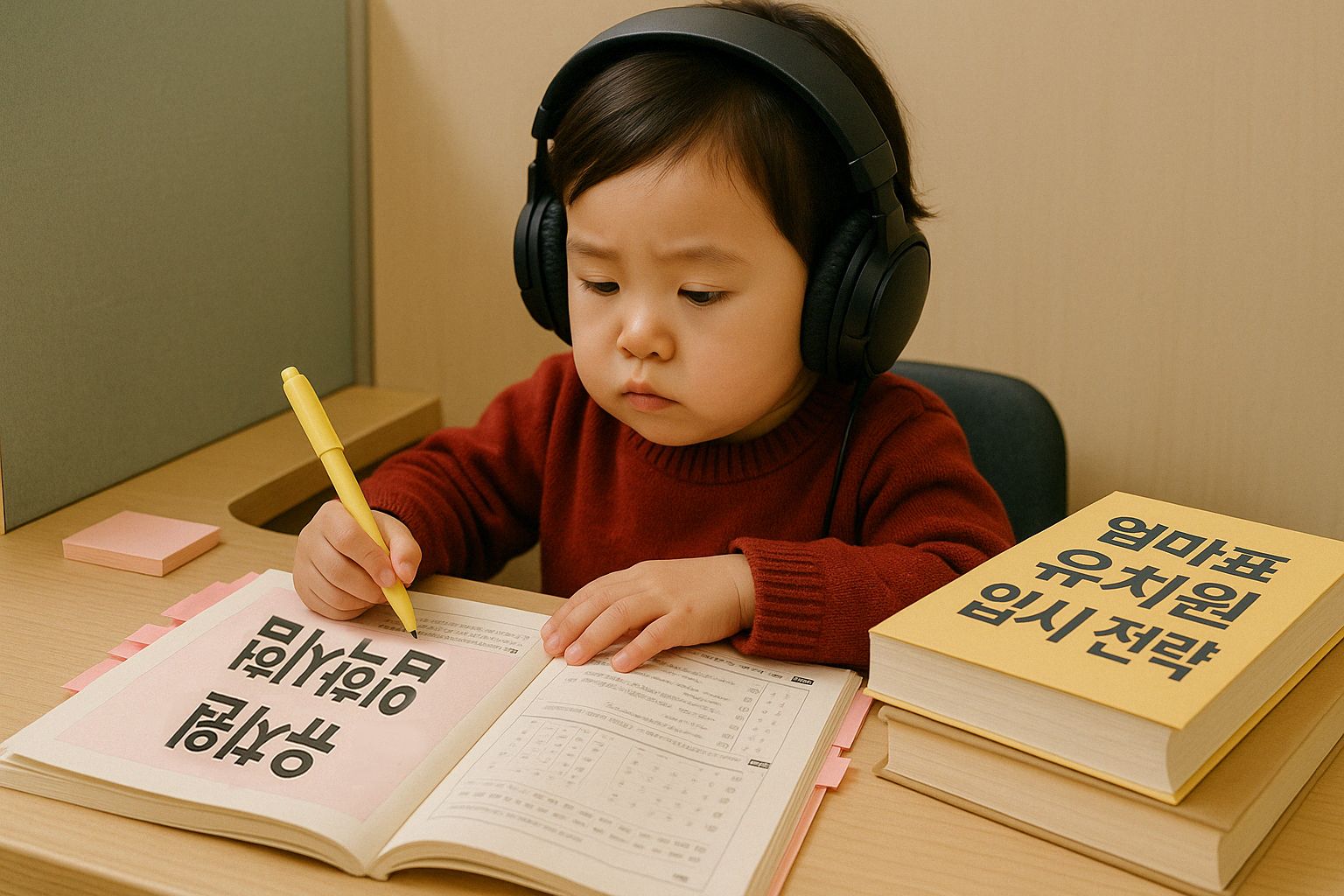
Entrance Exams for Prestigious Academies Even for Young Children... One in Two Receive Private Education, Market Overheats
As entrance exams for prestigious academies?so-called "age 7 exams"?have become widespread, South Korea's private education market for young children is showing signs of severe overheating. In this context, a petition has been submitted to the National Human Rights Commission of Korea (NHRCK), calling for the "age 7 exam" to be officially recognized as a serious form of child abuse.
On the 16th, the "National Accusation Group Against Child Abuse: Age 7 Exam," consisting of 1,000 citizens, held a press conference in front of the NHRCK in Jongno-gu, Seoul, demanding strong sanctions from educational authorities and a comprehensive investigation into the realities of private education for young children.
The group stated, "Under the pretext of entrance exams for English academies, six-year-old children are memorizing English sentences and preparing for interviews. The anxiety spread by the age 7 exam knows no regional boundaries. Parents, fearing their children will fall behind, rush to choose private education, leading to a competitive race for early learning across all of early childhood education." They further urged, "The NHRCK should define the age 7 exam as a serious criminal act, beyond child abuse, and take measures to ensure the educational authorities impose strong sanctions."
Accusation Group Files Human Rights Petition for Child Abuse... "A Serious Crime, Must Be Strongly Sanctioned"

Recently, the term "age 7 exam" has become popular in the private education sector. This refers to entrance exams that preschool children must take to gain admission to prestigious academies. According to a survey conducted by the Ministry of Education between July and September last year, involving 13,241 parents of households with children under the age of six, the overall participation rate in private education was 47.6%. This means that one in two young children were receiving private education. The total amount spent on private education reached 815.4 billion won, with the average monthly private education cost per child at 332,000 won. For five-year-olds, 8 out of 10 children were receiving private education, with an average monthly cost of 435,000 won.
Foreign media have analyzed that South Korea's excessive early education market has also contributed to the country's world-lowest birth rate. The UK daily Financial Times (FT) reported on the 16th of last month (local time), "Academic competition in South Korea is driving half of children under the age of six into entrance exam academies," and noted, "Korean parents have significant complaints about the burden of private education, but at the same time, they choose private education out of fear that their children will be left behind."
"South Korea Is Completely Doomed"... Foreign Media: "Excessive Early Education Also Impacts Low Birth Rate"
FT stated, "South Korea's excessive spending on private education is also affecting the country's severe low birth rate." The report explained that "Korean parents rely on these academies to help their children get ahead in the intense competition for admission to top universities and for the few high-paying jobs at major corporations." The BBC also reported, "In South Korea, children participate in a wide range of expensive extracurricular activities such as math, English, music, and taekwondo from the age of four," and observed that "the excessive education system, particularly in the Seoul metropolitan area, appears to be impacting the low birth rate." The scale of South Korea's private education market for young children has even astonished foreign scholars. Joanne Williams, Professor Emeritus at the University of California, upon hearing in an interview with EBS that South Korea's total fertility rate in 2022 was 0.78, exclaimed, "Wow! South Korea is completely doomed," while holding her head in disbelief.

Comedian Suji Lee sparked a sensation by creating a character of a 'Daechidong mom' obsessed with her child's education. YouTube channel 'HotIssueJ'
원본보기 아이콘The fever for excessive private education has also become a subject of satire. Recently, comedian Suji Lee sparked a sensation by creating the character of a "Daechidong mom," a mother obsessed with her child's education. Portraying "Jamie Mom," a mother living in Daechi-dong, Gangnam-gu, Seoul?a district known for its intense educational fervor?Suji Lee is constantly busy shuttling her four-year-old child, Jamie, between academies and private lessons. She drops her child off at academies, eats kimbap in her imported car, and interviews potential tutors for her child's jegichagi lessons. She even wipes away tears upon hearing that her child, whom she boasts is gifted, has succeeded in toilet training. The character played by Suji Lee resonated strongly with the public and became explosively popular. Two 10-minute videos garnered 12.7 million views in just one month.
Comedian's "Daechidong Mom" Satire Hits 12.7 Million Views in One Month
Meanwhile, despite a decline in the number of students due to the low birth rate, spending on private education hit a new record high last year. According to the Ministry of Education's "2024 Survey on Private Education Expenses for Elementary, Middle, and High School Students," total private education spending reached 29.2 trillion won last year, an increase of 2.1 trillion won from the previous year's 27.1 trillion won. This is the highest figure since the survey began in 2007. The proportion of students participating in private education also reached a record high of 80%, up 1.5 percentage points from the previous year. Even though the number of students decreased by 80,000 to 5.13 million last year, private education spending still hit a new record. Notably, although the government has promoted measures to reduce private education?such as eliminating "killer questions" from the College Scholastic Ability Test (CSAT) and introducing the Neulbom School program for elementary students?analysts say that policies such as expanding medical school admissions have instead fueled the overheating of the private education market.
-
Reporter Seo Jiyeong zo2zo2zo2@asiae.co.kr
-
Edit Yang Hyejin adoretj@asiae.co.kr
© The Asia Business Daily(www.asiae.co.kr). All rights reserved.



![[Culture Interview] "Unifying the Fragmented Music Market... Super Fans Are the Next Competitive Edge"](https://cwcontent.asiae.co.kr/asiaresize/304/2026042817051344090_1777363513.jpg)