"My child also walks this route every day..."
On the afternoon of April 17, Lee, a 45-year-old resident whom we met in Sinnae-dong, Jungnang-gu, Seoul, sighed as he looked at the sinkhole site. Recently, a sinkhole measuring approximately 40 centimeters wide, 40 centimeters long, and 1 meter deep appeared at the crosswalk near the Jungnang District Office intersection. Although a Jungnang District Office official discovered it during a patrol and filled it with soil and asphalt, the anxiety among local residents remained high. Lee said, "It's frightening to see a sinkhole in our neighborhood, something I used to only see on the news," adding, "I keep telling my child to be extra careful on the way to and from school."

The scene of measures taken after a ground subsidence (sinkhole) occurred on the road near the Jungnang District Office intersection in Sinnae-dong, Jungnang-gu, Seoul. Photo by Sunjin Byun
원본보기 아이콘Citizens Anxious Over Series of Sinkhole Incidents... 2,085 Cases Nationwide in the Past 10 Years
Sinkhole incidents are occurring almost daily across the country, posing a threat to everyday life. According to the Ministry of Land, Infrastructure and Transport, there were 2,085 sinkhole cases nationwide between 2014 and 2023. By region, Gyeonggi Province had the most with 429 cases, followed by Gangwon with 270, Seoul with 216, Gwangju with 182, North Chungcheong with 171, Busan with 157, and Daejeon with 130.
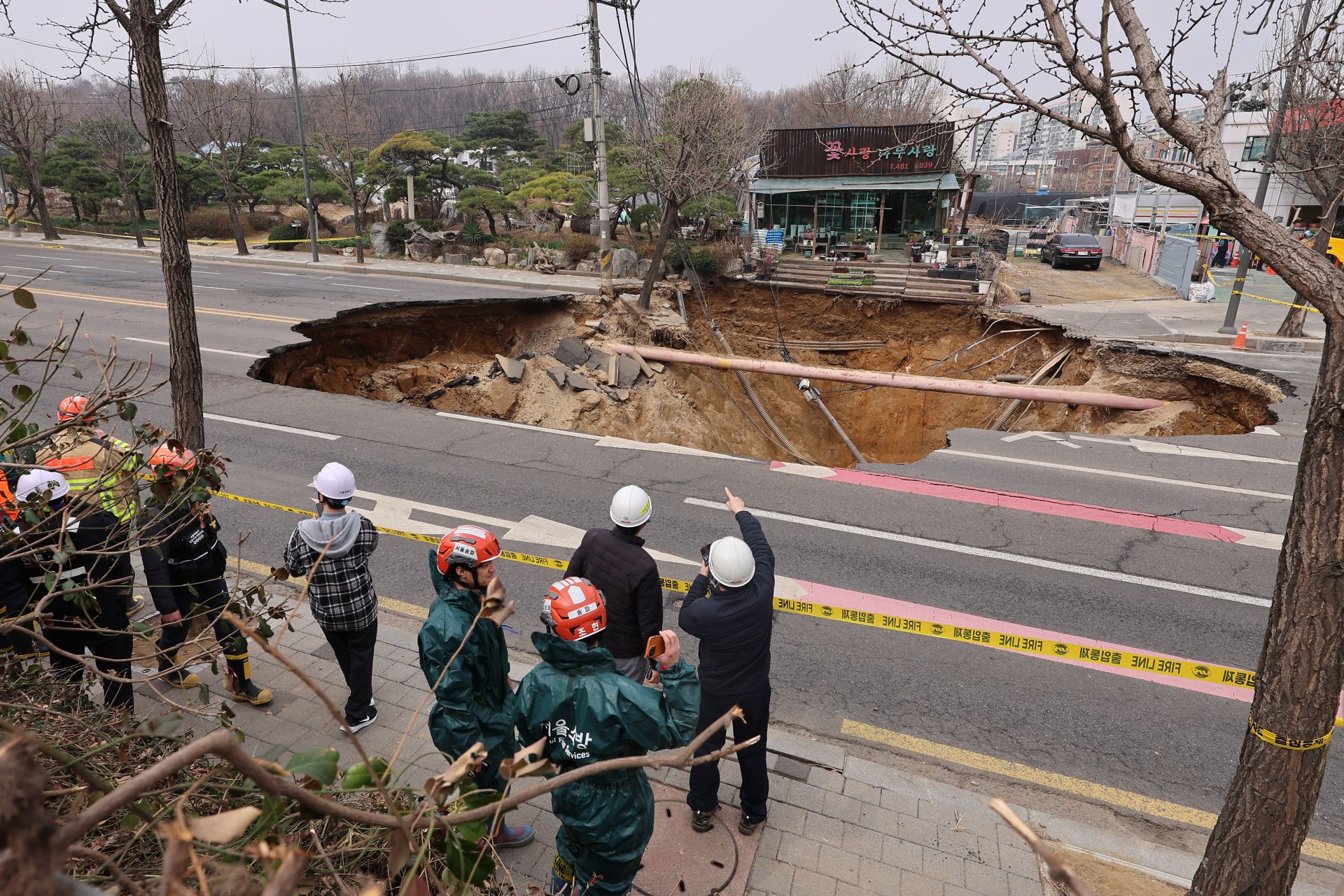
One notable incident occurred on March 24 in Gangdong-gu, Seoul, where a large sinkhole measuring 20 meters in diameter and 20 meters deep resulted in the death of a motorcycle rider. This month, on April 13, a sinkhole measuring 40 centimeters in diameter and 1.3 meters deep appeared near Exit 2 of Aeogae Station in Mapo-gu, Seoul. Although temporary repairs were completed about eight hours after the report was received, local residents were left shaken. Sinkholes were also reported in Bupyeong-gu, Incheon (10 centimeters deep), Dong-gu, Gwangju (1.7 meters deep), and on a road near the early morning market in Gamjeon-dong, Sasang-gu, Busan.

A large sinkhole approximately 10 meters wide, 5 meters long, and 8 meters deep occurred on a road in Sasang District, Busan, swallowing two trucks. Photo by Yonhap News
원본보기 아이콘
Police and fire officials are clearing the site of a sinkhole that occurred on Seongsan-ro in Seodaemun-gu, Seoul. Photo by Yonhap News
원본보기 아이콘
A ground subsidence occurred on a walking trail near an apartment in Sejong City, and related agencies are conducting emergency repairs. Yonhap News
원본보기 아이콘
A sinkhole measuring 12 meters wide, 8 meters long, and 5 meters deep occurred near Naksan Beach in Ganghyeon-myeon, Yangyang-gun, Gangwon Province, causing part of a nearby convenience store building to collapse. Photo by Yonhap News
원본보기 아이콘The Primary Cause: Aging Water and Sewage Pipes... 38% and 10% Installed Before 2003
The primary cause of sinkhole incidents is identified as aging water and sewage pipes. According to the Ministry of Environment, as of December 2023, there are 246,126 kilometers of water pipes and 172,495 kilometers of sewage pipes buried nationwide. Of these, water pipes and sewage pipes installed before 2003 account for 93,969 kilometers (38.2%) and 18,144 kilometers (10.5%), respectively. Generally, water and sewage pipes are considered aged if they have been in place for more than 20 years. Bae Ungyu, a professor of urban engineering at Chung-Ang University, explained, "Aging water and sewage pipes, which are prone to leaks, gradually wash away the underground soil, creating empty spaces and increasing the likelihood of sinkholes as the ground surface collapses."

The problem is the enormous replacement cost. The Seoul Metropolitan Government spends 200 billion won annually to repair 100 kilometers of old sewage pipes, but considering that there are 6,028 kilometers of sewage pipes in Seoul that are over 30 years old (according to city data), the pace of repairs is far too slow. The older the water and sewage pipes, the more difficult they are to repair. The Korean Association of Spatial Information, in its 2010 report "A Study on the Improvement of Underground Water Supply Facility Exploration," pointed out that the average error in the location of underground water supply facilities (the average distance between the actual location and the location on the map) is 79 centimeters (based on Seoul data).
Limits to Individual Local Government Responses... A Control Tower for Underground Safety Needed
Each local government is struggling to come up with countermeasures to prevent the recurrence of sinkholes. Seoul and Busan, among others, have announced plans to actively conduct ground-penetrating radar (GPR) surveys. However, since these surveys can only detect up to a depth of 2 meters underground, questions remain about their effectiveness. There are also calls to introduce 3D GPR, which can simultaneously collect data in width, length, and depth, but again, a lack of budget is a problem.
Experts point out that, to fundamentally prevent sinkhole accidents, a control tower related to underground safety must function organically. Moon Hyuncheol, vice president of the Korean Society of Disaster Information, said, "Various facilities such as water and sewage pipes, communication lines, and subways are intertwined underground, but each ministry and agency manages them separately," adding, "The government needs to establish measures to comprehensively understand and respond to the entire underground space."
Professor Bae also added, "There are limits to how much individual local governments can do to respond to sinkholes," and emphasized, "Active financial support at the government level is also necessary."
-

Reporter Byun Seonjin sj@asiae.co.kr
-
Edit Kim Yumi ymkim91@asiae.co.kr
© The Asia Business Daily(www.asiae.co.kr). All rights reserved.





![[Culture Interview] "Unifying the Fragmented Music Market... Super Fans Are the Next Competitive Edge"](https://cwcontent.asiae.co.kr/asiaresize/304/2026042817051344090_1777363513.jpg)