Boom in Creation of 'Barrier-Free Forest Trails' as Urban Healing Spots in Seoul's Districts
'Barrier-free forest trails,' which are deck-type walking paths with gentle slopes and no stairs or steps, are gaining popularity among residents as healing spots within the city. Riding this wave of popularity, many new forest trails are being established throughout Seoul.
The barrier-free forest trails maintain a slope of no more than 8% throughout the entire route and secure a width of at least 1.2 meters, making them easily accessible for residents using wheelchairs or strollers.

Seocho-gu 'Umyeonsan Barrier-Free Forest Trail'... Filled with Tranquility and Leisure
Seocho-gu, which opened the first phase (Companion Trail) of the 'Umyeonsan Barrier-Free Forest Trail' in May last year, has opened the second phase (Cow's Pace Trail) this month. The second phase covers about 1km from the National Gugak Center to across from BTN Buddhist Broadcasting. Seocho-gu named this section 'Cow's Pace Trail' to encourage people to walk slowly like a cow and enjoy the tranquility and leisure of nature.
According to Seocho-gu, this section is deeper in the forest than the first phase, offering a quiet and peaceful atmosphere, as well as rest areas and barefoot trails, providing a cozy resting space for residents weary from daily life. The first phase, opened last year, is a 3km section connecting Seocho Spring to the National Gugak Center.
Seocho-gu plans to create and connect a total of four phases, covering 8.69km of barrier-free forest trails by next year. The third phase is a 2.5km loop inside Bangbae Neighborhood Park, and the fourth phase is a 2.19km section connecting Bangbae Neighborhood Park and Bangbae Sports Park.

Eunpyeong-gu 'Bongsan Cypress Forest Trail'... Deck Path Surrounded by 13,400 Cypress Trees
Eunpyeong-gu is home to the unique 'Bongsan Cypress Forest Trail' in Seoul. Since 2014, 13,400 cypress trees have been carefully planted over 11 years, surrounding the wooden deck path. Cypress trees are known for their excellent ability to absorb carbon dioxide, reduce fine dust, and provide anti-inflammatory, antibacterial, and purifying effects, making them effective in treating atopic dermatitis. As a result, not only local residents but also many visitors from afar come to this forest trail, according to Eunpyeong-gu.
Eunpyeong-gu plans to complete a total length of 9.8km of barrier-free forest trails here by next year. Currently, part of the final sixth phase is under construction, with 6.1km already completed. The district has installed rest areas and restrooms along the trail and is displaying wooden crafts made from recycled timber. Felled defective acacia trees and others are crafted into benches, insect hotels, birdhouses, and wooden crafts at the Eunpyeong Hope Woodworking Studio, providing attractions along the trail.
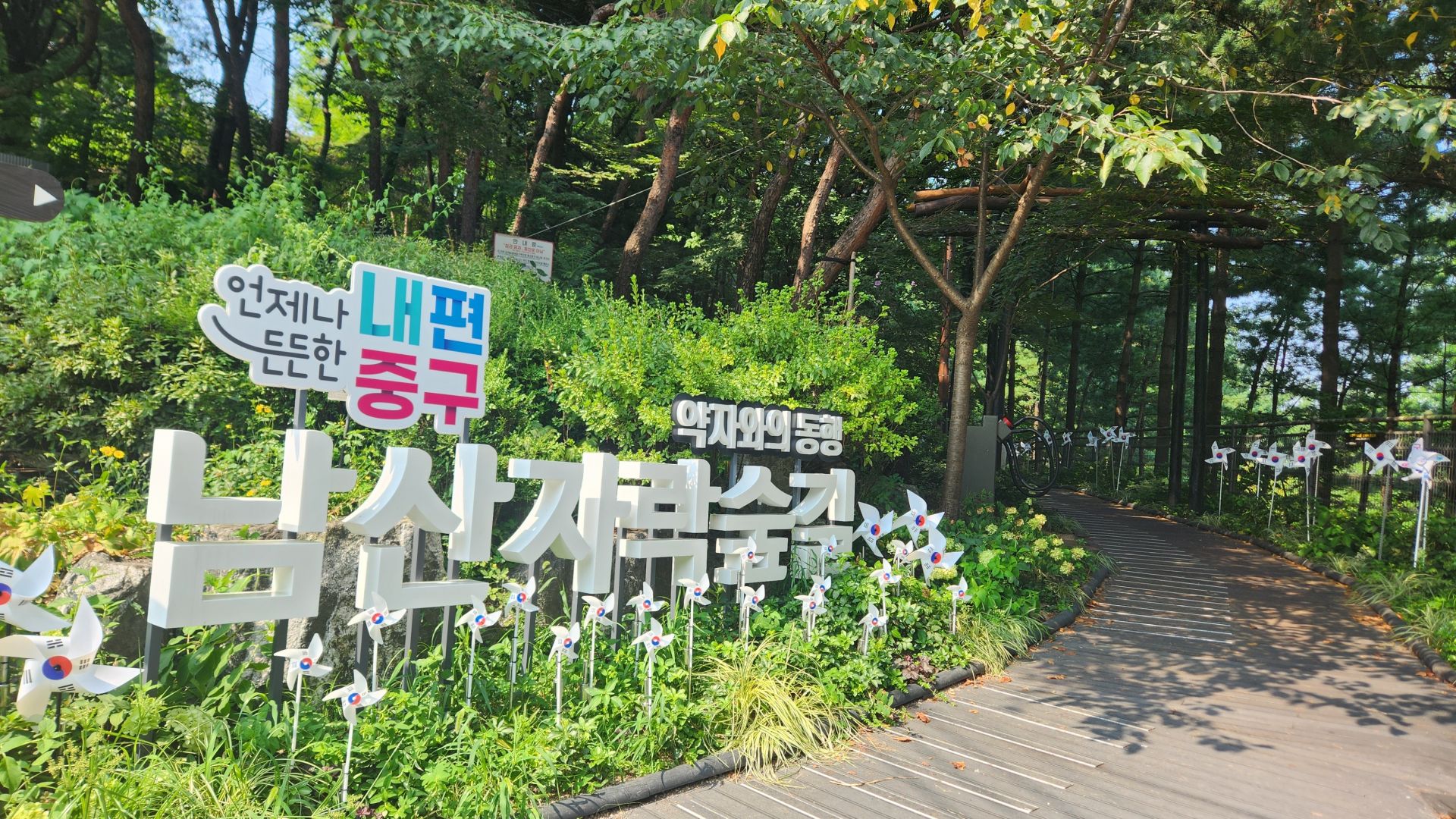
Jung-gu 'Namsan Foot Forest Trail'... Overlooking Seoul from the Observatory
Among urban barrier-free forest trail attractions, the 'Namsan Foot Forest Trail' stands out. Stretching 5.14km from Muhakbong Park in Jung-gu to Banyan Tree Hotel, the Namsan Foot Forest Trail fully opened at the end of last year. As an urban course, some sections are equipped with landscape lighting, allowing for safe nighttime walks. The trail is made of wooden decks and dirt paths, with a loess barefoot path for feeling nature directly. The observatory, offering a panoramic view of Seoul, and the zigzag deck path are hidden gems of the Namsan Foot Forest Trail.
Jung-gu plans to make Namsan a 'forest in daily life' accessible within 15 minutes from anywhere in the city. The district aims to connect the previously divided green axis of Namsan by linking it with Namsan Circular Road, and is conducting a feasibility study this year for a new green connection route from Banyan Tree Hotel to the National Theater of Korea.
-
Reporter Kim Minjin enter@asiae.co.kr
-
Edit Lee Kijae happylee17@asiae.co.kr
© The Asia Business Daily(www.asiae.co.kr). All rights reserved.




![[Report] "A Culinary Destination with a View of Gyeongbokgung"... Kim Dong-sun's High-End Dining Takes Over Gwanghwamun](https://cwcontent.asiae.co.kr/asiaresize/304/2026042114562634571_1776750985.jpg)

![[Gallery Stroll] Red Robe, Black Lines... Danjong Returns with the Face of Wounds](https://cwcontent.asiae.co.kr/asiaresize/304/2026042014183532691_1776662315.jpg)