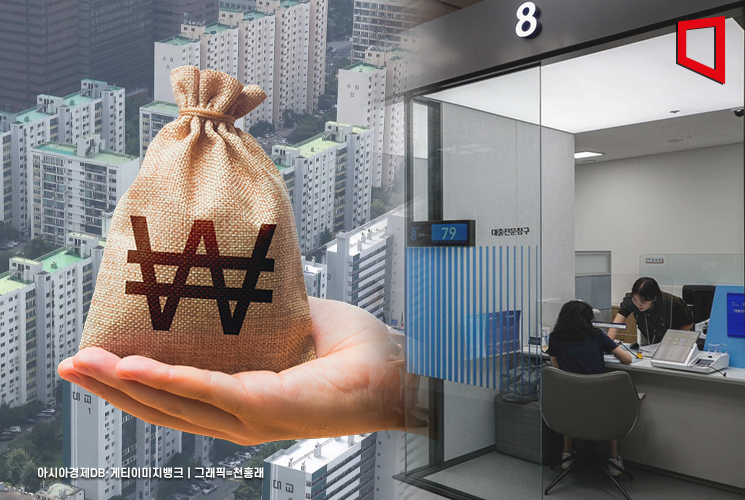
The number of bank branches in South Korea has reached its lowest point since related statistics began to be collected. As the digitalization of finance accelerates and non-face-to-face transactions increase, banks are continuously reducing the number of branches and employees. Concerns are rising that the disappearance of offline branches will increase inconvenience in accessing financial services, especially for groups vulnerable to digitalization.
According to the Financial Supervisory Service and the Bank of Korea on the 16th, the total number of bank branches in South Korea as of the end of last year was 5,792, the lowest since related statistics were first released in 2001. The number of branches nationwide peaked at 7,836 in 2012 and has since steadily declined to 6,234 in 2021, 5,948 in 2022, and 5,896 in 2023. This means a total of 2,044 branches disappeared between 2012 and last year.
A total of 5,792 locations... the lowest since statistics began Expansion of non-face-to-face transactions due to digitalization Banks continue to reduce branches and staff Five major banks expected to lose 2,000 employees this year Concerns grow over inconvenience for the digitally marginalized
Banks are reducing or merging branches as more customers use mobile applications and the proportion of non-face-to-face transactions increases. KB Kookmin Bank closed 28 branches last month, and Shinhan Bank also closed 28 branches in January. Woori Bank and NH Nonghyup Bank also plan to reduce the number of branches this year. An official from a major commercial bank said, "Since most banking services such as deposits, withdrawals, and loans can now be handled via mobile apps or the internet, it is inevitable to reduce offline branches."
As bank branches disappear, the number of bank employees is also decreasing. The total number of bank employees, which was 127,593 in 2012, fell to 113,882 last year, a decrease of 13,711. Major commercial banks such as Shinhan Bank, Nonghyup Bank, Kookmin Bank, and Hana Bank have continued voluntary retirement programs this year. It is expected that more than 2,000 employees from the five major commercial banks may leave this year alone.
While closing branches to improve profitability amid rapid digitalization of finance may be a rational decision for banks, there are concerns that it restricts access to financial services for consumers who are not comfortable using smartphones, such as the elderly.
As digitalization in finance accelerates, it may be a rational decision for banks to close branches to improve profitability, but there are concerns that this limits financial accessibility for consumers who have difficulty using smartphones, such as the elderly.
According to the Korea Institute of Finance, among the top 30 regions in South Korea where the distance to access a bank branch exceeds 20 kilometers, 26 are classified as super-aged areas where more than 20% of the population is aged 65 or older. The proportion of people aged 65 or older using banking apps is low, and as bank branches disappear, their access to financial services is becoming even more limited.
To address these issues, the government recently announced measures to promote bank agency services, shared ATMs among banks, and deposit/withdrawal services at convenience stores. This is intended to provide alternative ways for customers to handle core banking services such as deposits, savings, and loans face-to-face as branches disappear. The government plans to begin a pilot operation of bank agency services within this year by designating them as an innovative service in July.
However, there are clear limitations to these government policies, and some argue that more fundamental solutions are needed. Lee Siyeon, a research fellow at the Korea Institute of Finance, said, "It will be difficult for bank agents to fully guarantee the same quality and scope of services that bank branches used to provide. There are also concerns that the presence of institutions such as post offices, which can act as agents, may actually accelerate the closure of local bank branches."
She added, "Given the limitations in the homogeneity of accessible services when banking operations are outsourced to other institutions, it is necessary to more closely evaluate changes and alternatives in available financial institutions when branches are closed, and to review alternatives from an integrated perspective."










![[Culture Interview] "Unifying the Fragmented Music Market... Super Fans Are the Next Competitive Edge"](https://cwcontent.asiae.co.kr/asiaresize/304/2026042817051344090_1777363513.jpg)