[Monetary Policy Committee Poll]①
Asia Economy Survey of 12 Experts
Freeze Expected: "Tariff Shock, Increased FX Volatility, Household Debt Concerns"
'May Cut' 66.7%... Heightened Downside Risk to the Economy
"2.25% by Year-End, 2.00% Next Year"
Ahead of the Bank of Korea's Monetary Policy Committee meeting on the 17th, experts largely expect the base rate to remain unchanged at the current 2.75% per annum. With financial and FX markets unsettled by the tariff shock triggered by US President Donald Trump and heightened currency volatility, most expect the committee to pause and observe the situation. However, considering the deepening shadow of low growth, a rate cut is anticipated in May.
April 'Hold' Likely... Tariff Shock, FX Volatility, and Household Debt as Risk Factors
According to a survey conducted by Asia Economy from the 8th to the 11th of this month with 12 economic experts from domestic and international research institutes, securities firms, and banks, 9 respondents (75.0%) predicted a rate hold for this month. With the tariff shock from Trump causing wild swings and higher levels in the exchange rate, most expect the committee to pause before cutting rates, to see if the market stabilizes. On the 4th, the KRW/USD rate fell to the 1,434 won level as political uncertainty was removed with the impeachment of former President Yoon Sukyeol, but quickly soared to 1,484 won within three trading days due to concerns over an escalating US-China tariff war, maximizing volatility. Since then, the rate has fluctuated around 1,450 won as the US granted a 90-day tariff reprieve to about 75 countries excluding China.

Although the stronger-than-expected tariff measures have increased downside risks to the economy, the 90-day reprieve leaves uncertainty about the precise economic impact going forward. An Jae Kyun, researcher at Shinhan Investment, said, "The growth rate concerns from the tariff shock will be greater next year than this year," adding, "Rather than an emergency rate cut, the path will align with the timing of future fiscal expansion."
Concerns over expanding household debt are also a reason for expecting a rate hold this month. Although the Seoul Metropolitan Government's expanded designation of land transaction permit zones (Toheoguyeok) has stabilized the real estate market, the impact of previous deregulation on loan growth has yet to be confirmed. Thus, the committee is expected to monitor household debt sensitivity and the balloon effect in the capital area, controlling excessive expectations for monetary easing. If a cut were made this month, it could further fuel expectations for the base rate to fall to 2.00% this year, strengthening the case for a hold. Gong Dongrak, researcher at Daishin Securities, said, "Given concerns over financial stability from rising real estate prices and household loans in some parts of Seoul in March, a staggered approach to further rate cuts is more likely than consecutive cuts as seen in February." Heo Moonjong, head of Woori Financial Management Research Institute, also noted, "Considering the strong housing prices in Seoul and the increase in household loans, I expect a hold in April."
On the other hand, the three experts (25.0%) who forecast a cut in April saw the downside pressure on the economy as more significant. They argued that if the committee judges that the tariff shock makes a sharp downward revision of the domestic growth rate inevitable, a 0.25 percentage point (25bp) cut cannot be ruled out. Kang Minju, chief economist at ING Bank, said, "With US tariffs, weak domestic demand, natural disaster damage, and delayed supplementary budgets, the slowdown in growth will be steeper than expected," adding, "Although KRW weakness is a major obstacle to a rate cut, the inflation rise from a weaker KRW will likely be offset by weak demand, so a sharp jump in inflation above 2.0% is unlikely." Park Sanghyun, researcher at iM Securities, said, "Even looking at the domestic situation, considering the absence of a control tower and the possibility of supplementary budget delays due to early general elections, a rate cut this month is more likely."

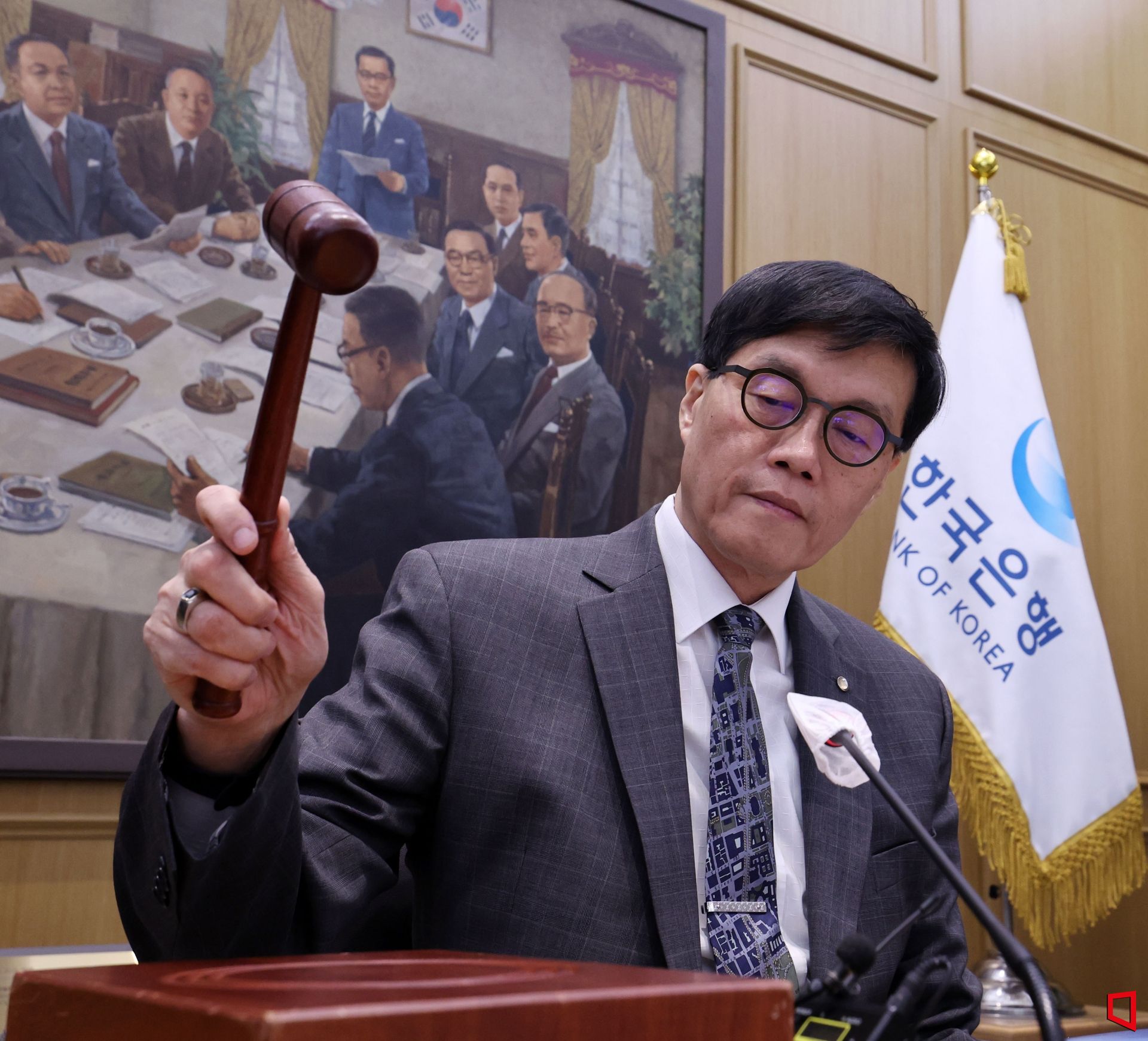
Lee Changyong, Governor of the Bank of Korea, is presiding over the Monetary Policy Committee plenary meeting at the Bank of Korea headquarters in Jung-gu, Seoul, on February 25. Photo by Joint Press Corps
원본보기 아이콘Next Cut: "If April is a Hold, May is Likely... If April is a Cut, Expect July-August"
Most experts see the next rate cut coming in May. Of the nine who expect a hold in April, eight (66.7%) forecast a cut in May. With growing downside risks from the US-led tariff shock and rising concerns over lower growth, the pressure for a rate cut is expected to intensify.
Park Jungwoo, economist at Nomura Securities, said, "With the downward revision of the economic outlook in May, the impact of the tariff shock on the domestic economy will become clearer," adding, "This will be addressed with an additional rate cut." Kang Seungwon, researcher at NH Investment & Securities, said, "Due to the unique situation of a tariff war, FX volatility is at an extreme level," adding, "After some time and with FX stability secured, a cut in May is likely."
Experts expecting a cut in April see the next cut coming in July or August. Park Seokgil, economist at JP Morgan, said, "After consecutive cuts in February and April, there will be a pause to assess the effects and policy environment, but as the year progresses, with the US Federal Reserve expected to cut its policy rate, further cuts will be necessary."
Some also see the next cut coming in July even if April is a hold. With uncertainties such as US tariff policy and the Korean presidential election persisting through the first half, cautious monetary policy is expected. Kim Seongsu, researcher at Hanwha Investment & Securities, said, "With three rate cuts already in this cycle, it's time to observe policy effects," adding, "The cautious stance of the Fed should also be considered."
Korea's Base Rate Expected to Fall to "2.25% by Year-End, 2.00% Next Year"
The dominant forecast is for Korea's base rate to fall to 2.25% by year-end. Of the 12 experts, seven (58.3%) expect 2.25%. Assuming 25bp (1bp=0.01 percentage point) cuts, this implies three cuts this year including the one in February. After the February decision, Bank of Korea Governor Rhee Changyong said, "(The expected number of cuts this year is) similar to the market's view (2 to 3 in total)," which is not much different.

Yoon Yeosam, researcher at Meritz Securities, said, "We maintain our existing forecast that two more cuts in May and August will bring the rate down to 2.25%," adding, "2.25% is the lower bound, below the midpoint of Korea's neutral rate (estimated at around 2.50%)." He added, "While a cut to 2.00% is possible given economic risks, at this stage, fiscal policy is more important for economic stability than monetary policy." He expects monetary policy responses to be aligned with the strength of fiscal policy after the June presidential election.
There were also several opinions that the rate would fall to 2.00% by year-end. Including the three experts who expect a cut this month, four (33.3%) expect a total of four cuts this year. In contrast, a minority expect only two cuts, with the rate remaining at 2.50% at year-end. Gong, the researcher, said, "Given the risks of FX volatility from further cuts, I expect a total of two cuts this year."
The most common view for next year's rate is 2.00% (five experts). This is seen as a normalization of rates, reflecting the possibility of a lower neutral rate due to slower potential growth. However, there were also several opinions (three experts) that cuts next year would be approached cautiously. Yoon, the researcher, said, "If this rate cut cycle creates a bottom for the economy this year, further cuts will be cautious for a while," adding, "While a reduction to the long-term equilibrium level of 2.00% is possible, responses will be calibrated with sensitivity to FX, real estate, and household debt stability."

US Policy Rate: 50% Expect June Cut... Response to Tariff-Driven Inflation and Economic Conditions
For the US Federal Open Market Committee (FOMC), six experts (50.0%) see a policy rate cut in June as most likely. The expected upper bound for the US policy rate, currently 4.50% per annum, is 3.75% by year-end and 3.00% by the end of next year, according to most forecasts.
Views on the timing of the next cut depend on whether more weight is given to the growth slowdown or inflation resulting from tariffs. The majority expect June because they believe the Fed will cut rates once it confirms that the inflation shock from tariffs is limited and the economic slowdown is apparent. Cho Youngmoo, research fellow at LG Economic Research Institute, said, "With concerns over inflation and economic slowdown conflicting, I expect the Fed to respond with a rate cut starting in June rather than May." Kang, the researcher, also said, "It is necessary to confirm whether actual economic indicators slow in Q2 and whether medium- to long-term inflation expectations decline," adding, "I expect the Fed to resume cuts from June."

Other forecasts were spread across May, July, September, and December. Moon Hongcheol, researcher at DB Securities, who expects a May cut, sees tariffs as a major downside risk to the economy. Kang, the chief economist who expects a July cut, said that despite uncertainty from Trump’s policies, indicators will remain relatively stable through early Q2. He said, "Sharp declines in sentiment, inflation expectations, and survey indicators will be reflected in real indicators with a lag, determining the timing of the Fed's cut. I expect a cut in July." Kim, the researcher, expects a cut in September, noting the Fed has emphasized it will respond when US government policies have a net effect on inflation and the economy. Although tariffs and immigration policy are affecting inflation and employment, they are not reversing the overall trend, so a cut is expected in September.
There was also an opinion that a cut would not come until December, focusing on the risk of rising US inflation. Park Jungwoo, the economist, said, "Despite the tariff shock, a robust job market and solid corporate investment make the risk of recession very low," adding, "The Fed will focus its monetary policy on the inflation risk from tariffs."

![[Culture Interview] "Unifying the Fragmented Music Market... Super Fans Are the Next Competitive Edge"](https://cwcontent.asiae.co.kr/asiaresize/304/2026042817051344090_1777363513.jpg)