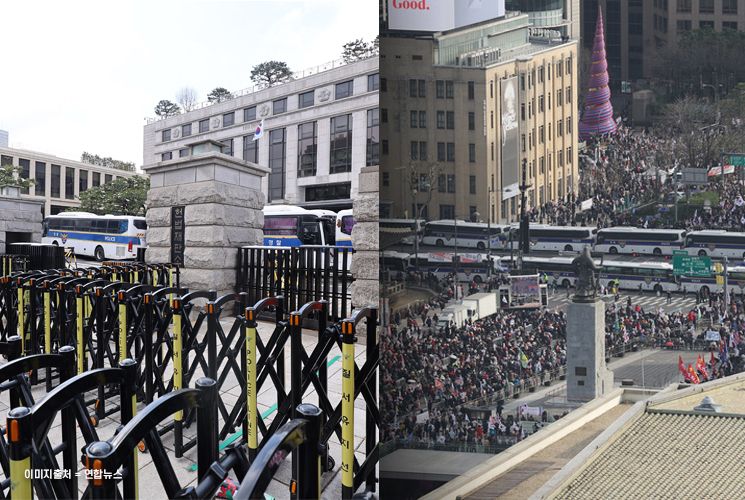
The Constitutional Court's ruling on the impeachment trial of President Yoon Seokyeol is likely to be postponed to next week. As of the morning of the 20th, the court had not yet set a date for the verdict. Based on the precedent of announcing the date 2 to 3 days in advance, the ruling is expected to take place after next week.
Rumors, rumors, rumors...
"Deliberations not proceeding smoothly"
"Waiting for nominee Ma Eunhyeok"
"Opposition is growing, causing concern"
Delayed ruling sparks rampant speculation
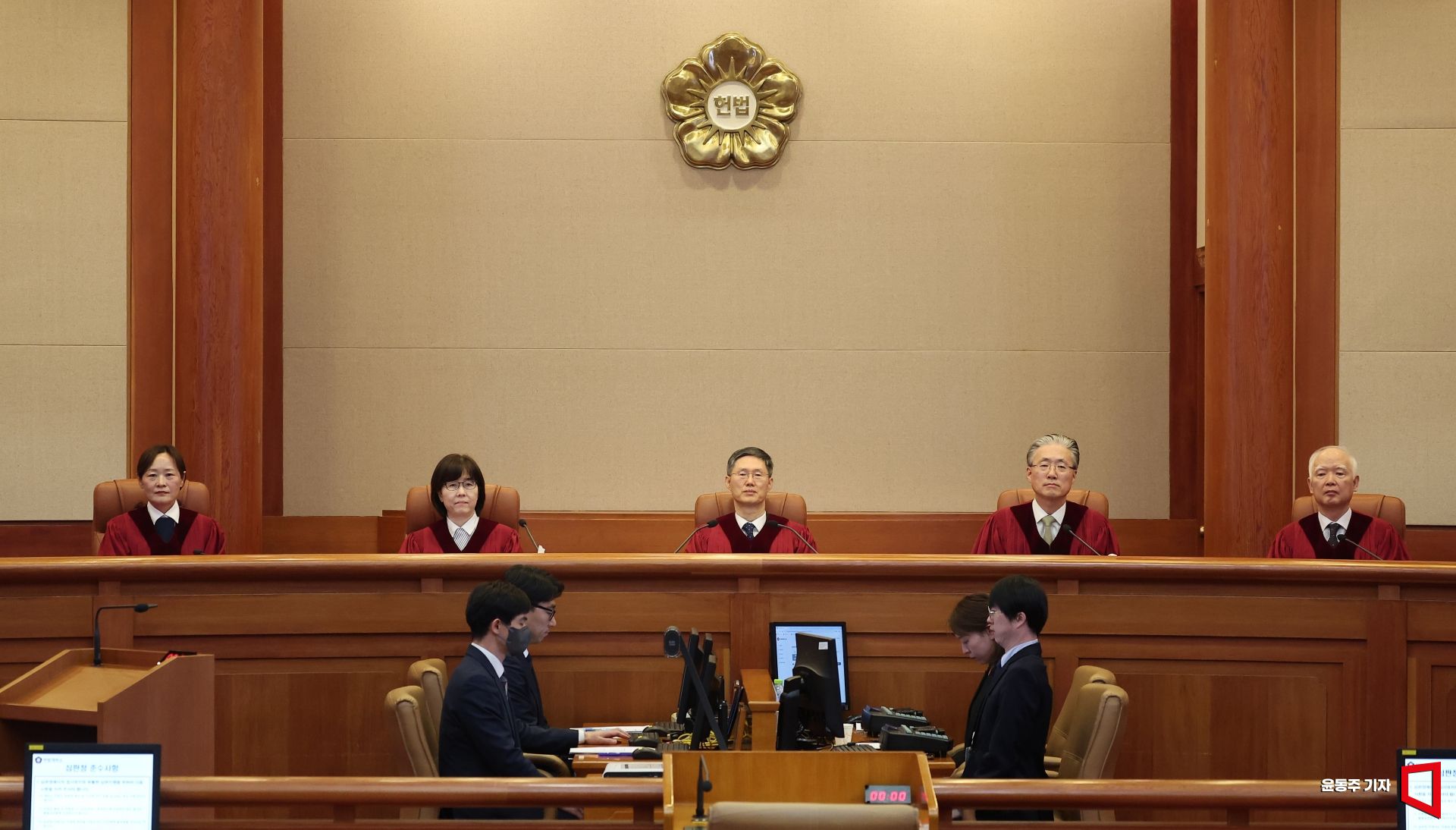
As the 'Constitutional Court's time' extends, various analyses and theories are pouring out from the legal community and around the court. This indicates that the situation is different from the usual 'expectations.'
The Constitutional Court's ruling on the impeachment trial of President Yoon Suk-yeol is now highly likely to be postponed until next week. As of the morning of the 20th, the court had not set a date for the verdict. Given that the court usually announces the date two to three days in advance, the verdict is expected to come after next week. This Saturday, the 23rd, will mark the 100th day since the start of President Yoon's impeachment trial, far exceeding the previous record of 91 days for the impeachment trial of former President Park Geun-hye. Even counting from the day the court concluded arguments (February 25), more than 23 days have passed. As the so-called "court's time" drags on, various analyses and rumors are circulating within legal circles and around the Constitutional Court, indicating that the situation is diverging from general expectations.
During this period, the Constitutional Court justices have been reviewing reports compiled by the impeachment trial task force (TF), which includes constitutional researchers, to organize the key issues, and have repeatedly discussed the five main points presented by the National Assembly. Through this process, multiple drafts of the ruling, including both acceptance and dismissal options, have been prepared. However, some in the legal community speculate that even the organization of the key issues may not be complete yet. Naturally, this means that the final deliberations and drafting of the ruling are also not finished.
Chin A Cha, professor at Korea University Law School, stated, "If the justices had reached a consensus, the verdict would have already been announced. The fact that no date has been set suggests that deliberations are not proceeding smoothly. Even if there are differences of opinion, there should have been enough discussion to reach a decision, but it seems heated debates are still ongoing." Kim Suntaek, also a professor at Korea University Law School, said, "If a few of the eight justices are still undecided, it is difficult to proceed, so the others may be waiting for them." Kim further speculated, "If three out of the eight justices are leaning toward dismissal or rejection, they might be waiting for nominee Ma Eunhyeok to be appointed and join the deliberations."
The key issues in President Yoon's impeachment case are: ▲ the constitutionality and legality of the December 3 martial law, ▲ the substance of Martial Law Proclamation No. 1, ▲ interference with National Assembly activities, ▲ attempts to take control of the National Election Commission, and ▲ orders to arrest major political figures and officials. Accordingly, some justices may see all of these as grounds for impeachment, while others may recognize only some. Coordinating these differences is not an easy task. Han Sanghee, professor at Konkuk University Law School, commented, "Some justices may see all as grounds for impeachment, others only four, and the process of reconciling opinions on the remaining issues may be causing the delay."
The impeachment trial of Prime Minister Han Ducksoo, which concluded before President Yoon's case, is also a variable. Since the reason for Prime Minister Han's impeachment is alleged collusion or support for President Yoon's martial law declaration, there is overlap between the two cases. If the court rules on Prime Minister Han's case first, which is likely to be dismissed, it could complicate the drafting of a ruling to accept President Yoon's impeachment. An anonymous legal expert said, "Since there are overlapping issues between President Yoon and Prime Minister Han's cases, the logic must be consistent whether the verdict is acceptance or dismissal. The fact that the court is drafting both rulings simultaneously seems to be causing the delay."

Some believe that the growing public opposition to the impeachment, fueled by procedural concerns, is influencing the court's final decision. The court is reportedly taking extra care to draft a ruling that emphasizes the fairness and procedural integrity of the trial. President Yoon's legal team has consistently raised issues of due process throughout the impeachment proceedings.
Meanwhile, next Wednesday, the 26th, the appellate court is scheduled to deliver its verdict in the election law case of Lee Jaemyung, leader of the Democratic Party. If President Yoon's impeachment ruling is also delayed until next week, the judiciary will be deciding the fate of two leading political figures in the same week?a so-called "Judicial Super Week." On the 19th, a week before his verdict, Lee submitted a 30-page written statement to the court asserting his innocence, signaling an all-out defense.
Tensions rising...
Pro- and anti-impeachment rallies across Seoul
Hunger strikes, overnight vigils, and even self-immolation deaths
Increasingly volatile public squares
Heightened anxiety and tension among citizens
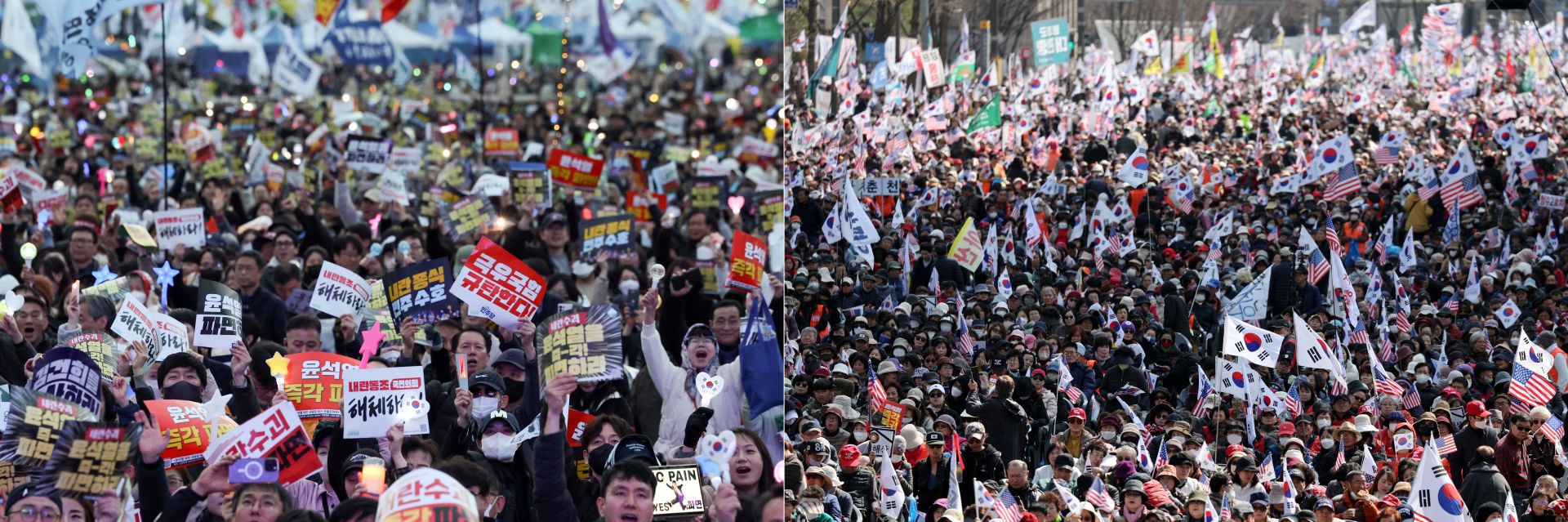
The Constitutional Court has not set a date for the impeachment trial decision of President Yoon Sukyeol, leading to intensified rallies by both sides including fasting, overnight vigils, and self-immolation attempts.
As protests continue daily in downtown Seoul, citizens' anxiety and tension are increasing.
Photo by Yonhap News
With the Constitutional Court yet to set a date for the impeachment ruling on President Yoon Suk-yeol, rallies on both sides?including hunger strikes, overnight vigils, and acts of self-immolation?are intensifying.
According to police on the 20th, pro- and anti-impeachment rallies are being held across Seoul, organized by groups such as the National University Students' Conference, the National Alliance Against Impeachment, the Free Unification Party, the Free Culture Citizens' Alliance, Candlelight Action, and Emergency Action for Resignation and the five opposition parties. With protests continuing daily in downtown Seoul, anxiety and tension among citizens are rising.
Hunger strikes and overnight protests are ongoing. Emergency Action for Yoon Suk-yeol's Immediate Resignation and Social Reform (Emergency Action) announced that Jin Youngjong, co-chair of People's Solidarity for Participatory Democracy, and Jung Youngi, president of the Korean Women Peasants Association, who had been on a hunger strike for 12 days, were hospitalized due to rapidly deteriorating health. Currently, 15 co-chairs of Emergency Action, including these individuals, are on hunger strike. Choi Huiju, national representative of Progressive Students Network and co-chair of Emergency Action, said, "If the verdict is delayed further, the anger of the people will soon be directed at the Constitutional Court."
Anti-impeachment groups, including the Free Unification Party led by Pastor Jeon Kwanghoon, have been holding overnight rallies near Exit 5 of Anguk Station, close to the Constitutional Court, since the 10th. The Presidential National Defense Lawyers, a group supporting President Yoon, held a relay press conference in front of the court all day yesterday, featuring various figures opposing the impeachment. On the 18th, a woman in her 50s surnamed Kim, who had been on a hunger strike in front of the court for nine days in protest of the impeachment, was hospitalized after showing signs of health problems.
There have also been two deaths by self-immolation. A 79-year-old man, identified as a supporter of President Yoon, died around 1 p.m. yesterday while receiving treatment at a burn hospital in Seoul. On the 7th, he had scattered leaflets criticizing the opposition and the Constitutional Court from the rooftop of the Seoul Urban Architecture Exhibition Hall and then set himself on fire. Earlier, on January 15, a man in his 50s died after attempting self-immolation near the Government Complex Gwacheon in Gyeonggi Province, where the Corruption Investigation Office for High-ranking Officials is located, during President Yoon's arrest by the office.
-
Reporter Lim Chulyoung cylim@asiae.co.kr
-

Reporter Yeom Dayeon allsalt@asiae.co.kr
-
Reporter Lim Chunhan choon@asiae.co.kr
-
Edit Choi Yujeong yjchoi@asiae.co.kr
© The Asia Business Daily(www.asiae.co.kr). All rights reserved.