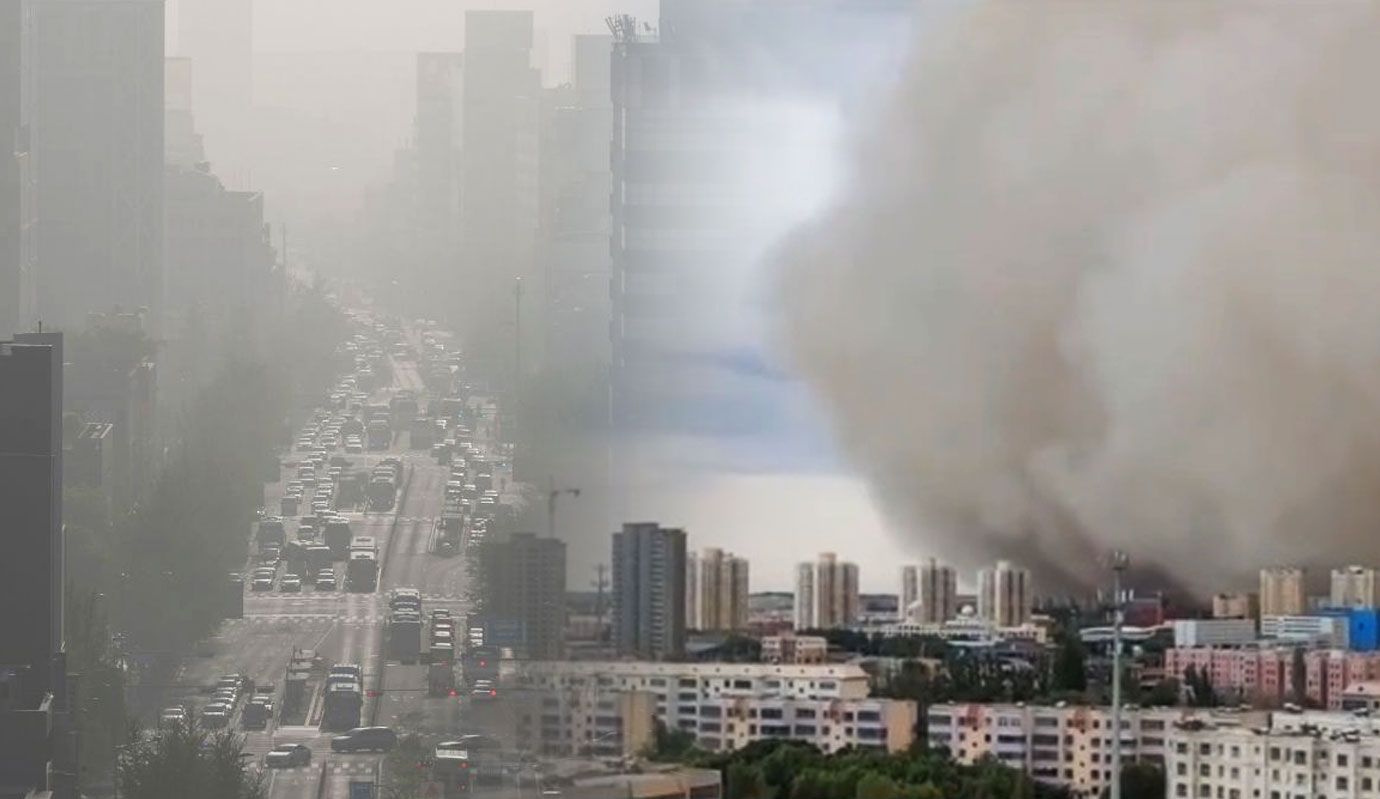
The main air pollutants that trouble Korea during the spring are yellow dust (Hwangsa) and fine dust (Mise-munji). Recently, as yellow dust originating from China and other regions has blanketed the Korean Peninsula, online communities and news comment sections have seen many comments such as "It's hard to live because of fine dust like yellow dust," and "Isn't yellow dust basically fine dust?"?demonstrating that many people confuse yellow dust and fine dust. However, yellow dust and fine dust are distinctly different air pollution phenomena.

South Korea has the highest level of fine dust concentration among OECD countries. According to the Statistics Korea announcement, in 2020, South Korea's fine dust concentration was 25.9㎍/㎥, ranking third highest after Chile and Turkey. The government established a comprehensive fine dust management plan through the "Special Act on Fine Dust" and set a goal to reduce ultrafine dust concentration to 13㎍/㎥, the OECD median level, by 2029. Photo by Dongju Yoon
원본보기 아이콘Yellow Dust: Naturally Occurring Dust from Deserts... Fine Dust: Artificial Air Pollutant


Yellow dust mainly refers to naturally occurring dust from deserts in China and Mongolia that is carried to the Korean Peninsula by northwesterly winds. In contrast, fine dust is an artificial air pollutant produced by vehicle exhaust and industrial processes, and the two phenomena differ greatly in their causes and components. The particle size of yellow dust ranges from 1 to 1000 micrometers (μm), and it is primarily composed of soil. Fine dust particles are smaller than 10μm in diameter, and ultrafine dust particles are smaller than 2.5μm. Ultrafine dust is particularly hazardous as it can penetrate deep into the human body and cause severe health effects. Thus, both yellow dust and fine dust are harmful to health, which is their main similarity.
Korea has the highest concentration of fine dust among OECD (Organisation for Economic Co-operation and Development) countries. According to Statistics Korea, in 2020, Korea's fine dust concentration was 25.9μg/m³, ranking third after Chile and Turkiye. The government has established a comprehensive fine dust management plan through the 'Special Act on Fine Dust' and aims to reduce the ultrafine dust concentration to the OECD median level of 13μg/m³ by 2029.
Both yellow dust and fine dust worsen air quality and reduce visibility, which can disrupt aircraft operations. They can also hinder photosynthesis in plants and damage industrial facilities and electronic devices. In particular, they can cause respiratory diseases, allergies, skin disorders, and fine and ultrafine dust may lead to cardiovascular diseases.
Yellow Dust Occurs from March to May... Controversy over 'China-Mongolia' Origins


There is ongoing debate between China and Mongolia regarding the origin of yellow dust. The main sources are deserts and arid regions in China and Mongolia. These are thought to include the Inner Mongolia Plateau and Gobi Desert (border area between Mongolia and China), the Taklamakan Desert (Xinjiang Uyghur Autonomous Region in China), and the Loess Plateau (north-central China). When strong winds occur in these regions, yellow dust is generated and carried by westerly winds to Korea, Japan, and, in severe cases, even North America. In Korea, the term 'China-origin yellow dust' is commonly used, but the Chinese government strongly denies this. The Chinese Ministry of Foreign Affairs emphasizes, "Yellow dust originates outside China’s borders, and China is merely a transit area."
To protect your health, it is best to refrain from going outside on days with high concentrations of yellow dust or fine dust. If you must go outside, it is important to wear a health mask such as KF80, KF94, or KF99. After returning home, wash thoroughly to remove dust on your body, use an air purifier indoors, and ventilate the space regularly. Yellow dust can worsen air quality, and in severe cases, schools may be closed. It is important to clearly understand the differences between fine dust and yellow dust and to respond appropriately.
Furthermore, after returning home, wash thoroughly to remove any remaining yellow dust and fine dust from your body. If your eyes sting or feel irritated, do not rub them; instead, use artificial tears or an eye wash solution. Indoors, keep windows closed to prevent the entry of fine dust, use an air purifier, and ventilate regularly. Wet cleaning, such as wiping surfaces with a damp cloth, helps maintain air quality, and using a humidifier or wet towel can help maintain proper humidity. Fruits and vegetables should be washed thoroughly with clean water before use, and cooking utensils should be washed and disinfected to remove any remaining dust before consumption.
-

Reporter Bang Jeil zeilism@asiae.co.kr
-
Edit Hong Jayeon hongzaa@asiae.co.kr
© The Asia Business Daily(www.asiae.co.kr). All rights reserved.





![[Report] "A Culinary Destination with a View of Gyeongbokgung"... Kim Dong-sun's High-End Dining Takes Over Gwanghwamun](https://cwcontent.asiae.co.kr/asiaresize/304/2026042114562634571_1776750985.jpg)

![[Gallery Stroll] Red Robe, Black Lines... Danjong Returns with the Face of Wounds](https://cwcontent.asiae.co.kr/asiaresize/304/2026042014183532691_1776662315.jpg)