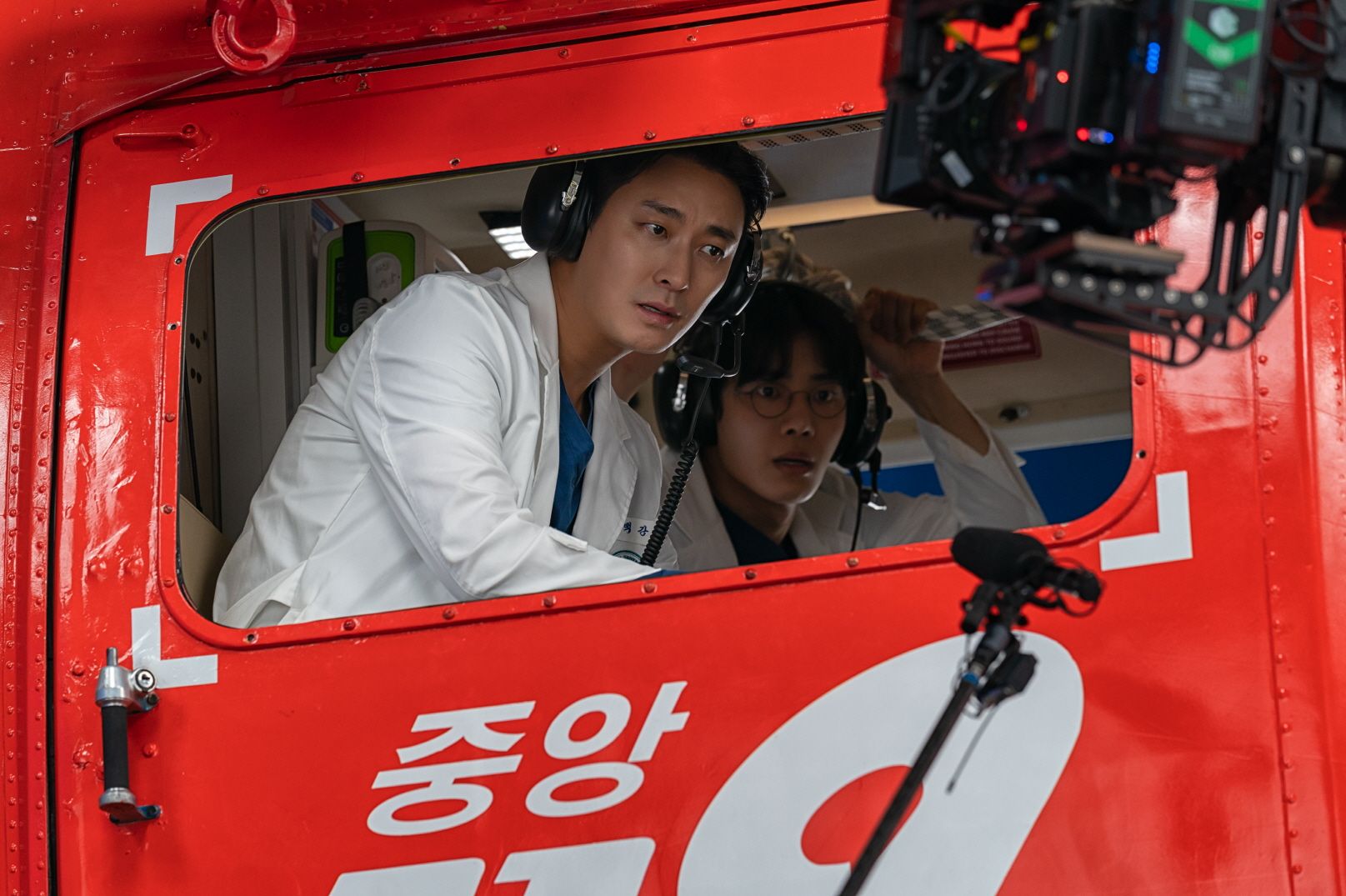
A scene from the currently airing Netflix drama "Severe Trauma Center," where the main character Professor Baek Kanghyuk (played by Ju Jihoon) boards a helicopter to save a patient. Provided by Netflix
Patients being rushed in, covered in blood due to unexpected accidents; doctors fighting desperately against time to save fading lives; a handful of medical staff efficiently triaging and treating patients even in extreme situations with mass casualties... The Netflix web novel drama 'Severe Trauma Center' depicts the struggles of trauma surgeons, prompting reflection on the harsh realities and relentless battles faced by actual trauma centers. Superhero trauma specialists like the drama's protagonist, 'Baek Kanghyeok', are hard to find in real life, and it is rare to see junior doctors inspired by such portrayals volunteering to work in trauma centers.
'Severe Trauma Centers' Enthusiastically Portrayed in Dramas... In Reality, Even Doctors Avoid Them Insufficient Compensation Compared to Work Intensity... Many Quit Midway After Training
Although There Are 371 Trauma Specialists, Fewer Than 200 Are Practicing Doctors Vicious Cycle of Staffing Shortages... Regional Trauma Centers Unable to Provide Emergency Care Are Increasing
The number of specialists giving up on trauma care increases every year. In 2011, Professor Lee Gukjong of Ajou University Hospital's trauma surgery department saved Captain Seok Haegyun, who was severely injured during the 'Dawn of Aden Operation', bringing nationwide attention and interest to the field of trauma care?but only temporarily. Due to chronic staff shortages, long working hours, and the risk of medical accidents, trauma surgery has become an unpopular specialty, and many regional trauma centers are unable to fulfill their intended roles.
Most Give Up Even After Completing Trauma Specialist Training
According to the Ministry of Health and Welfare and the Korean Society of Traumatology on the 17th, 13 specialists applied for and passed the trauma subspecialist exam held on the 8th. Trauma subspecialists are surgeons, neurosurgeons, or cardiothoracic surgeons who undergo an additional two years of trauma training at 27 designated hospitals nationwide and are certified after evaluation. Since 2010, an average of 25 to 26 trauma subspecialists have been certified each year, totaling 371 as of last year.
However, as of February 2025, only about 188 doctors are working as dedicated trauma specialists in the field, falling short of 200 nationwide. The number of new applicants is decreasing, while more doctors who have already obtained trauma subspecialist qualifications are giving up. The trauma subspecialist qualification must be renewed every five years, but this year, only 20.7% of those eligible for renewal applied, the lowest rate ever recorded.
The main reason for this attrition is that the compensation does not match the harsh working conditions. The salary for 'dedicated trauma center specialists' supported by the Ministry of Health and Welfare increased from 144 million won last year to 160 million won this year, but it still falls short of the average annual salary for all specialists, which was 236 million won as of 2020. While circumstances vary by hospital, trauma surgery is generally not considered profitable, resulting in insufficient treatment and support for medical staff. In hospitals with staff shortages, the remaining doctors are forced to work even harder, creating a vicious cycle.
Problems also arise due to a lack of understanding or support for trauma surgery within hospitals. Trauma centers must always keep separate space available for severe trauma patients who could arrive unexpectedly. Although the number of patients that can be admitted at one time is limited, if beds in the trauma center are given to less critical patients just because they are empty, the center may be unable to respond when a truly urgent case occurs. Because trauma centers sometimes have no patients and at other times are overwhelmed, some hospital administrators fail to understand the unique demands of emergency care. A doctor at a regional trauma center said, "Unlike in dramas, it's rare for hospital directors to openly criticize the trauma center's deficits or performance, but whenever we raise issues about staffing or ICU shortages, the response is always, 'There's nothing we can do,' or 'Other hospitals are the same,' so we've stopped bringing it up altogether."
Regional Trauma Centers Failing to Fulfill Emergency Care Responsibilities
Since the designation of regional trauma centers across the country in 2014, Korea's 'preventable trauma mortality rate' has dropped from 35.2% in 2011 to 13.9% in 2021, less than half. A regional trauma center is a dedicated treatment facility equipped to provide immediate emergency surgery and optimal care for severe trauma patients with multiple fractures or bleeding from car accidents or falls. The sharp decrease in the proportion of trauma deaths that could have been prevented with timely and appropriate treatment shows that, with adequate facilities, equipment, and staff, trauma centers can significantly reduce mortality rates.
However, while each center initially filled the required 23?27 specialists, the perception that compensation does not match the workload has spread, leading to worsening staff shortages over time. As of August last year, only Ajou University Hospital in southern Gyeonggi Province had more than 20 dedicated trauma specialists among the 17 regional trauma centers nationwide. Some centers have barely maintained operations with just 4?5 doctors working almost every night, but even that has become unsustainable due to ongoing conflicts between doctors and the government, resulting in some centers no longer operating normally. If a trauma center fails to meet the staffing requirements, its promised government funding is inevitably reduced. For this reason, some argue that instead of distributing government budgets equally to all centers, support should be concentrated on centers with superior capabilities.
Cho Hangjoo, president of the Korean Society of Traumatology (head of the trauma center at Uijeongbu St. Mary's Hospital), said, "For regional trauma centers to fulfill their roles, more doctors are needed to ensure a stable system, but that's difficult in the current environment. We need various incentives to encourage doctors to choose to work at trauma centers, given the extra hardship involved." Lim Aram, director of disaster medical policy at the Ministry of Health and Welfare, explained, "We are currently reviewing ways to provide differential support or set exit criteria for trauma centers based on evaluation results from ongoing research. However, since regional trauma centers play a key role in local emergency care, any decision to close a center in a particular area requires careful consideration."


!["Please Help Us": How Much Do Those Bowing 90 Degrees These Days Actually Earn? [Data Pick]](https://cwcontent.asiae.co.kr/asiaresize/323/2026052010120870131_1779239528.png)