
Professor Heo pointed out, "It was probably an unavoidable medical accident that occurred during emergency surgery to save a critically ill patient," and added, "Although it has been repeatedly discussed why doctors avoid essential departments, incorrect judicial decisions have once again driven a nail into the coffin." Professor Heo emphasized, "Every moment I work as a trauma center doctor, I feel like I am walking on the prison wall," and said, "If I could focus solely on saving lives without such risks, and if good-faith efforts in medical care were not punished even when outcomes are unfavorable, more medical professionals would return to essential medical fields."
"Accidents never stop, and there is always a shortage of staff... Trauma center doctors must make the quickest and most cold-headed decisions when treating emergency patients, saving lives, performing surgeries, and guiding patients through recovery. Yet, there are always some patients whose faces linger in my mind?whether on the bus to and from work or just before I fall asleep at night, I can't help but think of them."
Heo Yoonjung, a professor at Dankook University Hospital Chungnam Regional Trauma Center (age 37), who recently published the essay "Because I Want to Save Lives Again," said in an interview with an Asia Economy reporter on the 16th, "I wanted to keep remembering the patients who passed through my hands by writing down the thoughts and emotions I experienced as I saved lives or pronounced deaths several times a day."
Professor Heo had dreamed of becoming a trauma surgeon since her school days. After graduating from the College of Pharmacy, she attended medical school and completed a four-year surgical residency before undergoing further training to become a trauma surgery specialist. She chose Dankook University Hospital Regional Trauma Center, determined to learn as much as possible in a place with many patients.
Located in Cheonan, Chungnam, Dankook University Hospital sits next to the Gyeongbu Expressway, with industrial complexes to the west and farmland scattered throughout the surrounding area. It is a place overflowing with trauma patients?from large-scale traffic accidents to industrial accidents such as falls, machinery entrapments, amputations, and farming equipment accidents caused by overturned cultivators or tractors. Sometimes, victims of assault or injury arrive with their bodies battered, and there are also cases where patients who have attempted self-harm or suicide must be saved. In every situation, trauma center doctors must focus solely on saving the patient, making the fastest decisions and acting quickly. At Dankook University Hospital Trauma Center, there were senior doctors deeply committed to severe trauma care, and Professor Heo was able to learn what it meant to become a surgeon from them.
Professor Heo said, "Among the patients transferred to the trauma center, very few are economically well-off or have stable lives," and added, "Seeing people's bodies and lives shattered by recurring traffic accidents and similar industrial disasters year after year made me want to let more people know about this reality." That is why her book contains poignant and heartbreaking stories: patients who suffer unexpected accidents at their familiar workplaces but cannot have their injuries recognized as industrial accidents and must worry about medical bills and living expenses; breadwinners who, despite knowing the dangers, must return to hazardous job sites; bereaved families crying out in grief at the death of a loved one; and the sorrow and regret for young lives lost before they could even blossom. She confesses that she was able to endure the war-like environment of the trauma center because she believed it was her mission as a doctor to save each patient, help their families remain whole, and heal the ills of society by treating people.

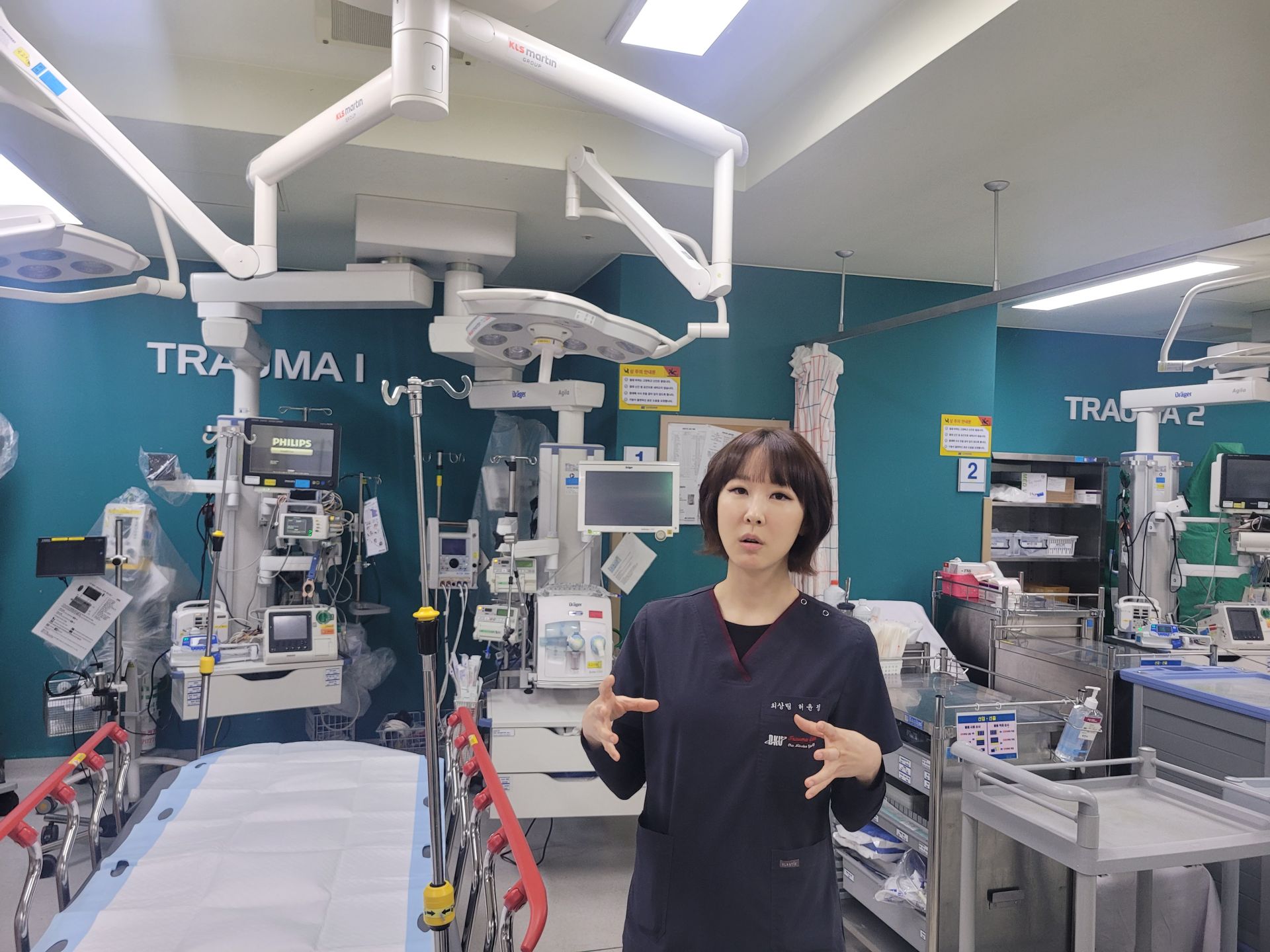
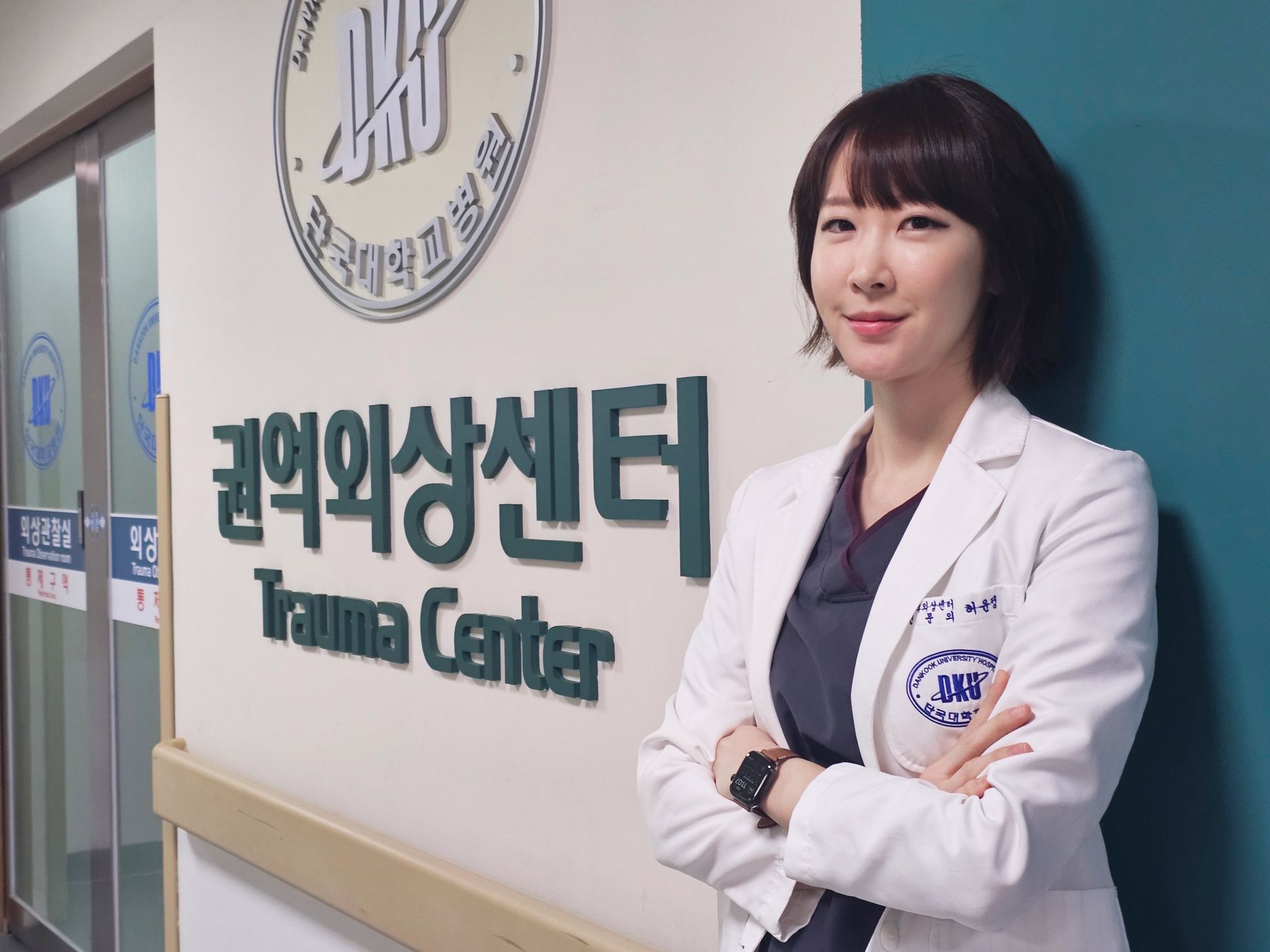
Professor Huh Yoonjung of Dankook University Hospital is being interviewed about patient treatment at the Severe Trauma Center. Photo by Jo Inkyung
원본보기 아이콘However, no matter how capable a trauma center may be, its doctors are not exempt from the grueling workload of eight 24-hour shifts and 36-hour continuous duties each month. Trauma surgery is a field that demands the highest level of mental and physical endurance, where doctors face death every day, the labor intensity is at its peak, and yet the compensation is woefully inadequate. As a result, the number of applicants decreases every year, and it has become a place where only those with a strong sense of duty can work. Professor Heo revealed, "Since I joined our center in 2020, not a single new trauma surgery fellow has joined."
Unfortunately, the conflict between the government and the medical community, triggered by the controversy over medical school quotas, has pushed both patients and doctors into even harsher conditions. Over the past year, some regional trauma centers have increasingly had to transfer accident patients to distant trauma centers because they could not handle the volume. Much of the infrastructure for transferring and treating critical patients has also collapsed. At Dankook University Hospital Trauma Center, the annual average number of patients used to be about 2,300, but last year, that number plummeted to around 1,370. After the mass resignation of residents, it became impossible to accept trauma patients in departments with staff shortages, even if the 119 emergency dispatch center called. Professor Heo said, "Even before the medical crisis, we played a backup role for other trauma centers in the region whose functions had declined," and added, "Patients we could not accept likely ended up dying while being transferred somewhere that could not provide definitive treatment, or suffered severe disabilities even if they received care."
The social atmosphere of frequent criminal and civil lawsuits, as well as criminal punishment for medical malpractice, is also making doctors more hesitant. Recently, the medical community was shocked when a court ruled that an anesthesiology resident must pay 440 million won in damages for a patient who died during emergency treatment for a subdural hemorrhage caused by dating violence. The court held the resident responsible for an error during central venous catheter insertion.