Jeju Air flight 7C2216, which departed from Bangkok, Thailand and was headed to Muan Airport, attempted to land on the runway at Muan Airport at around 9:03 a.m. the previous day with its landing gear (equipment necessary for takeoff and landing, such as airplane wheels) not deployed, and collided with the airport's outer wall. All 179 people onboard, including 175 passengers and two pilots and two cabin crew members, died at the scene. Only two people survived?the male and female crew members who were in the tail section of the aircraft.


Only 9 Minutes After Landing Clearance... Bird Warning → Emergency Landing → Crash
'Landing clearance → bird warning → emergency landing → crash'?the tragedy unfolded within nine minutes. According to Joo Jongwan, Director of Aviation Policy, and Yoo Kyungsu, Director of Aviation Safety Policy, who led the briefing at the Sejong Government Complex, the Muan Airport control tower granted landing clearance to Jeju Air flight 7C2216, the accident aircraft, at 8:54 a.m. that day.
While the aircraft was making its initial approach to the runway, at around 8:57 a.m., the control tower issued a 'bird activity (collision) warning'. This warning is typically given when a large flock or a sizable bird is detected near the aircraft.
After this, the captain of the aircraft detected an abnormality and, about two minutes later at 8:59 a.m., declared a 'Mayday'.
At 9:00 a.m., the aircraft attempted to land on runway 19, approaching from the opposite direction of the originally intended runway (runway 01). Then, three minutes later, at 9:03 a.m., the plane attempted to land with the landing gear (airplane wheels) not deployed, causing friction between the fuselage and the runway, failed to reduce speed, and crashed.
Director Joo explained, "The control tower granted permission to land in the opposite direction of the runway, and as the pilot accepted and attempted to land again, the aircraft overshot the runway and crashed into the outer wall."
Regarding the analysis that the aircraft may have experienced engine failure after colliding with a bird, Director Joo said, "Engine failure is not typically linked to landing gear malfunction," adding, "Even if the landing gear is broken, it can be deployed automatically or manually during landing."


"Save Them!"?Wailing Every Time a Family Member's Name Was Called
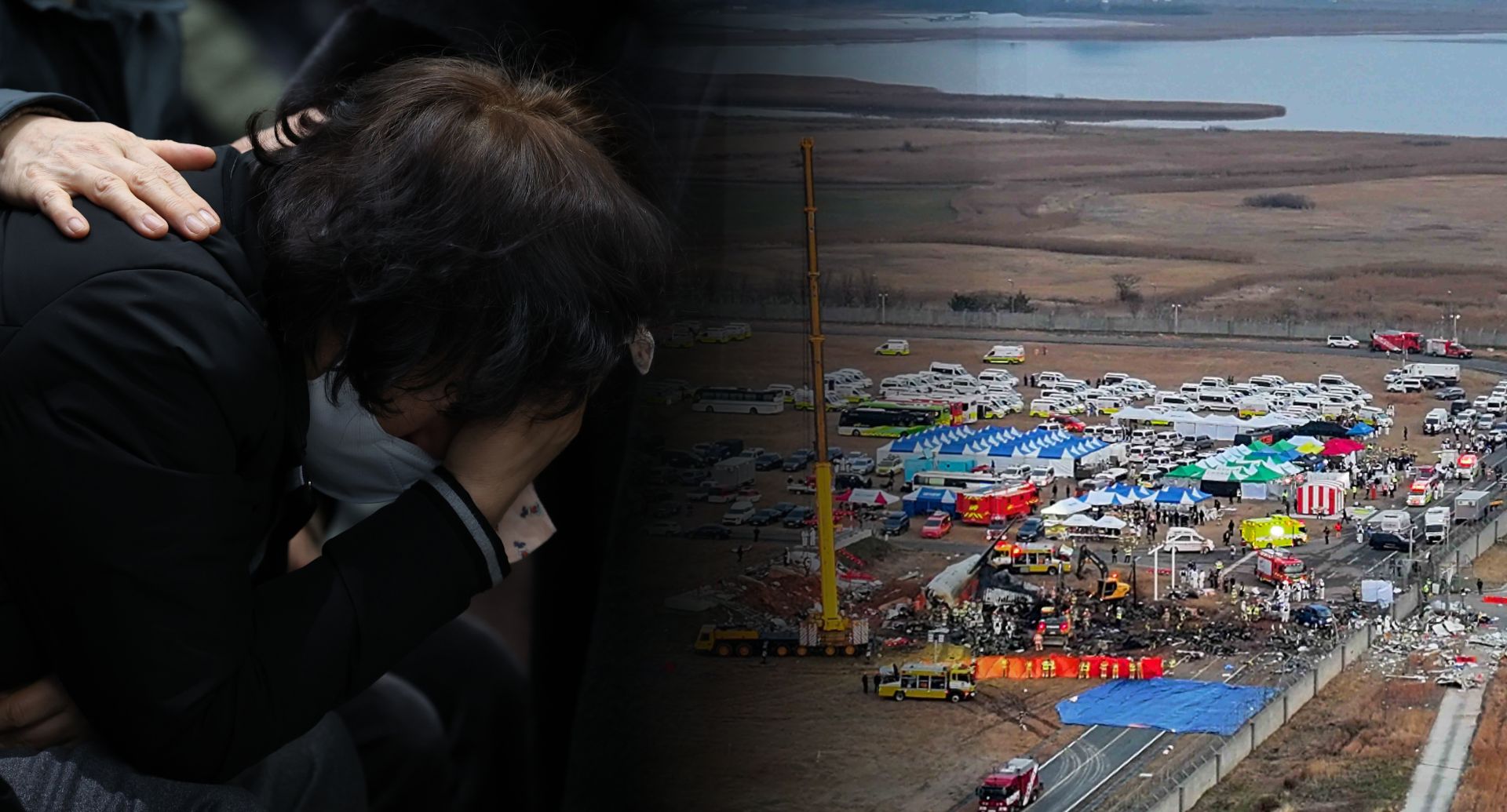
On the morning of the 30th, the wreckage of Jeju Air flight 7C2216 still lay scattered at Muan International Airport in South Jeolla Province. The cut surface of the aircraft, with only the tail section remaining, clearly revealed scorched equipment and parts. Traces of fire and impact on the victims were evident despite the somewhat overcast weather.
The aircraft exploded after hitting the outer wall of the runway, leaving only the tail section intact. Except for the tail, the rest was reduced to ashes, making it almost impossible to identify as an airplane. Even the interior, lifted by a crane, was unrecognizable.
Firefighters from the Muan Fire Station in South Jeolla were busy searching for victims among the wreckage. Drones they deployed circled the area, searching for any remaining traces. Although there is speculation that this air disaster was caused by a bird strike (a bird being sucked into the engine), the migratory birds were nowhere to be seen after the tragedy. On that morning, thick fog with visibility less than 1 km covered parts of the Jeonnam region.
The airport terminal was filled with bereaved families who rushed in upon hearing the news. Every time a victim's name was called, family members bowed their heads and fell to their knees. Cries of "Please save them, please bring them back," and "No, this can't be," echoed throughout the hall.
As the incident coincided with the year-end and Christmas holidays, many of the passengers were families traveling together. The youngest passenger was a 3-year-old boy born in 2021, and the oldest was 80 years old. There were reportedly about 15 passengers under the age of 20. The oldest passenger was traveling with eight family members, including children and relatives, to celebrate his 80th birthday, but the entire family was lost in the tragedy.
Briefings on the accident response were held in Sejong City and Gangseo District, Seoul, which meant that news often reached the bereaved at the scene with delays. One family member lamented, "How can it be that I have to learn the details of the investigation from the news while I'm here at the site?" Some agitated relatives raised their voices, saying there was neither a proper communication channel nor any substantial updates from government officials.
The bereaved families also requested to visit the accident site themselves. Park Hanshin, who served as the temporary representative for the families, said, "At least the men would like to see the site before sunset," and asked for the authorities' cooperation. Lee Jincheol, Director of the Busan Regional Aviation Administration, responded, "There is no precedent for this, and there could be trauma due to the tragedy," asking for their understanding.
Tensions rose further when Jeju Air executives, including CEO Kim Ibae, appeared at Muan Airport late the previous afternoon. Kim, along with Chae Hyungseok, Vice Chairman of Aekyung Group, and Ko Jun, CEO of AK Holdings, visited the airport around 8 p.m. on the 29th to offer condolences and promise full support to the bereaved families. Park criticized them, saying, "It only takes a few hours to get anywhere in the country, so what were you doing showing up 11 hours later?"

At the departure hall of Muan International Airport in Jeonnam on the 29th, bereaved families are checking the passenger list after a Jeju Air passenger plane carrying 181 passengers collided with the outer wall of the runway during landing, causing a fire and resulting in a major disaster with most passengers deceased. Photo by Kang Jinhyung
원본보기 아이콘38 Victims Still Unidentified... Black Boxes Sent to Gimpo Airport
As of the morning of the 30th, 141 out of the 179 deceased have been identified. The black boxes, which may reveal the cause of the accident, have also been found and sent to Gimpo Airport for analysis.
The Ministry of Land, Infrastructure and Transport held a briefing at the Sejong Government Complex at 10 a.m. that day, announcing, "As of 9:30 a.m., the identities of 141 victims have been confirmed." There are still 38 victims whose identities need to be confirmed, and DNA analysis and fingerprint collection are underway.
A ministry official said, "We will contact the families again once the investigation is complete and the bodies are ready to be released." The recovered remains are temporarily being kept in a hangar at Muan Airport, with refrigeration facilities in place to preserve them until they can be handed over to the families. The ministry decided to preserve the accident site for the time being to investigate the cause.
Both black boxes, which are key to determining the cause of the Jeju Air disaster, have been fully recovered. The black boxes consist of a Cockpit Voice Recorder (CVR) and Flight Data Recorder (FDR). Immediately after the accident, the CVR was found intact, but the FDR was recovered with some external damage. However, the missing FDR was found overnight, so the black boxes are now complete in appearance.
Gwak Youngpil, a manager with the Central Accident Investigation Headquarters, said, "We have now recovered all the black boxes, including the one that was missing overnight, and will transport them to Gimpo Airport," adding, "The most important thing now is for the Aviation and Railway Accident Investigation Board at Gimpo Airport to analyze the black boxes, and whether the data can be properly downloaded is the key issue."
The investigation into the cause will require comparing the records from both devices. The decoding of the FDR and CVR will determine the direction and duration of the entire investigation. If both devices are intact and the data can be downloaded, the work can proceed quickly. However, if the black boxes are too damaged to easily retrieve the data, help from the US National Transportation Safety Board (NTSB) may be needed, and the investigation could take several months. Joo Jeongwan, Director of Aviation Policy at the Ministry of Land, Infrastructure and Transport, said, "We need to comprehensively assess the condition of the black boxes and their impact on the accident," adding, "At this point, it is difficult to predict when the analysis will be completed."
-

Reporter Sim NaYoung sny@asiae.co.kr
-
Edit Kim Boram kbram6457@asiae.co.kr
© The Asia Business Daily(www.asiae.co.kr). All rights reserved.
!["Please Help Us": How Much Do Those Bowing 90 Degrees These Days Actually Earn? [Data Pick]](https://cwcontent.asiae.co.kr/asiaresize/323/2026052010120870131_1779239528.png)