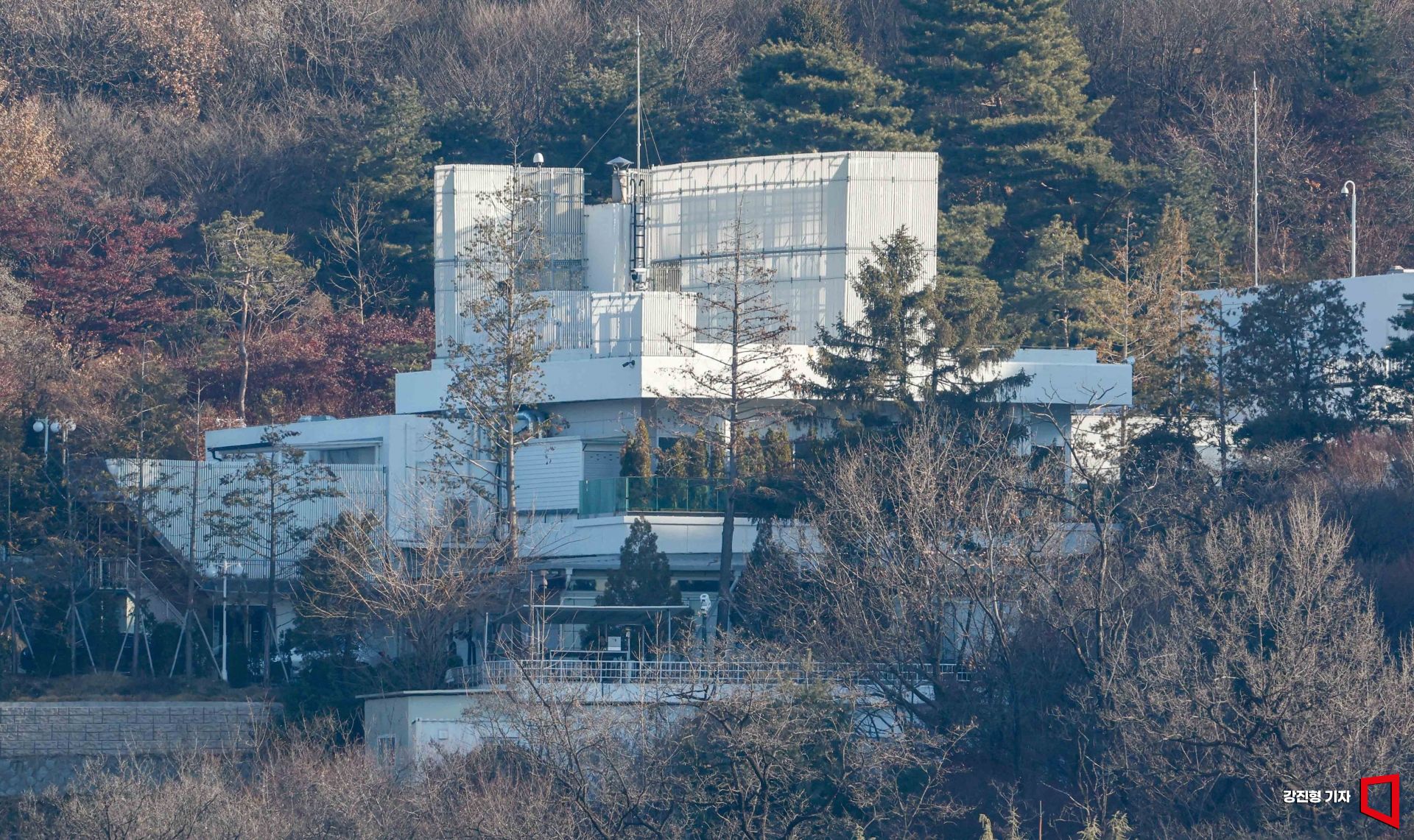

A postal worker is holding mail in front of the presidential residence in Hannam-dong, Yongsan-gu, Seoul, on the 24th, as President Yoon Seokyoul refuses to accept the summons from the Corruption Investigation Office and the impeachment trial documents from the Constitutional Court. Photo by Kang Jinhyung
원본보기 아이콘President Yoon Suk-yeol, who is accused of being the ringleader in an insurrection, has failed to respond to the Corruption Investigation Office for High-ranking Officials (CIO)'s request to appear on Christmas Day, raising the possibility that an arrest warrant may be issued. Legal experts both inside and outside the legal community believe that the requirements have already been largely met.
According to the CIO on the 26th, President Yoon did not comply with the office's request to appear for questioning at its office in the Gwacheon Government Complex by 10 a.m. the previous day. The CIO waited until 6 p.m. that day, but since President Yoon did not appear and his legal team did not issue any statement, the investigation was considered to have collapsed. The CIO stated, "There has been no contact from President Yoon's side, and no notice of attorney appointment has been submitted."

Amid the Constitutional Court's review of the impeachment petition against President Yoon Seokyeol, a wreath supporting President Yoon was placed on the outer wall of the Constitutional Court in Jongno-gu, Seoul on the 23rd. Photo by Kang Jinhyung
원본보기 아이콘The CIO had also sent a first summons to President Yoon on the 16th, requesting him to appear for questioning on the 18th, but at that time as well, President Yoon did not respond. After remaining silent for this second summons a week later, the CIO now faces a choice between issuing a third summons or requesting an arrest warrant.
The Criminal Procedure Act stipulates that an arrest warrant may be requested from the court if there is substantial reason to suspect the accused has committed a crime, and if the accused fails to comply with a summons from the investigative agency without just cause or is likely not to comply. In President Yoon's case, the legal community generally believes that these two requirements for an arrest warrant have been partially met. In the first case, since key figures involved in the emergency martial law, such as former Defense Minister Kim Yong-hyun and former Defense Security Command chief Yeo In-hyung, have already been detained on charges of involvement in insurrection, the court may see the requirements as fulfilled.

On the 16th, as the Constitutional Court proceeds with related procedures for a swift trial ahead of the full-scale impeachment trial of President Yoon Sukyeol, constitutional justices are entering the Constitutional Court building in Jongno-gu, Seoul. From the top left: Acting Chief Justice Moon Hyungbae (18th term, progressive), Justice Lee Miseon (26th term, progressive), Justice Kim Hyungdoo (19th term, moderate), Justice Jung Jungmi (25th term, moderate-progressive), Justice Jung Hyungsik (17th term, conservative), Justice Kim Bokhyung (24th term, moderate-conservative). Photo by Kang Jinhyung
원본보기 아이콘In particular, the latter requirement has been objectively met, as President Yoon has failed to respond to two summonses without any reply. A criminal law specialist at a law firm said, "Even if someone cannot comply with a summons, it is normal to communicate the reason and ask to reschedule," adding, "Not contacting the investigative agency at all can work against the accused in the future."
Moreover, President Yoon's side maintaining the position that the impeachment trial should take precedence over the investigation may also significantly affect the investigation going forward. Seok Dong-hyun, an attorney involved in forming President Yoon's legal team, said, "The President believes that since the National Assembly has initiated impeachment proceedings, the Constitutional Court's impeachment trial should take priority." However, since the impeachment trial and the investigation proceed separately, the CIO may determine that there is still a risk President Yoon will not comply with further summonses.

Typically, when an arrest warrant is requested, the possibility of a subsequent detention warrant is also considered, which could be a burden for President Yoon's side. After arresting a suspect, the investigative agency must request a detention warrant within 48 hours, or the suspect must be released if the court does not grant it. Under the Criminal Procedure Act, grounds for detention include risk of flight or destruction of evidence, and the seriousness of the crime and risk of repeat offenses are also considered. In President Yoon's case, it is generally believed that he has a fixed residence and is not a flight risk, but given the Presidential Security Service's previous refusal to allow police searches of the presidential office and residence, and the seriousness of the charges, there is discussion that he could be detained if arrested. Oh Dong-woon, head of the CIO, has stated, "Our principle is to conduct detention investigations for ringleaders and major offenders of insurrection."
-
Reporter Lee Gwanju leekj5@asiae.co.kr
-
Edit Sung Kiho kihoyeyo@asiae.co.kr
© The Asia Business Daily(www.asiae.co.kr). All rights reserved.