[Hamburger Decay Experiment]⑤
On Day 34 of the Asia Economy experiment, compared with Burger King Whopper
All burgers were covered in mold, though the 3D shape differed by packaging
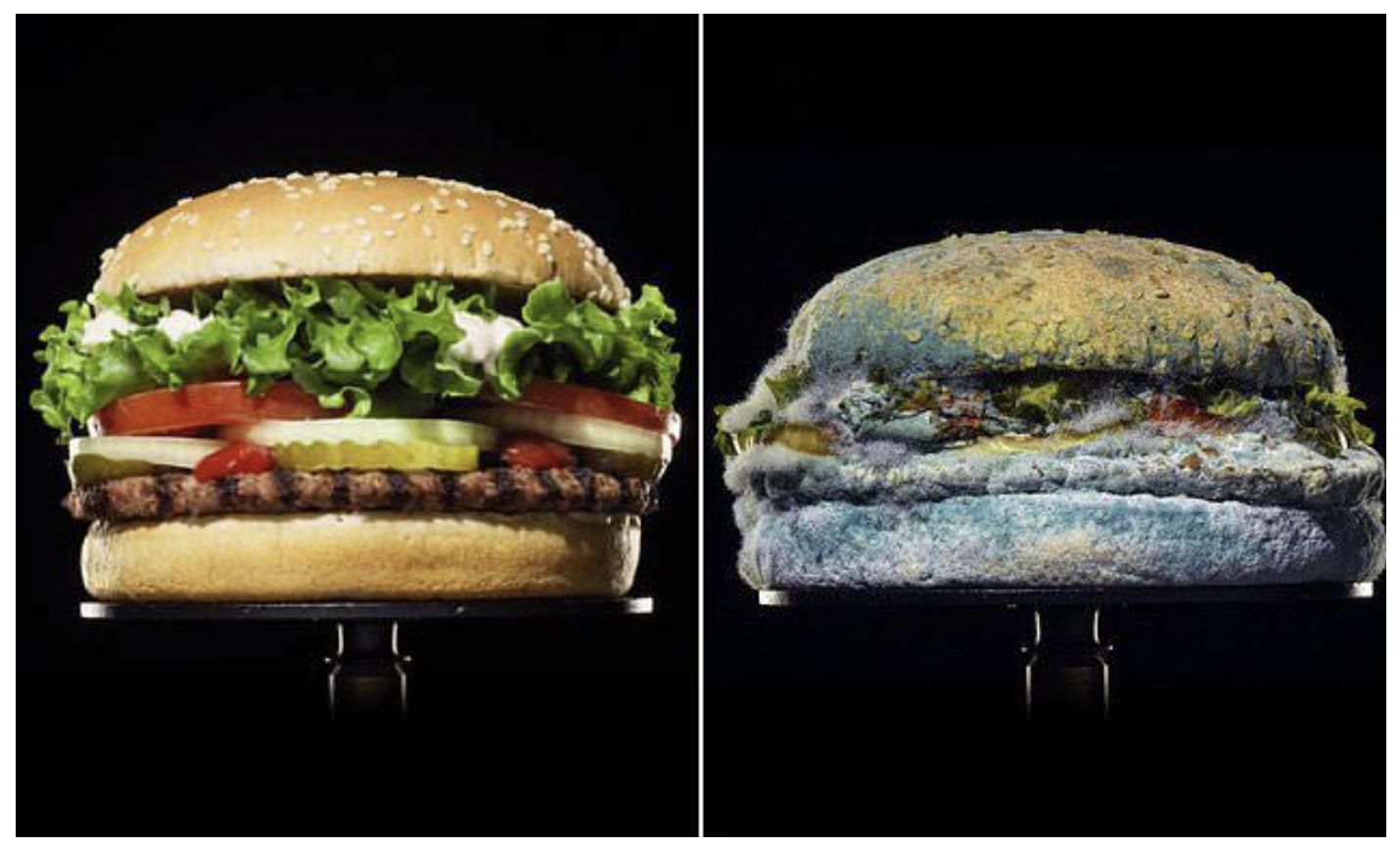
In 2020, Burger King’s US headquarters aired a shocking advertisement showing exactly what happens to a freshly made Whopper after 34 days. During that time, yellow, blue, and white molds grew all over the burger.
At the end of the ad, Burger King added the line, "The beauty of no artificial preservatives." This was to demonstrate that no artificial colors, additives, or preservatives were used in any part of the Whopper, from the bun and beef patty to the pickles, sliced onions, tomatoes, lettuce, and sauce.
On the 9th, exactly 34 days after Asia Economy began its experiment of letting signature burgers from six brands -- McDonald's, Mom's Touch, Lotteria, Burger King, KFC, and Five Guys -- decay, the Whopper’s condition was examined. How had the Whopper changed?
Stored in a plastic container at the Asia Economy studio, the Whopper was completely covered in white and blue mold. While the burger’s appearance remained unchanged for the first week, after about 30 days, fluffy mold had evenly spread across the top of the bun. On the areas sprinkled with sesame seeds, round mold colonies rose even higher. The bottom of the bun, which had not been exposed to air, showed relatively little change.
The visuals differed significantly from Burger King’s original experiment, mainly due to packaging. Burger King used freshly made, unwrapped products, so the decayed Whopper retained much of its original 3D structure, with the bun, beef patty, and lettuce still visible. In contrast, Asia Economy’s experiment started with a Whopper that had been wrapped and then unwrapped, so the space between the buns was compressed, making the ingredients inside barely visible and limiting the ability to observe each component’s condition.
Additionally, differences in storage environment such as temperature and humidity led to different types of mold compared to Burger King’s experiment, which featured a variety of mold colors. However, it cannot be said that the burger decayed less than in the 4-year-old advertisement, so the "beauty of no artificial preservatives" was still demonstrated.

The 34th day of the hamburger rotting experiment, a Burger King Whopper. Photo by Dongju Yoon
원본보기 아이콘Among the six signature burgers, Five Guys’ Bacon Cheeseburger showed the most advanced decay. The burger had transformed into a volcano-shaped mold island. The bun was thickly covered in blue and white mold, and white mold was also present on the patty, highlighting the use of fresh ingredients.
The KFC Zinger Burger and Mom’s Touch Thigh Burger, both featuring chicken patties, also began to catch up quickly. By the third week of the experiment, white mold was mainly found on the chicken patties, but now it has spread to the buns as well, making it hard to distinguish the brands by appearance alone. The melted cheese and sauce, mixed with mold, made the burgers look even more grotesque.

Day 34 of the hamburger rotting experiment: Mom's Touch Cyber Burger (left) and KFC Zinger Burger (right). Photo by Dongju Yoon
원본보기 아이콘Even Lotteria’s Bulgogi Burger and McDonald’s Big Mac, previously called "the phoenix," began to show changes. On the bottom of the Bulgogi Burger bun, white mold the size of a finger started to appear. Unlike the other products, it had a dry appearance, as if dusted with white powder. There were still no noticeable changes in the meat patty. The Big Mac also began to show signs of transformation, proving that the test subject was indeed a real food item and not a model. Unlike Lotteria, there was still no mold on the bun, but a small patch of white mold, the size of a fingernail, developed on the meat patty. Other than that, it remained unchanged from before.
As of the 14th, the hamburger decay experiment has reached 40 days. Asia Economy will continue to observe which burger lasts the longest without decaying under the same conditions.

Day 34 of the hamburger rotting experiment: Lotteria Bulgogi Burger (left) and McDonald's Big Mac (right). Photo by Dongju Yoon
원본보기 아이콘!["Please Help Us": How Much Do Those Bowing Deeply for Your Vote Really Earn? [Data Pick]](https://cwcontent.asiae.co.kr/asiaresize/323/2026052010120870131_1779239528.png)