The deployment of North Korean troops may rather accelerate the collapse of North Korea.
Editor's NoteChairman Kim Jong Un is building barriers day after day, turning North Korea into his own fortress. However, the most powerful cracks have already begun from within. For the younger generation who grew up in the era when the rationing system collapsed, there is no belief that the "Suryong" will protect the people. Rather than sacrificing themselves for the Party, these young people choose to live for themselves. Instead of loyalty, they yearn for freedom. We take a look at the potential for change that could shake the Kim family's dictatorship, which has solidified over more than 70 years, by examining the Jangmadang Generation. ①The 'North Korean MZ' Threatening Kim Jong Un
"Loyalty? The Suryong has never even given me a bowl of corn porridge."
![In 2019, residents gathered to trade at a marketplace in Hyesan City, Yanggang Province, North Korea. [Photo by Dongwan Kang, Professor at Dong-A University]](http://www.asiae.co.kr/en/news/img_view.htm?img=2024102800080174979_1730041681.jpg)
In 2019, residents gathered to trade at a marketplace in Hyesan City, Yanggang Province, North Korea. [Photo by Dongwan Kang, Professor at Dong-A University]
원본보기 아이콘Kim Eunjeong (alias), a North Korean defector in her 30s, gave this answer when asked about her thoughts on the "Suryong." A rebellious way of thinking that was unimaginable in the past in North Korea, and an individualism that places oneself above the Party. She is part of the "Jangmadang Generation."
Eunjeong sighed as she recalled her teenage years in North Korea. Her father worked at a factory but could not receive enough rations for the family. Her mother took on the responsibility of providing for the family by going to the Jangmadang (market). Eunjeong said, "Every morning, girls my age in the neighborhood would disappear one by one," adding, "They were sold to China."
She said, "I thought I would die here no matter what," and "I never once believed that the Suryong, whom I had never even seen, would save me." In the end, Eunjeong left her opposing family behind and escaped from North Korea. At the end of 2011, when the Kim Jong Un regime had just begun, she stepped onto the frozen Tumen River at the age of nineteen.
Kim Jong Un's Headache: The Jangmadang Generation Driving Change
A new driving force for change is emerging in North Korea, which has been isolated from the outside world for more than 70 years. The draconian laws of the Kim Jong Un era, such as executing those who distribute South Korean dramas, paradoxically reveal the regime's fear of this young generation. This is the North Korean version of the MZ Generation (Millennials + Generation Z), the "Jangmadang Generation," who have the potential to topple the dictatorship.
North Korea defines "revolutionary generations" based on the historical background experienced during their youth. The first generation is the anti-Japanese partisan generation who fought alongside Kim Il Sung; the second generation is the Chollima Generation, who experienced the Korean War and postwar reconstruction. The third generation led the Three Revolutions Movement in the 1970s, and the fourth generation endured the Arduous March of the 1990s.
![In 2019, residents gathered to trade at a marketplace in Hyesan City, Yanggang Province, North Korea. [Photo by Kang Dongwan, professor at Dong-A University]](http://www.asiae.co.kr/en/news/img_view.htm?img=2023060116145450634_1685603694.jpg)
In 2019, residents gathered to trade at a marketplace in Hyesan City, Yanggang Province, North Korea. [Photo by Kang Dongwan, professor at Dong-A University]
원본보기 아이콘With the advent of the Kim Jong Un era, the fifth generation, today's youth, who entered society, does not have a specific term. Outsiders refer to them as the "Jangmadang Generation." They were born and raised during the "Arduous March," when the rationing system collapsed. In terms of age, this includes those born from the early 1980s to those currently in their 20s to 40s. The Millennial Generation refers to those born from the early 1980s to the mid-1990s, and Generation Z refers to those born from the mid-1990s to 2005, so the categories largely overlap. This is why the Jangmadang Generation is called the "North Korean MZ."
The generational composition gives an idea of the influence of this generation in North Korea. Since there are no precise statistics for North Korea, the generational ratios were compared using UN population estimates for the North and Statistics Korea data for the South. In 1980, when the Jangmadang Generation began to be born, the ratio of those in their 10s to 40s was 65.4% in South Korea and 66.2% in North Korea, a similar level. Last year, the ratio in South Korea had dropped to 50.1%, while in North Korea, those in their 10s to 40s, corresponding to the Jangmadang Generation, remained high at 57.9%. Narrowing it down to those in their 20s and 30s, the gap widens: 25.9% in South Korea and 30.8% in North Korea.
The large proportion of the Jangmadang Generation suggests that they are leading the overall social consciousness. It is argued that future North Korea policy and psychological warfare should focus on this group, which will continue to be the main driver of change.
Collapse of the Rationing System Led to Capitalist Experience..."Myself Over the Party"
Having grown up experiencing spontaneous capitalism, the Jangmadang Generation is characterized by a strong sense of individualism. This stands in stark contrast to the Juche ideology that has dominated the mindset of North Korean residents. This is why they are seen as a source of potential change.
The foundation that enabled the Kim family's dictatorship for so long was the "rationing system." It was a tool to promote the Party and Suryong's love for the people. Under the guise of the state's responsibility for food, clothing, and shelter, it was, in reality, a cruel tool of control?if you didn't obey, you starved. The Jangmadang Generation emerged alongside the collapse of this rationing system.
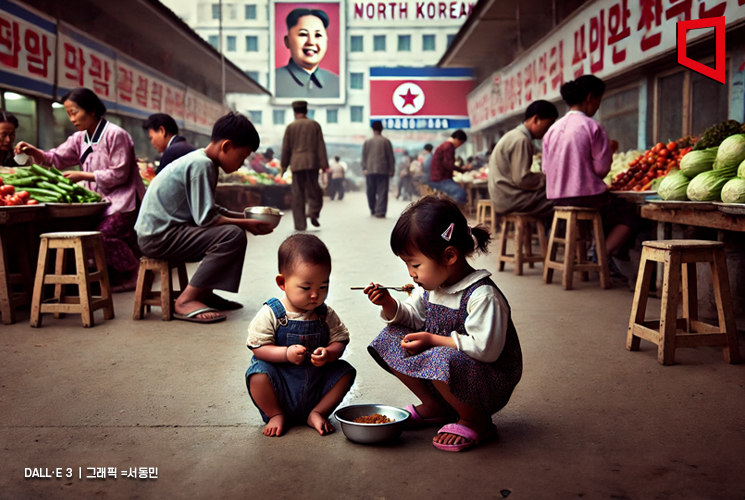
As food shortages weakened the authorities' control over the economy, border trade and the Jangmadang markets rapidly expanded. Not only food and daily necessities but even real estate transactions took place. Residents began to earn "informal income." It was more than just buying and selling goods. The markets became spaces where "information" was exchanged and ideas were shared.
Park Wongon, professor of North Korean Studies at Ewha Womans University, pointed out, "In capitalism, you achieve as much as you work and enjoy economic prosperity, and this leads to individualism. The more people experience capitalism and individualism, the less dependent and loyal they become to the state." He explained that the weakening of monarchy and the rise of democracy in Europe following the Industrial Revolution, and the democratization of South Korea alongside the emergence of the middle class, are similar cases.
Professor Park said, "Once people achieve economic stability, they begin to demand political rights," adding, "It is difficult to say that radical change will happen immediately, but the Jangmadang Generation will pose a significant challenge to Kim Jong Un."
"High-Level Psychological Warfare... North Korean Troop Dispatch, a Dangerous Gamble"
It is a dangerous mistake to think that the Jangmadang Generation will immediately bring about the collapse of the regime. Various surveys show that young people's opinions on issues like nuclear weapons vary depending on their exposure to outside information. There are suggestions that sophisticated psychological warfare is needed to unleash the latent power for change.
Kim Kyouhyun, former Director of the National Intelligence Service, said in his first lecture after retirement, "There are two parties in North Korea: the Workers' Party and the Jangmadang," emphasizing, "We need to conduct cultural and psychological warfare that takes into account the characteristics of the Jangmadang Generation in this battle." The idea is to awaken the "potential energy of resistance" in young people who grew up without benefiting from the Party.
In this context, there are predictions that North Korea's recent troop dispatch to Russia could be a major turning point. A government official said, "Large-scale troop deployment is a complete gamble for Kim Jong Un," adding, "If fear of the battlefield and death combines with exposure to outside information, even if young soldiers return alive, they could become a threat to Kim Jong Un."
IndexJangmadang Generation
- "Did the Suryeong Ever Give Us Even a Bowl of Rice?"... North Korea's MZ Generation Experiences Capitalism
- North and South Korean Youth Have 11cm Height Gap... At This Rate, They Could Become Different Races
- A North Korean Security Officer Who Defected Dreamed of Becoming a South Korean Soldier
-
Reporter Jang Heejun junh@asiae.co.kr
-
Edit Sung Kiho kihoyeyo@asiae.co.kr
© The Asia Business Daily(www.asiae.co.kr). All rights reserved.
!['WHO Declares International Public Health Emergency' Why the Untreatable 'Variant Ebola' Is More Deadly Than COVID-19 [Reading Science]](https://cwcontent.asiae.co.kr/asiaresize/323/2026052110164072055_1779326201.png)
!["Please Help Us": How Much Do Those Bowing 90 Degrees These Days Actually Earn? [Data Pick]](https://cwcontent.asiae.co.kr/asiaresize/323/2026052010120870131_1779239528.png)