Koizumi, Ishiba, or Takaichi... A Tight Three-Way Race
Koizumi, Ishiba, or Takaichi... A Tight Three-Way Race
by Cho Seulkina
by Choo Myeonghoon
Published 26 Sep.2024 15:10(KST)
Updated 26 Sep.2024 15:13(KST)
Candidates for the Liberal Democratic Party presidency in Japan are taking a commemorative photo before a debate held at the Nixon Kisha Club in Tokyo on the 13th (local time). From the left, Sanae Takaichi, Minister of Economic Security; Takayuki Kobayashi, former Minister of Economic Security; Yoshimasa Hayashi, Chief Cabinet Secretary; Shinjiro Koizumi, former Minister of the Environment; Yoko Kamikawa, Minister of Foreign Affairs; Katsunobu Kato, former Chief Cabinet Secretary; Taro Kono, Minister of Digital Affairs; Shigeru Ishiba, former Minister of Defense; Toshimitsu Motegi, Secretary General of the Liberal Democratic Party. [Image source=Reuters]
LDP Presidential Election D-1... Last-Minute Alliances Are Key
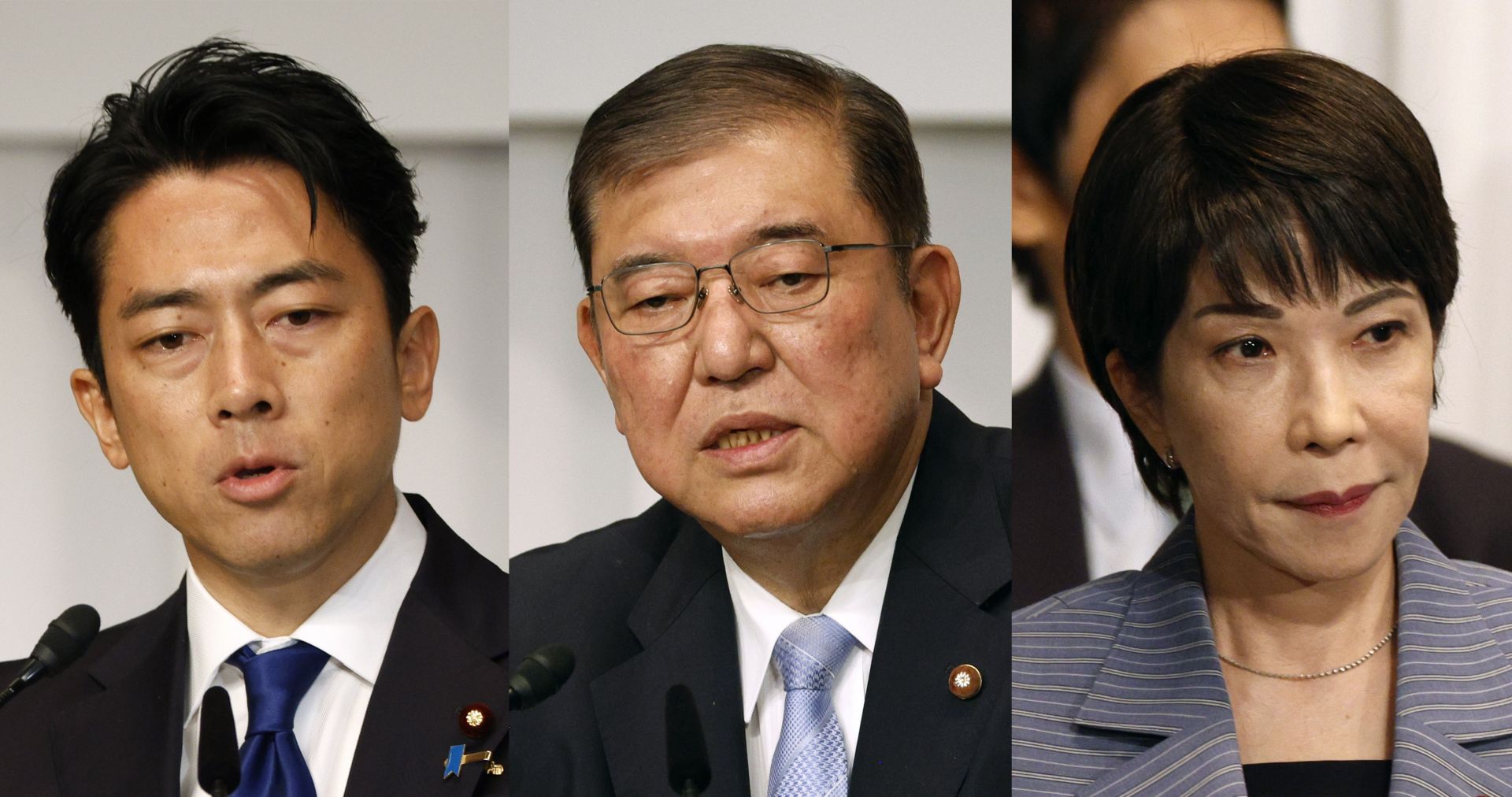
The ruling Liberal Democratic Party (LDP) presidential election, which will determine Japan's next prime minister, is just one day away. With a tight three-way race between former Secretary General Shigeru Ishiba, Minister for Economic Security Sanae Takaichi, and former Environment Minister Shinjiro Koizumi, attention is focused on who will become the 'post-Kishida.' With no clear frontrunner and a runoff vote considered inevitable, the key issue is where lawmakers' votes will go in the final hours, depending on last-minute alliances and mergers.
According to local reports including FNN on the 26th, this year's LDP presidential election is being contested by a record nine candidates. FNN's own analysis shows that, among parliamentary votes, former Environment Minister Koizumi has support from around 60 lawmakers, while former Secretary General Ishiba and Minister Takaichi each have support from around 40 lawmakers. About 40 lawmakers have yet to decide whom to support.
Meanwhile, in the party member votes, Ishiba is leading nationwide, especially in areas like Tokyo and Shimane. The LDP presidential election combines 368 parliamentary votes with 368 party member and associate member votes. If no candidate secures a majority, a runoff is held between the top two candidates, with 368 parliamentary votes and 47 regional organization votes.
Status of Diet Members' Votes Secured in the Japanese LDP Presidential Election - Former Environment Minister Koizumi Around 60 Members - Former Secretary-General Ishiba Around 40 Members - Minister in Charge of Economic Security Takaichi Around 40 Members - Undecided Support Candidates Around 40 Members
FNN stated, "When combining current parliamentary and party member votes, Ishiba, Takaichi, and Koizumi are locked in a fierce three-way battle," adding, "It is becoming increasingly likely that two of them will proceed to a runoff." The previous day, the Yomiuri Shimbun also reported, citing its own survey of 361 lawmakers, that a runoff between the top two among these three is virtually certain. The paper noted, "If a candidate secures around 140 votes in total, they are almost guaranteed a spot in the runoff." Voting for party members and associate members closes one day prior, on this day.
Accordingly, the candidates are making their final efforts to secure lawmakers' votes on the eve of the election. Among the roughly 50 House of Councillors members facing re-election next summer, some have not decided whom to support as they assess which candidate would be most advantageous for their own re-election. Local media report that, despite major factions being dissolved last year due to a slush fund scandal, meetings of lawmakers from various former factions are still taking place. Thirty lawmakers from the Abe faction met the previous day to exchange views on the presidential election. Around ten lawmakers from the Nikai faction also gathered under the initiative of former Internal Affairs Minister Ryota Takeda. As a result, there is speculation that last-minute alliances among these lawmakers could become a decisive factor in the election outcome.
Former Secretary General Ishiba, who enjoys strong support from party members, is making his fifth bid for the presidency. Having served twice as party secretary general, he is a 12-term veteran politician and policy expert, but is seen as lacking a strong in-party factional base. This was evident in the 2012 election, when he came first in the initial party member vote but lost to former Prime Minister Shinzo Abe. Ishiba is also known for his strained relationship with Deputy Prime Minister Taro Aso, the 'kingmaker' who maintained his faction even as others dissolved during the slush fund scandal. The Aso faction currently comprises about 54 lawmakers.
Former Environment Minister Koizumi, aiming to become the youngest prime minister in his 40s, is the son of former Prime Minister Junichiro Koizumi. Backed strongly by former Prime Minister Yoshihide Suga, he is performing well among parliamentary votes, but his lack of cabinet experience is seen as a weakness. Recently, his pledge to introduce a 'separate surname system for married couples' caused his approval ratings to stall, as he failed to recognize strong opposition among the LDP's conservative base. Most LDP party members eligible to vote are understood to be older men.
This election also raises the possibility of Japan's first-ever female prime minister. The leading candidate is Minister for Economic Security Sanae Takaichi, a right-wing politician often referred to as the 'female Abe.' Initially, the race was expected to be a two-way contest between Ishiba and Koizumi, but Takaichi, who had been in third place, surged by consolidating support from the right-wing conservative base, creating a three-way race. Born in 1961, she is highly regarded for having held key posts such as Minister of Finance, Foreign Affairs, and Economy, Trade and Industry, all of which have been held by past prime ministers. If elected, she plans to continue the economic and foreign/security policy lines of former Prime Minister Shinzo Abe, including 'Abenomics.'
![Candidates for the Liberal Democratic Party presidency in Japan are taking a commemorative photo before a debate held at the Nixon Kisha Club in Tokyo on the 13th (local time). From the left, Sanae Takaichi, Minister of Economic Security; Takayuki Kobayashi, former Minister of Economic Security; Yoshimasa Hayashi, Chief Cabinet Secretary; Shinjiro Koizumi, former Minister of the Environment; Yoko Kamikawa, Minister of Foreign Affairs; Katsunobu Kato, former Chief Cabinet Secretary; Taro Kono, Minister of Digital Affairs; Shigeru Ishiba, former Minister of Defense; Toshimitsu Motegi, Secretary General of the Liberal Democratic Party. [Image source=Reuters]](https://cphoto.asiae.co.kr/listimglink/9/2024092614542640464_1727330065.jpeg)
![[Image source=Reuters Yonhap News]](http://www.asiae.co.kr/news/img_view.htm?img=2024092615082240494_1727330902.jpeg)
![[Image source=Reuters Yonhap News]](http://www.asiae.co.kr/news/img_view.htm?img=2024092615082040493_1727330900.jpeg)
![[Image source=EPA Yonhap News]](http://www.asiae.co.kr/news/img_view.htm?img=2024092615084640495_1727330926.jpeg)