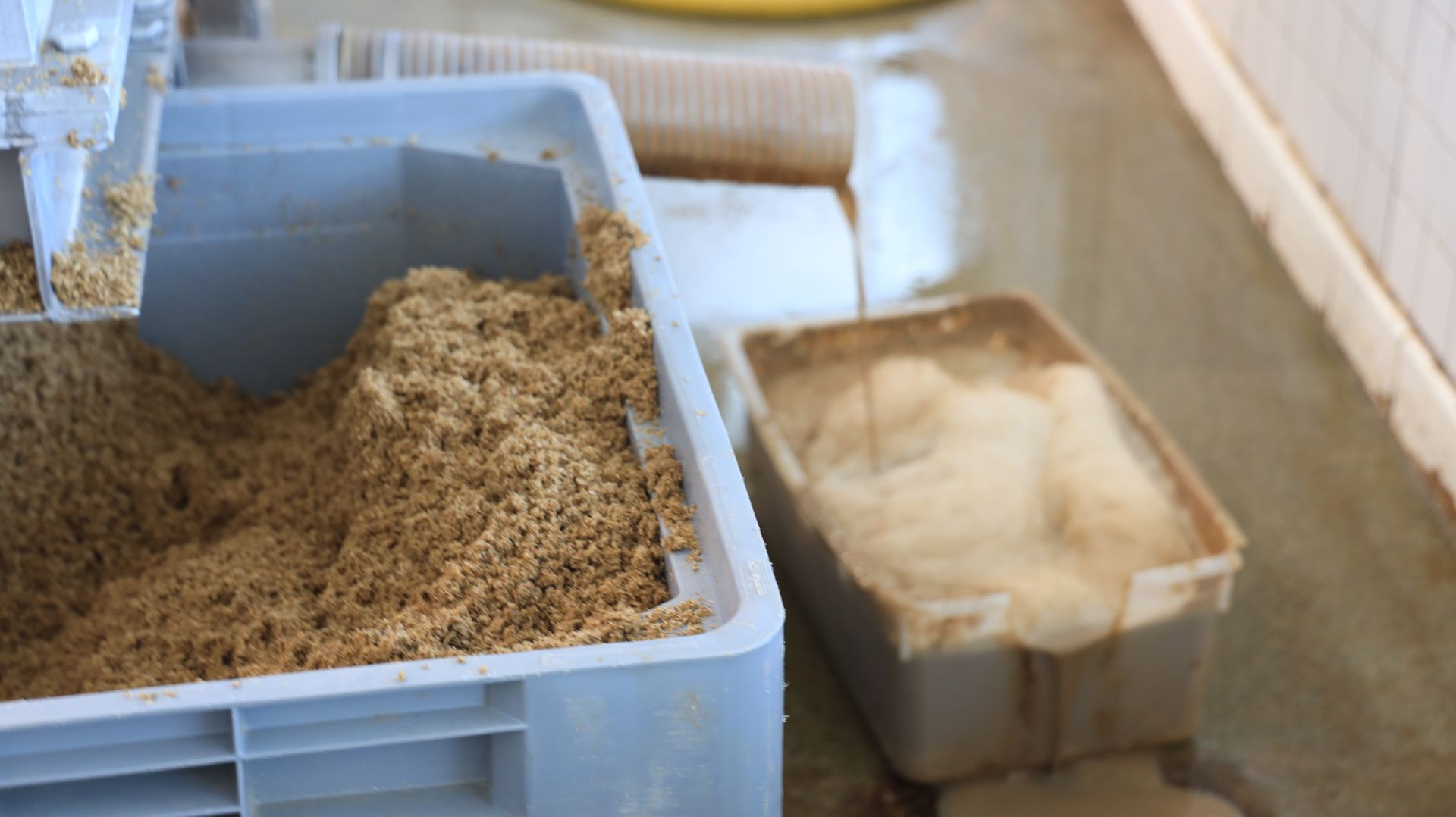
Agreen factory in Vejle, Denmark. Using a press to separate brewers' spent grains into pressed water and moisture-removed brewers' spent grains.
[Rediscovering Food Waste] ①
18,000 tons of food waste generated daily in Korea
30% of agricultural products produced globally are discarded
Upcycling in the spotlight amid global warming
30% of agricultural products produced globally are discarded
Upcycling in the spotlight amid global warming

Agrain factory in Bieverskov, Denmark. An employee is shoveling brewers' spent grain, a food upcycling material. Photo by Goo Eunmo gooeunmo@
원본보기 아이콘Bjaeverskov, a small town an hour's drive from Copenhagen, Denmark. At the production plant of Agrain, operated by Danish food upcycling startup Circular Food Technology, piles of dark, soil-like raw material were stacked like mountains. Agrain transforms 'spent grain,' a byproduct from the brewing process of over 150 types of beer, into grain flour and sells it.
"Try drinking it."
To turn moist spent grain into flour, it must go through three steps: pressing, drying, and grinding. When the spent grain was pressed by a screw press in the first step, water began to drip from one side. Jesper Kliment, Chief Operating Officer of Circular Food Technology, watched with a faint smile and offered the pressed water to the reporter to taste.
At first glance, the muddy appearance of the liquid made it seem like wastewater that would naturally be disposed of, causing a moment's hesitation. But after trying it, the pressed water had a surprisingly pleasant grain aroma. It was a moment that shattered the prejudice that food byproducts are unsanitary. Riman-Andersen, CEO of Circular Food Technology, said, "To produce one ton of regular wheat flour, you need 9 liters of water, but we produce grain flour from spent grain that would have been thrown away, without using a single drop of water," adding, "In a world where the climate is changing, resources are depleting, and hundreds of millions of people face high levels of food insecurity every day, food upcycling is not a choice but a necessity."
18,000 tons of food waste per day in Korea... 30% of global agricultural production discarded
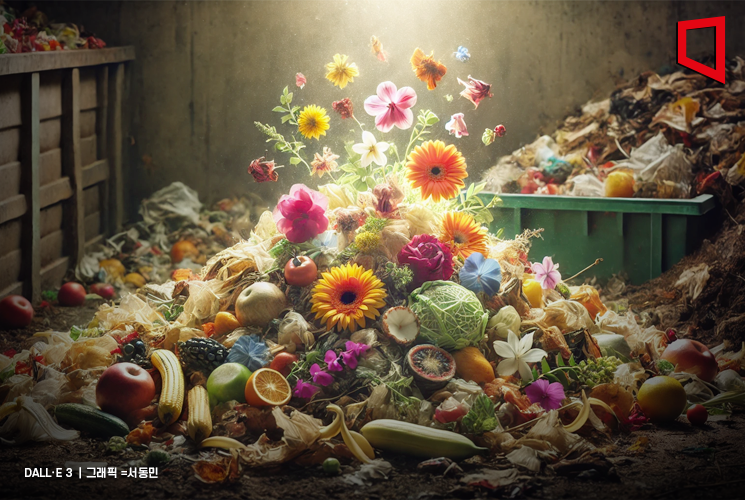
In Korea, 17,805 tons of food waste are generated every day. That's enough to fill an Olympic-sized swimming pool (50m long, 25m wide, 2m deep, 2,500m³) seven times over. Annually, this totals 6,498,825 tons. Based on Korea's population of 51.63 million, this means each person generates 126kg of food waste per year?the equivalent weight of 500 apples (250g each).
Korea has earned an international reputation as an 'advanced country in food waste separation and disposal,' but policies to reduce food loss and waste remain insufficient. According to an analysis by Asia Economy of the Ministry of Environment's 'National Waste Generation and Disposal Status,' domestic food waste increased by 10.3%, from 16,145 tons per day in 2012 to 17,805 tons per day in 2022. This includes separately collected waste from households, restaurants, large supermarkets, and cafeterias, as well as plant and animal residues from food manufacturing and mixed waste disposed of in standard-volume bags. Food waste peaked at 21,065 tons in 2019 and has decreased for three consecutive years, but despite various government reduction efforts, it has actually increased compared to ten years ago.
Food waste is not just a problem in Korea but a global issue. According to the United Nations Food and Agriculture Organization (FAO), 1.3 billion tons of agricultural products are discarded worldwide each year, accounting for 31% of total production.
Food waste, a boomerang for global warming... Food upcycling emerges as a solution

Food waste does not just mean the loss of time, effort, money, and energy used in production. The disposal process generates not only wastewater but also greenhouse gases, which return as a boomerang, accounting for 8% of total emissions. This figure does not even include the greenhouse gases generated during the production and transportation of the discarded food. This is why food upcycling, which minimizes food waste, is emerging as the best solution to climate change in the US, Europe, Japan, and elsewhere.
Food upcycling refers to creating new products from byproducts generated during food production or ingredients that have lost their commercial value due to appearance, as Agrain does. The simple act of consuming 'ugly' produce also falls under food upcycling. Through food upcycling, food that would have been incinerated or buried in landfills is given new life.
According to market research firm Allied Market Research, the food upcycling market is expected to grow from $5.37 billion (about 7.13 trillion won) in 2021 to $9.7 billion (about 12.88 trillion won) in 2031. Park Joomsoon, a researcher at the Korea Environment Institute, pointed out, "Until now, domestic policies related to food waste have focused on separation and stable disposal after generation, but going forward, a shift to reduction before generation is needed."
※ This feature was supported by the Press Promotion Fund, created through government advertising fees.
-
Reporter Im Onyu ioy@asiae.co.kr
-

Reporter gooeunmo@asiae.co.kr
-

Edit Kim Dongpyo letmein@asiae.co.kr
© The Asia Business Daily(www.asiae.co.kr). All rights reserved.
!["Please Help Us": How Much Do Those Bowing 90 Degrees These Days Actually Earn? [Data Pick]](https://cwcontent.asiae.co.kr/asiaresize/323/2026052010120870131_1779239528.png)