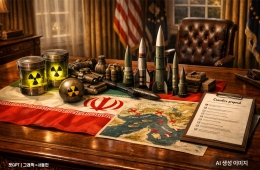
Trump's "Scorched Earth" Warning to Iran... Oil Prices Break Through Psychological Barrier (Comprehensive)
Trump's Approval Rating Plummets to 33%
"Iran Preparing to Blockade the Red Sea Through Houthis"

U.S. President Donald Trump has announced a plan to devastate Iran, prompting Iran to respond by threatening to blockade the Red Sea through Houthi rebels. Iran has also stated its intention to collect tolls in the Strait of Hormuz, causing international oil prices to soar to their highest levels since 2022. For President Trump, both successful negotiations with Iran or a large-scale bombing and ground campaign that devastates the country could provide him an opportunity to gain the upper hand. President Trump has set a negotiation deadline for the 6th of next month, and his approval rating is currently at its lowest since the start of his second term.
Trump Pressures Iran with "Devastation" Threat... Oil Prices Approach Psychological Barrier

According to CNBC, as of 7:38 p.m. Eastern Time on the 30th, May futures for West Texas Intermediate (WTI) crude oil were trading at $106.27 per barrel, up 3.30% from the previous trading day. The previous closing price was $102.88 per barrel, meaning the price has exceeded $100 for the first time in three years and eight months since July 2022. The $100-per-barrel level has long been considered a psychological barrier. Brent crude oil for May delivery also closed up 0.19% at $112.78 per barrel.
President Trump's remarks about devastating Iran have driven oil prices higher. On his own social network, Truth Social, he warned, "If an agreement is not reached soon, we can bomb and completely devastate all of Iran's power plants, oil wells, Kharg Island—which is a key oil export terminal—and desalination facilities." He is threatening to cut off electricity and water supplies essential for survival, and to destroy oil production and export facilities that are the regime's financial lifeline. This essentially signals an intent to destroy everything.
This move is seen as a political gambit in response to growing anti-war sentiment in the U.S. and his sharply declining approval rating. Whether negotiations with Iran succeed or Iran is paralyzed through a devastation campaign, either outcome could allow the U.S. to declare victory and end the conflict. In this scenario, President Trump could conclude the war by the deadline he has set, enabling him to fully prepare for the midterm elections scheduled for November.
Currently, President Trump's approval rating is at its lowest since the start of his second term. According to a poll conducted by YouGov for the University of Massachusetts Amherst from the 20th to the 25th, surveying 1,000 U.S. adults with a margin of error of ±3.5 percentage points, President Trump's approval rating has dropped to 33%.
Iran Pushes for Strait of Hormuz Toll... Pressures Houthis to Blockade the Red Sea

President Trump's pressure does not seem to be having the desired effect. Iran has maintained a hardline stance. According to Tasnim News, a semi-official Iranian media outlet, the Iranian parliament approved a bill on this day that had been submitted earlier this month to impose tolls on ships passing through the Strait of Hormuz. However, the exact toll amount was not disclosed.
Tasnim News reported that, instead of charging tolls in Chinese yuan, "it is expected that the toll will be imposed in Iranian rial." Despite international criticism, Iran has already charged some ships passing through the Strait of Hormuz. According to the New York Times, since the outbreak of hostilities on the 28th of last month, Iran has allowed ships from friendly countries such as China and India to pass through the Strait of Hormuz. It is also reported that Iran collected tolls as high as $2 million (about 3 billion won) in Chinese yuan from some vessels.
In addition, Iran is reportedly preparing to use the Yemen-based Houthi armed group, which is aligned with Iran, to blockade the Red Sea shipping route. Quoting European officials familiar with the matter, Bloomberg News reported, "After Houthi leaders, backed by Iran, launched ballistic missiles toward Israel last weekend, they are now considering even more aggressive military actions," adding, "They are pressuring the Houthis to prepare for the resumption of attacks on ships in the Red Sea."
If ships are attacked in the southern Red Sea and near the Bab-el-Mandeb Strait, the global energy market could face even greater turmoil. Since the outbreak of conflict late last month, Iran's effective closure of the Strait of Hormuz has made this route even more important. Saudi Arabia has been exporting crude oil through the Yanbu port on the Red Sea coast since the war began.
Hot Picks Today
 "If Your Age and Years of Service Total Over 70...
- "Did Trump Anticipate This?" Export Orders Surge Amid War... Record-High Export ...
- "Be Quiet, Pig": Jimmy Kimmel Live! Wins 'Broadcasting Pulitzer' After Sharp Sat...
- "Using Company Funds Like a Personal Piggy Bank"... Musk Turned to SpaceX Whenev...
- "Surviving 17 Days on Rainwater Without Food"... Ukraine Shocked by Photos of Ma...
Jane Foley, Head of FX Strategy at Rabobank, a Netherlands-based investment bank, told the BBC, "President Trump continues to make statements aimed at stabilizing the energy market, but Iran is consistently denying these overtures, and both sides are sending sharply divergent signals to the market," adding, "Many investors see the likelihood of an early end to the war as very low, and the market remains unstable."
© The Asia Business Daily(www.asiae.co.kr). All rights reserved.