Gulf States Urge Trump: "U.S. Must Continue Military Operations, Opportunity to Topple Iran" [U.S.-Iran War]
Saudi Arabia, UAE, Kuwait, and Bahrain Support Military Operations
Still No Request for Direct Involvement... Battlefield Complexity and Strategic Uncertainty Cause Hesitation
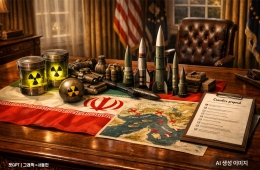
As the war between the United States, Israel, and Iran stands at a tipping point of further escalation, the Associated Press reported on March 30 (local time), citing U.S., Gulf, and Israeli officials, that America’s Gulf allies are urging U.S. President Donald Trump to continue military operations against Iran. Some countries are calling on the White House for a strong response, insisting that this is a golden opportunity to topple Iran’s theocratic regime.
According to sources who requested anonymity, officials from Saudi Arabia, the United Arab Emirates (UAE), Kuwait, and Bahrain conveyed in closed-door meetings that they do not want military operations to end until there is a significant change in Iran’s leadership or policies.

President Trump, although struggling domestically as public sentiment worsens due to the Iran war ahead of the midterm elections, appears confident that he has secured the support of the Gulf allies. Speaking to reporters aboard Air Force One the previous day, he emphasized that Gulf countries such as Saudi Arabia, Qatar, the UAE, Kuwait, and Bahrain have joined the counterattack. Until now, these countries had allowed the stationing of U.S. troops and bases on their soil but had not directly participated in military offensives against Iran.
However, there are some differences of opinion even among the Gulf states. According to a Gulf region diplomat, the UAE has taken the most hardline stance, strongly urging President Trump to launch a ground invasion. The UAE is reportedly outraged by concerns that the Iran war could tarnish its image as a safe and prosperous hub for trade and tourism in the Middle East. Kuwait and Bahrain are also said to prefer a ground invasion.
Saudi Arabia is also calling for a strong response. It believes that when the war ends, Iran’s nuclear program must be neutralized and its ballistic missile capabilities destroyed. Additionally, Saudi Arabia argues that Iran must be forced to stop supporting proxy forces and lift its blockade of the Strait of Hormuz. The Associated Press explained that achieving these goals would require Iran’s theocratic regime to fundamentally revise its policies or for the regime itself to be replaced.
According to sources, Saudi Arabia’s de facto leader, Crown Prince Mohammed bin Salman, told White House officials that weakening Iran’s military power and theocratic regime aligns with the long-term interests of the Gulf states and other countries. The New York Times also recently reported that Crown Prince Mohammed bin Salman had been urging President Trump to continue the war with Iran. A Saudi government official told the Associated Press that while the country ultimately wants a political solution to the crisis, the immediate top priority is the protection of its citizens and key energy infrastructure.
In contrast, Oman and Qatar, which have long acted as mediators between Iran and the West, are reportedly in favor of a diplomatic solution.
U.S. Secretary of State Marco Rubio said in an interview with ABC News that the United States and its Gulf Arab allies are in agreement on the Iran issue. He criticized Iran as "religious fanatics who must not be allowed to possess nuclear weapons" and said that neighboring countries are supporting the United States.
President Trump has not yet officially requested Gulf states to join the war. The Associated Press cited concerns that adding air force power beyond Israel’s could make the battlefield excessively complex as the reason. In fact, during the early stages of the war, three U.S. fighter jets were shot down by friendly fire from Kuwait.
Hot Picks Today
 "If Your Age and Years of Service Total Over 70...
- "Did Trump Anticipate This?" Export Orders Surge Amid War... Record-High Export ...
- "Be Quiet, Pig": Jimmy Kimmel Live! Wins 'Broadcasting Pulitzer' After Sharp Sat...
- "Using Company Funds Like a Personal Piggy Bank"... Musk Turned to SpaceX Whenev...
- "Surviving 17 Days on Rainwater Without Food"... Ukraine Shocked by Photos of Ma...
Yasmin Farouk, head of the Gulf and Arabian Peninsula Project at the International Crisis Group (ICG), analyzed that only the UAE and Bahrain among the Gulf states have official diplomatic ties with Israel, which complicates the situation. She said, "Without clear objectives and lacking confidence that the United States will see the operation through to the end, some countries are hesitating. If a major incident occurs that causes large-scale casualties in one of these countries, their participation as belligerents could be justified."
© The Asia Business Daily(www.asiae.co.kr). All rights reserved.