Senior-Friendly Industry Worth 85 Trillion Won, But Silver Housing Market Only 240 Billion... "Sales Must Be Permitted" [Open-Door Silver Housing]
Growing Senior-Friendly Industries, But Senior Housing Market Still in Its Infancy
High Expectations for Market Demand... Industry Calls for Profitability Safeguards First
As the government considers revitalizing senior housing for middle-class elderly individuals, industry insiders generally agree with the need but emphasize that mechanisms ensuring profitability must come first. Companies that have already entered the senior residence business are currently enduring short-term losses, anticipating long-term growth.
A construction company official said on April 22, "Although the elderly population in Korea has surpassed 10 million, the proportion of senior housing facilities is less than 1%, suggesting significant potential for long-term growth. That said, it is not easy to secure initial investment capital, prime urban locations, or operational expertise, so we are approaching the business with caution, carefully evaluating its feasibility."
Given the size of Korea's age-friendly industry, the domestic silver housing market is still in its infancy. According to the Korea Health Industry Development Institute, the age-friendly industry was valued at about 85 trillion won in 2023, but the related housing market accounted for just 0.3%, or only 240 billion won. Companies building and operating senior towns have also posted poor results. For instance, a company that developed a senior town in the Seoul metropolitan area recorded a loss exceeding 3 billion won last year.
Lee Kwanik, Head of the Digital Health Division at the Korea Health Industry Development Institute and author of a related report, said, "Since companies tend to focus on real estate value and profitability, market growth is inevitably limited. There is a need to increase the supply of senior housing integrated with care services."
Despite this, the construction industry remains interested due to the sector's growth potential. With the aging population, there is a strong likelihood of continued expansion. The industry believes that discussions with the government are necessary to ensure profitability.

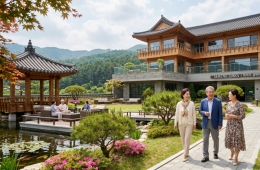
Residents are playing Baduk at a senior welfare housing complex in Yongin, Gyeonggi Province. Photo by Kang Jin-hyung
View original imageThe industry’s greatest wish is for the government to allow the sale of relevant housing units. Currently, senior welfare housing developed and operated by the private sector is permitted only as rental units. This is because, after unqualified individuals moved in through loopholes and various disputes arose in the past with for-sale senior towns, all sales were fully banned in 2015. Since then, operators have had to recover their long-term investments solely through rental deposits and monthly usage fees. Even the most expensive senior towns do not see profits for the first several years. For public-supported private rental models, the sale of units is not allowed until 20 years have passed.
The industry views the current structure as making it difficult to expand private-sector supply. A real estate development official explained, "Given the return rates expected by the private sector, it is difficult to repay project financing (PF) loans and secure initial business costs with a 100% rental model. At least the construction costs, which account for more than 80% of total project expenses, must be recovered through initial sales in order to maintain service quality during the operation phase."
The government, however, remains cautious about introducing a for-sale model. In the case of for-sale housing units where individual ownership is recognized, residents could refuse expensive senior-specific services by claiming, "This is my house, why should I be forced to pay for such specialized services?" There is no clear legal means to compel them. It is also difficult to prevent owners from selling homes to younger people through loopholes or from terminating specialized services for the elderly via the residents’ committee. This could undermine the very identity of housing for seniors. A Ministry of Land, Infrastructure and Transport official stated, "For now, we are not considering the introduction of a for-sale model." However, the official added, "If companies say it is impossible to do business without sales in a situation where supply is urgently needed, we may examine the feasibility under various conditions."
There are also calls for the government to provide locations that would support profitability. A construction industry official said, "It is necessary to expand financing and loan guarantees for Silver Stay construction projects promoted by the government. The number of private operator invitations should also be increased, especially for business sites in Seoul and the metropolitan area, which are most preferred by the elderly population."
The industry is also concerned about potential price disputes during the conversion to sales after the mandatory rental period ends. A mid-sized construction company official noted, "Even for general public-supported private rentals, there is often friction between operators and residents regarding prices at the time of conversion to sales. The potential for future disputes is a major uncertainty for companies."
There are also discussions about ways to boost demand for residency. A real estate development official said, "It would be worth considering a model in which those eligible to move in could lease out their existing homes and receive reductions in comprehensive real estate taxes and other fees. This could provide an incentive for elderly individuals who are hesitant to leave their own homes to move from old houses in Seoul to senior housing in the outskirts of the capital region." There are also ideas about linking this to corporate welfare. The same official said, "A model in which large companies sign a memorandum of understanding (MOU) with the government to provide long-term employees with housing benefits as part of corporate welfare could also be an alternative."
Hot Picks Today
![[Exclusive] "What? I Used It for Fried Eggs and Kimchi Pancakes, but It Wasn't Edible?"... Raw Pork Lard Supplied to Department Stores, Causing Stir](https://cwcontent.asiae.co.kr/asiaresize/93/2026042216151436513_1776842114.png) [Exclusive] "What? I Used It for Fried Eggs and...
[Exclusive] "What? I Used It for Fried Eggs and...
- After Cheongung's Success, Now It's 'Haegung'... First Export Achievement Worth ...
- May BSI at 87.5... Business Sentiment Chilled for Second Month Amid Middle East ...
- Thought the Pandemic Was Over? Bat Virus Warns of Human Cell Infiltration Withou...
- [Report] "Professionals in Their 30s and 40s With at Least 2 Billion Won in Cash...
The government also believes that as it attracts greater private-sector participation, it is necessary to design systems that will ensure the long-term quality of services for the elderly. A Ministry of Land, Infrastructure and Transport official said, "Beyond simply supplying housing, the key is to secure management bodies that can maintain high-quality services over the long term. We will gather opinions from operators with professional service know-how from various angles to derive a sustainable business model."
© The Asia Business Daily(www.asiae.co.kr). All rights reserved.