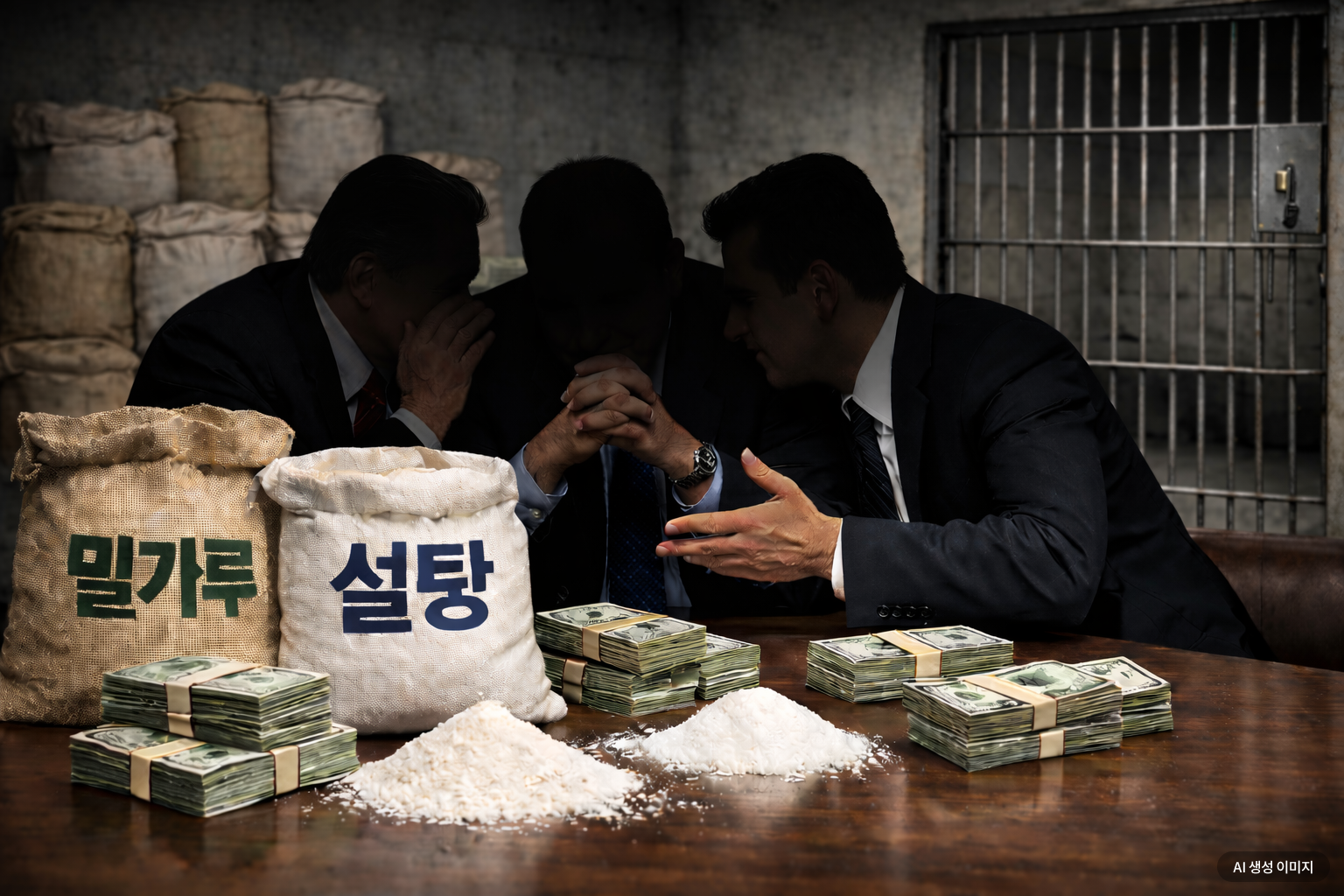


In the United States, where competition law is most advanced, the purpose of antitrust law is realized through active punishment of individuals.
Editor's NoteThe lighter the color, the higher the grade: “white powder.” Wheat flour, known as “Jin Garu” during the Joseon Dynasty and considered a rare delicacy, began to be supplied in large quantities to the Korean Peninsula as an aid commodity after the Korean War. It filled the empty stomachs of a war-torn population. Now a staple ingredient in products such as noodles, ramen, bread, and snacks, flour is an essential raw material in the food industry. When flour prices rise, not only does the cost of flour-based foods increase, but so does overall grocery and dining-out inflation, adding to the cost-of-living burden for ordinary people. Based on the prosecution’s indictment in the flour cartel case, The Asia Business Daily reconstructs the design of a “flour price-fixing” scheme worth 6 trillion KRW, and analyzes how the cartel has made life more difficult for everyday people over the past six years.
"Collusion that abuses market dominance is a cancer that blocks fair competition, undermines market trust, and hinders national economic development."
(Senior Presidential Aides Meeting, February 19)
"It is said that manipulating stock prices will ruin your life, but the same applies to collusion and abuse of monopoly."
(Cabinet Meeting, March 10)
Expert Recommendations to Eradicate Ongoing Food Price Collusion
Still Profitable Even When Caught? Cartels Continue Amid Slap-on-the-Wrist Penalties
President Lee Jae-myung has issued stern criticism and called for economic sanctions in connection with the sugar and flour price-fixing cases, which amount to more than 1 trillion KRW. In response, the government has decided to sharply increase fines for companies engaged in collusion. There are also discussions about raising reward payments for internal whistleblowers to deter collusion. Experts unanimously agree that, in addition to strengthening economic sanctions, criminal penalties for individuals involved in collusion must be increased, as repeated slap-on-the-wrist punishments have made collusion persist to the point where it is considered “profitable even when caught.”
According to the prosecution’s indictment in the flour price-fixing case released on March 13, Song, the CEO of Daehan Flour Mills who was indicted in February, attended collusion meetings with competitors and agreed on flour prices and supply volumes while serving as sales manager at Daehan Flour Mills during the 2006 collusion among eight flour milling companies. The prosecution noted, “He was actively involved in previous flour price-fixing cases.”
Lenient Punishment for Colluders... “Need to Increase the Level of Criminal Penalties”
This repeated collusion is occurring because current fines for price-fixing are only imposed on corporations, while the actual individuals (employees) who discuss and execute the collusion face only minor penalties.
Article 124 of the current Monopoly Regulation and Fair Trade Act stipulates that cartel companies (businesses) and those who direct collusion may be punished with “imprisonment of up to three years or a fine of up to 200 million KRW.” This is significantly less severe compared to major countries overseas.
Korea: Up to Three Years in Prison or 200 Million KRW Fine... Yet Even This Is Rarely Enforced

The number of individuals prosecuted for antitrust violations far exceeds that of corporations, and more than half of those brought to trial are sentenced to imprisonment.
In the United Kingdom, cartel participants can be sentenced to up to 5 years in prison or unlimited fines, while in Canada, the sentence can be up to 14 years in prison or unlimited fines.
Australia can impose sentences of up to 10 years imprisonment and fines of up to 660,000 Australian dollars (approximately 660 million KRW).
Denmark, Romania, and Japan also impose strict penalties on cartel participants, with maximum prison sentences of 5 to 6 years.
U.S. Enforces Active Punishment, Over Half Receive Prison Sentences... Canada Imposes Up to 14 Years or Unlimited Fines
In the United States, where competition law is most advanced, the purpose of antitrust law is realized through active punishment of individuals. The number of individuals prosecuted for antitrust violations far exceeds that of corporations, and more than half of those brought to trial are sentenced to imprisonment.
In the United Kingdom, cartel participants can be sentenced to up to five years in prison or unlimited fines, while in Canada, the sentence can be up to 14 years in prison or unlimited fines. Australia can impose sentences of up to 10 years imprisonment and fines of up to 660,000 Australian dollars (approximately 660 million KRW). Denmark, Romania, and Japan also impose strict penalties on cartel participants, with maximum prison sentences of five to six years.
Attorney Koo Sang-yeop, who previously served as director of the Legal Affairs Bureau at the Ministry of Justice and as head of the Fair Trade Investigation Division at the Seoul Central District Prosecutors’ Office, stated, “Currently, punishment for colluders is up to 3 years imprisonment or a 200 million KRW fine, but this is rarely enforced. If monetary penalties such as fines and surcharges are ineffective, strong criminal penalties for the main offenders must be considered.” Former Korea Fair Trade Mediation Agency President Kim Hyung-bae also pointed out, “As long as companies can profit, they will continue to collude. Ultimately, the level and frequency of criminal penalties for colluders must be increased. There needs to be an awareness that individuals could go to prison for the company.”
The “exclusive right to file a complaint,” which stipulates that only the Fair Trade Commission can file a complaint regarding collusion, is also problematic. Only when the Fair Trade Commission files a complaint can the prosecution indict colluders. As a supplementary measure, the Prosecutor General has been given the right to request a complaint. However, when the prosecution is abolished in October, this authority is likely to be transferred to another investigative agency, such as the Serious Crimes Investigation Agency. There are concerns that the unique investigative capabilities of the prosecution regarding cartel cases may be lost in the process.
"Collusion Will Ruin Your Life"... Raise Penalties, Increase Detection Rates
Most experts agree that it is realistically impossible to eradicate collusion completely. From an economic perspective, as the profits from collusion increase, collusion continues even under the current system, where the expected profits outweigh the anticipated penalties if discovered. In other words, a structure must be created in which collusion results in significant disadvantages.
Attorney Koo explained, “In a monopolistic market, it is rational to collude. To prevent collusion, there must be corresponding risk factors, and individuals must be instilled with a strong sense of the dangers of collusion. For example, if the social cost of a certain cartel is 10 billion KRW but the detection rate is only 20%, then the penalty should be raised to 50 billion KRW instead of 10 billion KRW to increase the detection rate and the risks and disadvantages associated with collusion.”
Lee Hwang, professor at Korea University School of Law, said, “Given Korea’s historical agricultural culture, it is difficult to expect total eradication of collusion. The reason collusion is more severe than in other countries is because deterrence is lacking. If the detection rate were 100%, even a modest fine would act as a deterrent. Conversely, if detection is unlikely, collusion will continue regardless of the penalty level. To increase detection rates, it is important to improve the enforcement capabilities of bodies like the Fair Trade Commission.”

"Actively Utilize Leniency... Reporting Window Should Be Unified"
Many experts argue that leniency (the voluntary reporting and immunity system), which has recently been criticized as a loophole for avoiding fines, should still be maintained. Leniency is essential for detecting cartels. In particular, leniency instills companies with the fear that “cartels can be exposed at any time,” acting as a strong deterrent and a means to increase detection rates.
Former President Kim said, “Leniency has a strong deterrent effect because companies believe their collusion can be detected at any time. While there may be moral criticism that leniency allows offenders to evade punishment, without the system, collusion would go undetected and become even easier.” He added, “Most collusion detected by the Fair Trade Commission is through voluntary reporting, and globally, most cartels are uncovered this way. While the Fair Trade Commission has a system for detecting bid-rigging through various analyses, ordinary price-fixing is impossible to identify unless someone from within the company comes forward.”
The problem is that the current leniency system has two separate reporting channels: the Fair Trade Commission and the prosecution. As a result, even if a company voluntarily reports, it may not receive immunity from fines and other benefits. Therefore, there is a need to unify the reporting window to either the Fair Trade Commission or the prosecution, so companies can utilize leniency more effectively. Attorney Koo stated, “The leniency window should be unified, and real-time information sharing between the Fair Trade Commission and the prosecution should be implemented. Currently, cooperation between the two agencies is insufficient. Collusion should not be a turf war. If cooperation is achieved and leniency is shared in real-time, the detection rate of collusion will dramatically increase, and applications for leniency can be recognized as having been submitted to both agencies simultaneously.”
IndexPlanners
- Go to Jail for the Company? Endless Collusion Will Only End with Severe Punishment
-

Reporter Heo Kyungjun kjune@asiae.co.kr
-
Edit Kim Yumi ymkim91@asiae.co.kr
© The Asia Business Daily(www.asiae.co.kr). All rights reserved.



![[Report] "A Culinary Destination with a View of Gyeongbokgung"... Kim Dong-sun's High-End Dining Takes Over Gwanghwamun](https://cwcontent.asiae.co.kr/asiaresize/304/2026042114562634571_1776750985.jpg)

![[Gallery Stroll] Red Robe, Black Lines... Danjong Returns with the Face of Wounds](https://cwcontent.asiae.co.kr/asiaresize/304/2026042014183532691_1776662315.jpg)