Won-Dollar Exchange Rate Surges... Second Vice Minister of Finance and Economy: "Recent Volatility Excessive, Appropriate Measures if Needed"
Emergency Meeting Held as Exchange Rate Surges Past 1,500 Won
Participants Say "Foreign Investor Outflows Are Temporary"
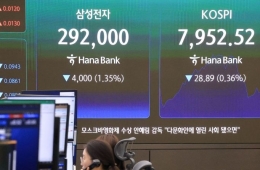
Amid continued volatility in the foreign exchange market, with the won-dollar exchange rate surging into the 1,500-won range, the foreign exchange authorities stated that recent fluctuations are excessive compared to South Korea's economic fundamentals and that they will take appropriate measures if necessary.

Heo Jang, Vice Minister of Strategy and Finance, is delivering opening remarks at the foreign exchange market meeting held on the 20th at the Government Complex Seoul in Jongno-gu, Seoul. Ministry of Strategy and Finance
View original imageHo Jang, the Second Vice Minister of Finance and Economy, made this announcement during a foreign exchange market meeting held on the afternoon of May 20 at the Government Seoul Office. The meeting was convened to gather the opinions of market experts on the recent foreign exchange market situation, response strategies, and development plans for the foreign exchange and capital markets. It was attended by representatives and key managers from major foreign banks and securities firms, including Goldman Sachs, BNY Mellon, Deutsche Bank, and Morgan Stanley.
Deputy Minister Ho stated, "Recently, our foreign exchange market has been affected by external uncertainties such as delays in Middle East war negotiations, concerns over global inflation, and rising government bond yields in major countries, as well as foreign investors selling Korean stocks." He added, "However, the volatility is excessive compared to the fundamentals of the Korean economy."
He further emphasized, "We are closely monitoring the market situation 24 hours a day to prevent the expansion of market volatility from spreading to increased speculative trading, and we will take appropriate measures if necessary."
The participants noted that, as South Korea is recording its largest-ever current account surplus, existing policies—such as the official inclusion in the World Government Bond Index (WGBI), the National Pension Service's new framework, and the Domestic Stock Repurchase Account (RIA)—are contributing to the stability of foreign exchange supply and demand. They also projected that if external factors such as the Middle East war are resolved, the foreign exchange market will stabilize.
In addition, while the recent increase in Korean stock sales by foreign investors was acknowledged, participants agreed that this is primarily due to mechanical rebalancing to adjust the temporarily increased scale and proportion of Korean stock holdings following the rapid growth of Korea's capital market, as well as some profit-taking.
Hot Picks Today
 If They Fail Next Year, Bonus Drops to 97 Million Won... A Closer Look at Samsung Electronics DS Division’s 600M vs 460M vs 160M Performance Bonuses
- RIA Accounts Surpass 240,000 Subscriptions... Sold Nvidia, Bought Samsung Electronics
- Room Prices Soar from 60,000 to 760,000 Won and Sudden Cancellations: "We Won't Even Buy Water in Busan" — BTS Fans Outraged
- "Manhole Cover Blasts Open in 12 Seconds... The Reason Behind the 'Gangnam Flood Disaster' [Report]"
- "Who Is Visiting Japan These Days?" The Once-Crowded Tourist Spots Empty Out... What's Happening?
Meanwhile, attendees commented on the ongoing efforts to revitalize South Korea's foreign exchange and capital markets, stating, "The Korean government has significantly improved foreign investors' access to Korea's foreign exchange and capital markets in a short period of time, and has achieved tangible results, such as increased trading volume and participation in the foreign exchange market, as well as expanded use of integrated accounts for foreign investors."
© The Asia Business Daily(www.asiae.co.kr). All rights reserved.
!['WHO Declares International Public Health Emergency' Why the Untreatable 'Variant Ebola' Is More Deadly Than COVID-19 [Reading Science]](https://cwcontent.asiae.co.kr/asiaresize/307/2026052110164072055_1779326201.png)
!["Please Help Us": How Much Do Those Bowing 90 Degrees These Days Actually Earn? [Data Pick]](https://cwcontent.asiae.co.kr/asiaresize/307/2026052010120870131_1779239528.png)