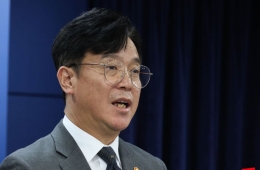
'General Strike D-1': Samsung Electronics Labor and Management Hold Final Talks... Third Post-Adjustment Meeting at Central Labor Relations Commission
Samsung Electronics labor and management are entering their final negotiations just one day before the scheduled general strike. With both sides unable to narrow their differences over institutionalizing the criteria for performance-based bonuses, attention is focused on whether they can reach a last-minute agreement.
On May 20, starting at 10 a.m., labor and management at Samsung Electronics will hold a closed-door third post-adjustment meeting at the Central Labor Relations Commission in the Government Complex Sejong.

Yeomyeonggu, Head of the People Team in the DS (Semiconductor Division) and Chief Negotiator for Samsung Electronics (left), and Choi Seungho, Chairman of the Samsung Electronics Branch of the Samsung Group Supra-Enterprise Labor Union (right), are leaving the negotiation venue after the first day of the second post-adjustment meeting held on the 18th at the Central Labor Relations Commission in the Government Complex Sejong. Photo by Yonhap News
View original imagePreviously, since May 18, labor and management continued marathon negotiations for over 14 hours during the second post-adjustment meeting but were unable to bridge their differences and adjourned around midnight on May 20. The Central Labor Relations Commission stated that the two sides ultimately failed to reach an agreement on a key issue and that management will finalize its position and participate in the third meeting today. In effect, it is interpreted that a decisive move by company management will be the critical factor determining the outcome of these negotiations.
If management unexpectedly accepts the mediation proposal from the Central Labor Relations Commission, labor and management will reach a tentative agreement, after which the union will proceed with a final approval process through a vote by its members. However, if management rejects the mediation proposal or, even if an agreement is reached, the proposal is voted down by union members, the union will proceed with a full-scale general strike starting on May 21 as previously announced.
The union's position is that 15% of the semiconductor division's operating profit should be paid as performance-based bonuses, with 70% of that amount distributed across the entire semiconductor division and the remaining 30% distributed differentially by business unit according to performance. Management, citing the principle of a performance-based HR system, insists that the differential amount paid by business unit should be increased.
If labor-management negotiations break down and a general strike materializes, there are concerns that disruptions to semiconductor production lines could have a significant impact on the national economy as a whole. Consequently, the government is closely monitoring the situation and is reportedly considering the extraordinary step of invoking 'emergency mediation powers' to prevent the strike from spreading.
Hot Picks Today
 "Stocks Are Not Taxed, but Annual Crypto Gains Over 2.5 Million Won to Be Taxed Next Year... Investors Push Back"
- "Don't Throw Away Coffee Grounds" Transformed into 'High-Grade Fuel' in Just 90 Seconds [Reading Science]
- [Lee Jaemyung Administration 1 Year] 300,000 Benefit from Rural Basic Income, K-Food Hits 'All-Time High' Last Year
- "Groups of 5 or More Now Restricted"... Unrelenting Running Craze Leaves Citizens and Police Exhausted
- "Even With a 90 Million Won Salary and Bonuses, It Doesn’t Feel Like Much"... A Latecomer Rookie Who Beat 70 to 1 Odds [Scientists Are Disappearing] ③
Emergency mediation powers are an exceptional measure that the government can use to suspend labor disputes in cases where there is concern about national economic damage. Once invoked, labor disputes are immediately halted, and mediation and arbitration procedures by the Central Labor Relations Commission are initiated.
© The Asia Business Daily(www.asiae.co.kr). All rights reserved.