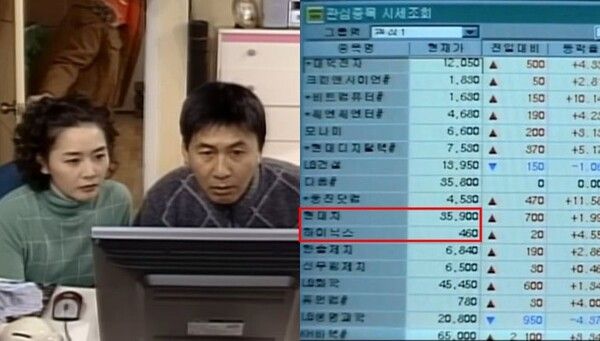

"If only I had bought 1 million won worth of Hynix stocks back then..."
A scene from a sitcom that aired in the early 2000s is once again drawing attention on social media and online communities. This renewed interest comes after it was revealed that, in the stock ticker shown on screen, Hynix's stock price was listed at 460 won at the time.
On May 17, a screenshot from an episode of the SBS sitcom "Live Straight" was posted on social media threads and other platforms. The scene features the "frugal couple," Park Youngkyu and Lee Eungkyung, checking stock prices on their computer.
What caught the attention of online users were the stock names and prices shown on the monitor. In the scene, Hynix is listed at 460 won. Hyundai Motor is shown at 35,900 won, and LG Chem at 45,450 won. This episode is known to have aired in December 2002. At that time, Hynix was in a far different situation compared to today. Having originated from Hyundai Electronics and acquired LG Semicon, Hynix struggled with mounting debt and a depressed semiconductor market, leading the company into a workout program. This was before "SK" was added to its name.
The scene also offers a glimpse of the market atmosphere at the time. Hynix's trading volume is shown to have exceeded 400 million shares. Despite concerns over liquidity issues and restructuring, day traders rushed in, causing trading volumes to skyrocket. However, more than 20 years later, the situation has changed completely. After being acquired by SK Group in 2011, Hynix was reborn as SK hynix. Since then, it has grown into a global memory semiconductor company focused on DRAM and NAND flash, and more recently, it has been recognized as a core company in the artificial intelligence (AI) semiconductor supply chain, leveraging its competitiveness in high bandwidth memory (HBM).

The stock price has also skyrocketed. On May 15, SK hynix's intraday price reached 1,995,000 won, and it closed at 1,819,000 won. A simple comparison with the 460 won shown in the 2002 sitcom gives an increase of about 3,954 times. As a result, some online users commented, "If I had bought 1 million won worth of shares back then, it would be worth 4 billion won now." However, this is an exaggerated calculation. If you had bought 1 million won worth at 460 won per share, you could have purchased about 2,173 shares, and at the recent closing price of 1,819,000 won, this would amount to approximately 3.95 billion won. If you factor in capital changes since 2003, actual investment returns may differ from a simple price comparison.
Nevertheless, online reactions remain enthusiastic. Comments include: "I really thought it would go bankrupt back then," "I wish I could go back in time and tell myself to buy Hynix," "When it was 460 won I was too scared to buy, but now at 1.8 million won it looks attractive," "In the end, those who endure win in the stock market," and "You only see the lessons of history in hindsight." Other users noted, "Even if you bought back then, you probably couldn't have held on," "How many people would have held onto a stock for 20 years when they were worried about delisting?" "It seems easy in hindsight, but at the time it must have been terrifying," and "This scene shows survivor bias rather than investment advice."

Meanwhile, on May 17, Nomura Securities released a recent report raising its target price for Samsung Electronics from 340,000 won to 590,000 won, and for SK hynix from 2.34 million won to 4 million won. This is the first time that a target price in the 4 million won range has been suggested for SK hynix. Nomura Securities analyzed that both companies should be reevaluated not as traditional cyclical stocks, but as "structural growth stocks." In the past, memory prices moved according to PC and smartphone demand, but now, the report explains, the proliferation of AI has ushered in a period of structural growth for memory demand itself. Nomura Securities wrote in the report, "The 12-month forward price-to-earnings ratios (PER) of Samsung Electronics and SK hynix remain at about 6 times," adding, "They should be valued similarly to TSMC, which has a PER of around 20 times."
-
Reporter Bang Jeil zeilism@asiae.co.kr
-
Edit Yang Hyejin adoretj@asiae.co.kr
© The Asia Business Daily(www.asiae.co.kr). All rights reserved.



![Inside the Power Core of the AI Era: A Visit to the Shinhanul Nuclear Power Plant [Report]](https://cwcontent.asiae.co.kr/asiaresize/304/2026051809521466725_1779065534.jpg)
![[Gallery Walk] There Are No Paths in Yoo Youngkuk's Mountains](https://cwcontent.asiae.co.kr/asiaresize/304/2026051907273667889_1779143256.jpg)