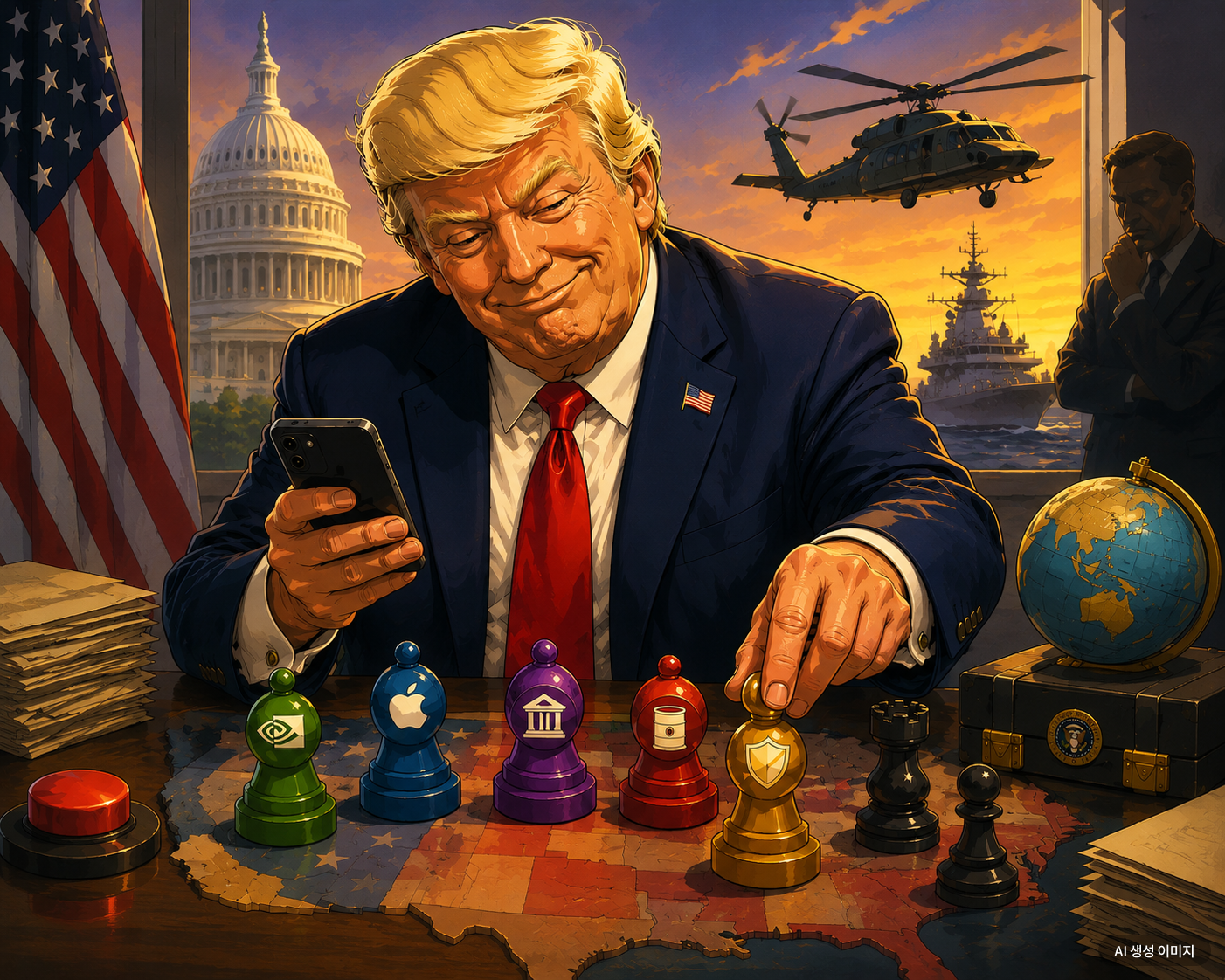
It has been revealed that U.S. President Donald Trump conducted thousands of securities trades in just the first quarter of this year, fueling growing controversy over conflicts of interest and potential market manipulation. There are suspicions that he may have used his presidential status, which can influence government policy and national security issues, to his advantage.
Microsoft · Meta
According to documents released by the U.S. Office of Government Ethics, President Trump executed at least 3,600 securities trades between January and March of this year. The total transaction volume is estimated to exceed 1 trillion won. The trades included shares of major U.S. companies such as Nvidia, Microsoft, Meta, and Amazon.

In particular, trades involving Palantir, an artificial intelligence (AI) defense contractor, have drawn significant attention. President Trump reportedly sold a large amount of Palantir stock in February, then repeatedly bought shares again in March. Subsequently, he publicly praised Palantir's military capabilities via social media.

The timing of the trades is at the heart of the issue. At the time, Palantir attracted market attention for its involvement in Iran-related military operations, and there were reports of large-scale purchases of Nvidia shares just before the announcement of approval for exports to China. Some have raised suspicions that the president may have leveraged his access to policy decisions or non-public information.

On the other hand, Trump's representatives have explained that all trades were conducted automatically under the independent management of external financial institutions. The Trump Organization asserted that neither the president, his family, nor the company were involved in individual investment decisions and that all trading was handled at the sole discretion of a third-party financial institution.
The U.S. president is required to disclose asset transactions above a certain threshold. However, there is no requirement to actually divest holdings or place them in a blind trust. As a result, controversies over presidential conflicts of interest are repeatedly raised.
-

Reporter Choi Seungwoo loonytuna@asiae.co.kr
-
Edit Hur Eunmi eungmimon@asiae.co.kr
© The Asia Business Daily(www.asiae.co.kr). All rights reserved.
![Cheaper Than Mychew, but Nowhere to Be Found... Fears of a 'Pediatric Medical Crisis' as Drug Makers Halt Production [Why&Next]](https://cwcontent.asiae.co.kr/asiaresize/323/2026051910065268365_1779152813.jpg)


![[Bitcoin Now] US SEC Considers Allowing Stock Token Issuance Without Listed Company Approval](https://cwcontent.asiae.co.kr/asiaresize/304/2026051910094568378_1779152986.jpg)

![[Local Elections D-15] ① Three Keywords That Will Decide the Outcome: ‘Judgment, Mistakes, and Consolidation’](https://cwcontent.asiae.co.kr/asiaresize/304/2026051812050267056_1779073502.jpg)
![[Gallery Walk] There Are No Paths in Yoo Youngkuk's Mountains](https://cwcontent.asiae.co.kr/asiaresize/304/2026051907273667889_1779143256.jpg)