"Limited Talent Pool"... Foreign IT Company Presidents in Korea Rotate in a Revolving Door
Foreign information and communications technology (IT) and big tech companies, due to the limited scope of their Korean operations, often appoint the same individuals to lead their businesses in Korea, resulting in a revolving door of executives within the industry.
According to the career histories of key foreign IT company presidents in Korea as of May 15, the current president of Google Korea, Yoon Goo, who took office in January this year, previously served as president of Apple Korea from April 2018 to January 2022. In his first year at Apple Korea in 2018, he led the expansion of the Korean market by opening the country's first Apple Store in Garosu-gil. However, he abruptly resigned during conflicts with the Korean government over the company's in-app payment policies.

Yoon is now focusing on advertising sales at Google Korea, overseeing the Korean market. With ongoing complaints from Korean companies about mandatory and circumvented in-app payment policies by Google and Apple, the in-app payment issue remains a key task for Yoon, alongside the network usage fee issue.
Mark Lee, the current president of Apple Korea, also has experience leading other foreign IT companies in Korea. He previously served as president of Applied Materials Korea, a U.S. semiconductor equipment company. Lee is also well-versed in Korean business and Samsung, having once overseen sales at Samsung Electronics. Last year, during the National Assembly audit, Lee faced strong criticism from lawmakers regarding excessive in-app payment fees.
OpenAI established its Korean branch last year and appointed Kim Junghoon as president to oversee the Korean market. Kim previously served as president of Google Korea.
Kiho Ham, who has led Amazon Web Services (AWS) Korea since October 2020, also has extensive experience overseeing the Korean market for U.S. firm HP. He joined HP in 1997 and served as president of HP Korea for about nine years from 2011. Yongnam Kang, who was appointed president of HP Korea this March, likewise served as president of Lenovo Korea, a competitor, for seven years.
These executives are leveraging their experience as company presidents in the global IT industry, where the concept of a "lifetime job" is less prevalent, leading to unique competition among a limited pool of leaders. This stands in contrast to Korean companies, where internal executives are typically promoted to the top post rather than hiring external talent. The prevailing view in the industry is that this situation is due to the limited talent pool—companies look for leaders who understand the unique characteristics of the Korean market and are familiar with foreign corporate cultures. In particular, most Korean branches of foreign IT firms are sales organizations, so there is a strong tendency to appoint those with experience in sales results and performance-driven cultures as overall leaders.
An industry insider explained, "Due to the strong influence of local brands such as Samsung and LG, foreign companies see Korea as a unique market," adding, "For foreign firms that must compete with local brands, this environment is one of the biggest challenges, so there is a tendency to appoint leaders who are familiar with and experienced in Korea as company presidents."
The long-standing careers of Korean presidents are a major asset when it comes to running local subsidiaries and branches, as well as facilitating communication with global headquarters. Their accumulated know-how in product and service sales and their professional networks in the industry are also significant strengths.
However, there are concerns that this type of revolving-door appointment system could make it difficult to infuse long-term innovation and creativity. While it may reduce business risk by ensuring stable management, there are also evaluations that it can make it harder to change organizational and operational practices, thereby limiting the ability to present long-term strategies or visions. Another industry source commented, "Although the title is 'president,' in reality they are little more than sales managers for the Korean market. Because they must follow headquarters' regulations and policies, they have little autonomy and cannot make independent decisions."
Hot Picks Today
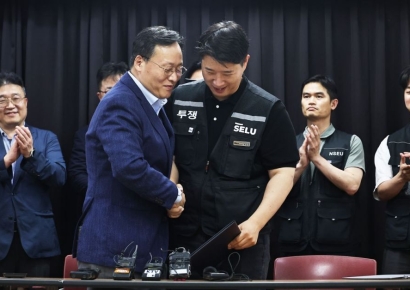 Up to 600 Million Won for Semiconductors, 160 Million Won Bonus for Loss-Making Non-Memory… Samsung Electronics Labor and Management Reach Tentative Deal on Unprecedented Performance Compensation (Comprehensive)
- "Could I Also Receive 370 Billion Won?"... No Limit on 'Stock Manipulation Whistleblower Rewards' Starting the 26th
- "From a 70 Million Won Loss to a 350 Million Won Profit with Samsung and SK hynix"... 'Stock Jackpot' Grandfather Gains Attention
- Opening a Bank Account in Korea Is Too Difficult..."It Costs 150,000 Won Just to Open a Child's Account or Check Card" [Foreigner K-Finance Status]②
- "Who Is Visiting Japan These Days?" The Once-Crowded Tourist Spots Empty Out... What's Happening?
Professor Yoon Heo of Sogang University Graduate School of International Studies explained, "These executives have built relationships with Korean competitors and partner firms and are familiar with public affairs work involving the American Chamber of Commerce in Korea and the Korean government." He added, "Because they communicate smoothly regarding the difficulties and investment conditions foreign companies face, they are able to support business activities in Korea, and this is one reason for such personnel appointments."
© The Asia Business Daily(www.asiae.co.kr). All rights reserved.
!["Please Help": How Much Do Those Bowing 90 Degrees Really Earn? [Data Pick]](https://cwcontent.asiae.co.kr/asiaresize/307/2026052010120870131_1779239528.png)