"End of Going It Alone"... Government Overhauls Nuclear Export System into 'One Team' Model
Establishment of Nuclear Export Planning Committee and Strengthening of Government-Led Negotiation System
Shift to Joint Venture Model Following UAE Dispute
"Nuclear Export Promotion Act" to Be Enacted Within the Year

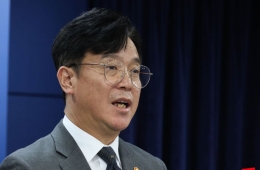
Kim Jong-kwan, Minister of Trade, Industry and Energy (center), attended the "KEPCO-KHNP Strategic Partnership Agreement on Nuclear Power Export and Arbitration Venue Change Agreement Ceremony" held at the Korea Trade Insurance Corporation in Jongno-gu, Seoul, on May 14th, 2026, and posed for a commemorative photo with Kim Dong-chul, President of Korea Electric Power Corporation (left), and Kim Hoe-chun, President of Korea Hydro & Nuclear Power. Photo by Kang Jinhyung
View original imageThe government will completely overhaul the current separated export system of Korea Electric Power Corporation (KEPCO) and Korea Hydro & Nuclear Power (KHNP), shifting to a unified "K-Nuclear One Team" system in response to intensifying global competition to win nuclear power plant contracts. Reflecting the limitations of the existing system, as seen with the settlement dispute over the Barakah Nuclear Power Plant in the United Arab Emirates (UAE), the government plans to reorganize nuclear power exports as G2G (government-to-government) national projects, rather than treating them as simple public enterprise businesses.
The Ministry of Trade, Industry and Energy (MOTIE) announced these plans in its "Nuclear Power Export System Efficiency Improvement Plan" at the "1st Nuclear Power Export Strategy Council Meeting of 2026," chaired by Minister Kim Jungkwan and held at Korea Trade Insurance Corporation in Seoul on May 14.
The core of the plan is to strengthen government-led planning and coordination functions. The ministry will move away from the current system of dividing export markets by country between KEPCO and KHNP, and will instead have the government take full charge of negotiation frameworks and strategies. As an immediate measure, a "Nuclear Power Export Planning Committee" will be established under the council. This committee will be chaired by the Director General for Nuclear Power Strategy at MOTIE, and will include government officials, representatives from public enterprises, as well as experts in contracts, accounting, law, and international relations. The committee will be responsible for developing country-specific negotiation strategies, analyzing competitors, reviewing economic feasibility, and coordinating role allocation.

A ministry official explained, "Nuclear power plant exports are not just corporate businesses but large-scale projects linked to national security and the economy," adding, "The government aims to improve project completeness by reviewing economic feasibility, risks, and negotiation strategies in advance together with external experts." The official further noted, "This is an interim measure until a lead organization is officially designated."
A joint export system between KEPCO and KHNP will also be introduced. Up to now, based on the 2016 public institution function adjustment plan, KEPCO has been responsible for 13 countries including the UAE, Saudi Arabia, and Vietnam, while KHNP has handled 25 countries including the Czech Republic, Poland, and the Philippines. Going forward, both companies will jointly pursue projects without country divisions. Project development and main contracting will be carried out jointly, while KEPCO will handle external negotiations, KHNP will be responsible for construction and operation, and KEPCO will take charge of equity investment and project financing (PF).
The ministry explained that it intends to enhance competitiveness by combining KEPCO's project development, investment, and financial capabilities with KHNP's construction and operational expertise. The official stated, "KEPCO and Hyundai Engineering & Construction have significant brand power in the global market," and added, "Even if KEPCO acts as the negotiation channel, the actual negotiation team will include KHNP, KEPCO Engineering & Construction, KEPCO KPS, construction firms, and equipment suppliers."

Kim Hoechun, President of Korea Hydro & Nuclear Power (third from the left in the front row), Kim Jungkwan, Minister of Trade, Industry and Energy, Kim Dongchul, President of Korea Electric Power Corporation, and Jang Youngjin, President of Korea Trade Insurance Corporation, are cheering together with attendees at the 'First Nuclear Power Export Strategy Council of 2026' on the 14th.
View original imageHowever, some projects will continue under the existing system. For the follow-up units in the Czech Republic, the large-scale nuclear power project in the Philippines, and the Korean-designed small modular reactor (iSMR) project, KHNP will continue to oversee project development through to construction and operation. The ministry explained that, in the case of SMRs, KHNP's direct involvement in development and commercialization was considered in light of its technical expertise.
Future new nuclear export projects will proceed in the form of joint ventures (JVs) or consortia. This move stems from the repeated issues with cost settlement and responsibility allocation in the previous structure—such as the Barakah project—where KEPCO acted as the lead operator and KHNP managed certain project services. The ministry official said, "Going forward, JVs or consortia, established as independent entities, will directly carry out the projects and bear contractual responsibilities," and added, "We will put in place safeguards to prevent repeated cost settlement disputes, as witnessed in the existing UAE project."

On the same day, KEPCO President Kim Dongcheol and KHNP President Kim Hoecheon signed a "Strategic Partnership Agreement for Nuclear Power Export," agreeing to expand cooperation and exchange of information and personnel at each stage of the business. They also agreed to amend the contract to change the arbitration institution for the UAE Barakah Nuclear Power Plant settlement dispute from the London Court of International Arbitration to the Korean Commercial Arbitration Board. This follows MOTIE's recommendation in February for an amicable resolution between the two companies.
The ministry is also pushing to enact the "Nuclear Power Export Promotion Act" within the year. The government believes there is currently a lack of legal basis for support and coordination functions related to nuclear power exports. The bill is expected to include provisions for market information provision, financial support, government funding, professional workforce training, technology development and certification support, and the institutionalization of the Strategy Council and Planning Committee.
Additionally, the ministry is considering designating a comprehensive organization to oversee nuclear power exports in the future. All possibilities are open, including a KEPCO- or KHNP-centered system, or the establishment of a separate unified export agency. The official said, "We are also reviewing the separate export corporation model, such as EDF (the French nuclear power company)," adding, "The final direction will be determined after evaluating how the joint operation system actually works and assessing contract-winning performance and other outcomes."
At the meeting, the ministry also reviewed the status of permit application submissions and construction preparations for the Dukovany Nuclear Power Plant project in the Czech Republic, as well as cooperation plans for Vietnam's new nuclear power project.
Hot Picks Today
 "Stocks Are Not Taxed, but Annual Crypto Gains Over 2.5 Million Won to Be Taxed Next Year... Investors Push Back"
- "Don't Throw Away Coffee Grounds" Transformed into 'High-Grade Fuel' in Just 90 Seconds [Reading Science]
- Signed Without Viewing for 1.6 Billion Won... Jamsil and Seongbuk Jeonse Prices Jump 200 Million Won in a Month [Real Estate AtoZ]
- "Groups of 5 or More Now Restricted"... Unrelenting Running Craze Leaves Citizens and Police Exhausted
- "Even With a 90 Million Won Salary and Bonuses, It Doesn’t Feel Like Much"... A Latecomer Rookie Who Beat 70 to 1 Odds [Scientists Are Disappearing] ③
Minister Kim stated, "To respond more effectively to issues concerning nuclear power exports to the United States, the Czech Republic, Vietnam, and others, we will reorganize the K-Nuclear One Team export system," and added, "To seize the opportunity presented by the global nuclear renaissance driven by advances in artificial intelligence (AI) and changes in the energy security environment, the government will take the lead in consolidating domestic institutional capabilities and strengthening systems for economic viability and risk management."
© The Asia Business Daily(www.asiae.co.kr). All rights reserved.