[Reporter’s Notebook] What If a Double Blockade Hits the Taiwan Strait?
Japan Deploys Combat Troops to the Philippines for the First Time
Growing Concerns Over Dual U.S.-China Blockade in the Taiwan Strait
![[Reporter’s Notebook] What If a Double Blockade Hits the Taiwan Strait?](http://www.asiae.co.kr/news/img_view.htm?img=2026043008431246437_1777506192.jpg)
On April 17, three days after the United States initiated maritime blockade measures against Iran, China's Ministry of National Defense issued an unusually strong statement. The ministry fiercely condemned the Japanese Maritime Self-Defense Force destroyer Ikazuchi for passing through the Taiwan Strait on its way to the Philippines, expressing its outrage in no uncertain terms.
China's Ministry of National Defense pointed out, "April 17 marks the day the Treaty of Shimonoseki was signed after the end of the First Sino-Japanese War in 1895." The ministry criticized Japan for "deliberately sending a warship through the Taiwan Strait on this day, provoking the anger of the Chinese people." In China, the First Sino-Japanese War is considered a historical humiliation and is rarely discussed. Nonetheless, China invoked this history to issue a forceful rebuke. Subsequently, the Chinese military dispatched an aircraft carrier fleet to the area between Taiwan and Japan, openly demonstrating its military power.
There are clear reasons for China's assertive stance. Starting on April 20, the Balikatan exercise, involving the United States, the Philippines, Australia, Canada, France, and New Zealand, was scheduled to be held in the Philippines. The Maritime Self-Defense Force vessels, including the Ikazuchi, were dispatched to participate in this drill. Notably, for the first time since World War II, 1,400 combat troops accompanied the mission. The exercise was intended to prepare for potential military clashes in the Taiwan Strait. From China's perspective, not only were these countries conducting exercises to prepare for war with China, but they also sent combat troops, which China regarded as a direct military threat.
As the double blockade continued in the Strait of Hormuz due to the conflict between the United States and Iran, the heightened military tensions in the Taiwan Strait have drawn significant attention from international media. There are serious concerns about the possibility of China blockading the Taiwan Strait. Dr. Eyck Freymann, a research fellow at Stanford University's Hoover Institution, warned in a recent interview with Fox News, "If China were to blockade Taiwan tomorrow, Americans with retirement savings invested in the market would immediately feel the impact." He further cautioned, "China could pressure, isolate, and force Taiwan to capitulate without firing a single shot."

An image of the American-made High Mobility Artillery Rocket System (HIMARS) deployed in a military exercise held in Taichung, Taiwan, last January. Photo by Reuters Yonhap News
View original imageLooking at the map of Taiwan, it may seem that a blockade would be difficult to implement, as the island's eastern coastline does not face mainland China, unlike the Strait of Hormuz. However, Taiwan's major international trading ports—Taipei, Taichung, Kaohsiung, and Keelung—are all concentrated along the Taiwan Strait, directly opposite China. If access to these four ports, located just 130 kilometers from the Chinese mainland, is blocked, Taiwan would be immediately and entirely cut off.
If China were to lay naval mines or restrict access for over a month in the northern and southern parts of the Taiwan Strait under the pretext of military exercises, without directly attacking Taiwan proper, the resulting economic shock could be far more severe than that caused by the Strait of Hormuz.
It is especially noteworthy that the Taiwan Strait serves as a vital artery for crude oil and raw materials flowing to major East Asian countries such as China, South Korea, and Japan. More than 48% of the world's exported goods pass through this corridor daily, and over 90% of the military-grade semiconductors used by the United States and Western countries are manufactured exclusively in Taiwan. This underscores the significance of China's strident statement.
Hot Picks Today
!["What If the KOSPI Plummets?... Record Funds Flow into 'Target Maturity Funds' [Investment Trends]"](https://cwcontent.asiae.co.kr/asiaresize/93/2026043008433546440_1777506215.jpg) "What If the KOSPI Plummets?... Record Funds Fl...
"What If the KOSPI Plummets?... Record Funds Fl...
- "Parents Deposited 10 Million Won for Me"... Securities Accounts Surge 272% Amid...
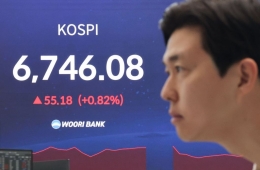
- [Breaking] KOSPI Hits Record High During Trading, Surpasses 6,740 Mark
- "Major Crash Is Coming... Buy Even If You Have to Skip a Meal" 'Rich Dad' Shares...
- Did Her Wealthy Husband Quash the Investigation? Yang Jungwon Appears Before Pol...
If a war or a blockade operation similar to that in the Strait of Hormuz were to break out around Taiwan, South Korea would inevitably suffer consequences. It is unlikely that the United States would hesitate to confront China out of concern for South Korea's situation. On the contrary, the United States is urging South Korea to take a more proactive role. The appointment of former U.S. Congresswoman Michelle Park Steel, who has consistently emphasized that "South Korea must play a leading role if China attacks Taiwan," as the new U.S. Ambassador to South Korea, is no coincidence. There is a need to be vigilant and to prepare for the possibility that a double blockade scenario akin to that in the Strait of Hormuz could unfold much closer to home.
© The Asia Business Daily(www.asiae.co.kr). All rights reserved.