“Everyone Said You’d Make Money” — Chinese Investors Rush In and Lose Principal Chasing High Interest Rates
Backlash for Dollar Deposit Investments Chasing High Interest Rates
Principal Losses Widen as Exchange Rate Falls
As the Chinese yuan continues to strengthen, losses are mounting for Chinese retail investors who had invested in US dollar assets seeking high interest rates. The decline in the exchange rate has resulted in losses that exceed the interest income from dollar deposits and financial products, leaving some investors facing principal losses.

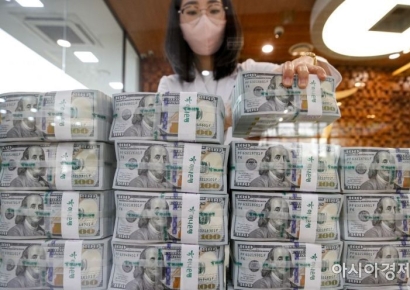
An employee is organizing US dollar bills at the Counterfeit Currency Response Center of Hana Bank in Jung-gu, Seoul. Photo by Jinhyung Kang
View original imageAccording to a report by Economic Observer on April 27, a person surnamed Bai who works in Shenzhen exchanged yuan for US dollars to fund a child's overseas education, investing approximately 80,000 US dollars from 2024 to the first quarter of 2025. Bai purchased dollars in tranches when the exchange rate was around 7.3 yuan per US dollar, and diversified the investment between dollar term deposits and financial products.
However, the situation reversed recently as the yuan strengthened. It is reported that Bai's dollar assets have now recorded an unrealized loss of around 40,000 yuan.
Rush into Dollars Fueled by High Interest Rates
This trend coincided with the boom in “high interest dollar products” that spread across China around the middle of 2024. At the time, yuan deposit rates steadily declined, while some banks offered dollar term deposit rates exceeding 5% per annum, presenting an attractive yield.
Additionally, as expectations grew that the US Federal Reserve would soon cut rates, the high interest rate environment was not expected to last, further spurring investor sentiment. The demand to lock in relatively high interest rates led to a rapid inflow of funds into dollar-denominated assets.
Bai also followed this trend, exchanging 50,000 US dollars at an exchange rate of 7.3 yuan per dollar to sign up for a term deposit offering interest rates in the 5% range. Bai subsequently purchased additional dollars to expand the investment, allocating some of the funds to dollar-denominated financial products in hopes of earning interest income.
Exchange Rate Reversal... Interest Gains Neutralized
The problem arose in 2025 as the yuan began to appreciate. When the exchange rate dropped to around 7 yuan per US dollar, investors who bought dollars at higher rates could not avoid foreign exchange losses.

Although the yield on dollar-denominated financial products remained in the 3% range and term deposit rates hovered around 4%, losses from the declining exchange rate more than offset the interest income. As a result, some investors now face principal losses instead of the stable returns they had expected.
Experts point out that focusing solely on interest rates when investing in foreign currencies risks overlooking exchange rate volatility. In particular, if the exchange rate moves sharply in the opposite direction in a short period, the profit structure can deteriorate rapidly.
Declining Rate Appeal... Need for Strategy Reassessment
Recently, the interest rate advantage of dollar assets has been eroding quickly. Dollar deposit rates at major Chinese commercial banks are generally on a downward trend, and most large banks now offer rates below 3%. Some banks' short-term deposit rates have dropped to the low-to-mid 2% range. Market analysts note that, with narrowing interest rate differentials and heightened exchange rate volatility occurring simultaneously, a reassessment of foreign currency asset investment strategies is inevitable.
Hot Picks Today
 “Everyone Said You’d Make Money” ? Chinese I...
- Shaken Again... "Should I Just Cancel My Trip to Japan?" Heightened Tension as E...
- As Children Have Babies, Grandparents Open Their Wallets Wide... Paying Postpart...
- 'Three Cups a Day' Coffee Linked to Higher Muscle Mass... Seoul National Univers...
- Once a Leading 'Outdoor Legend'...Is Nepa Headed Down the Same Path as Homeplus?...
Experts advise that investment approaches should vary according to investment purpose and fund holding period. If the funds are not intended for long-term use, holding the assets for a certain period can help offset exchange rate fluctuations through interest income, but for short-term funds, investors should carefully consider the timing of currency conversion and the profit-loss structure to adjust their asset allocation accordingly.
© The Asia Business Daily(www.asiae.co.kr). All rights reserved.