"Korea's Pension Expenditure to Rise Fastest Among G20 Advanced Economies... Government to Prepare Reform Plan Within the Year"

It has been forecast that by 2030, Korea's pension expenditures, including the National Pension Service, will increase at the fastest rate among the G20 advanced economies.
According to the April edition of the International Monetary Fund (IMF)'s "Fiscal Monitor" released on the 26th, Korea's pension expenditures are expected to rise by 0.7% of its gross domestic product (GDP) over the five years between 2025 and 2030. Among the nine countries classified by the IMF as advanced economies within the G20—Korea, the United States, Japan, the United Kingdom, Germany, France, Canada, Australia, and Italy—this represents the steepest rate of increase.
This figure is much higher than Japan's 0.2%, despite Japan having entered the era of super-aging earlier than Korea. The United States is expected to see a 0.5% increase, Italy 0.6%, Germany 0.3%, Canada 0.4%, and France 0.1%.
Among the 36 countries and regions for which the IMF compiled data on pension expenditure changes as a share of GDP, Korea's rate ranked third, following Andorra (1.5%) and Hong Kong (0.9%). Lithuania, Portugal, and New Zealand are expected to experience the same rate of increase as Korea.
The average increase for the 36 countries and regions, the G20 advanced economies, and the G7 major economies all stood at 0.4%, which is 0.3 percentage points lower than Korea.
The report also projected that Korea's healthcare expenditures will increase by 0.9% of GDP by 2030 compared to 2025, the second highest among G20 advanced economies after the United States (2.3%). The rapid rise in Korea's pension and healthcare-related expenditures is attributed to the dramatic shift in its population structure.
In the "Korea Article IV Consultation Report" published in November last year, the IMF stated, "Population aging, which is expected to drive increases in pension and healthcare costs, is a primary factor behind Korea facing high levels of long-term spending pressure." The report emphasized that reforms to the pension system are essential to alleviating Korea's long-term fiscal challenges.
The government is currently coordinating among related ministries to revise the basic pension system, which provides payments to the bottom 70% income bracket (according to statutory criteria) of residents aged 65 and older in Korea.
Hot Picks Today
!["What Should I Eat? Cooking at Home Is a Hassle... 10,000~20,000 Won 'Hotel-Level Catering' Spreads in Ultra-Luxury Apartments [Luxury World]"](https://cwcontent.asiae.co.kr/asiaresize/93/2026042610544940447_1777168490.png) "What Should I Eat? Cooking at Home Is a Hassle...
"What Should I Eat? Cooking at Home Is a Hassle...
- Even with KOSPI at 6,500..."Selling Samsung and SK hynix for Cash," Individuals ...
- "Up to 600,000 Won Per Person, Finally Available"... Be Careful: Filling Up at Y...
- US Millionaire Trampled to Death by Elephant While Hunting in Africa
- No Work, No Inheritance for the Eldest... 30 Billion KRW in Shares Gifted to Sec...
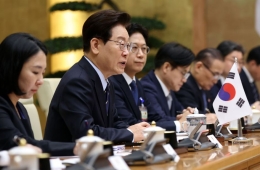
The government has begun work on revising the basic pension, aiming to include a concrete direction in next year's budget proposal. Last month, President Lee Jaemyung highlighted the need for pension reform in a post on X (formerly Twitter), proposing a differentiated payment system based on the "more support for lower income" principle. On the 21st, Minister of Planning and Budget Park Honggeun stated regarding the basic pension, "We can prepare a reform plan within this year," and added, "We are in discussions with relevant ministries."
© The Asia Business Daily(www.asiae.co.kr). All rights reserved.