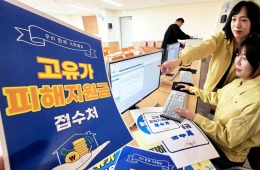
Sokcho City Launches Government Collaboration Tomorrow Fill Deduction... Up to KRW 12.24 Million After 3 Years
Sokcho City and Central Government Begin Full-Scale Response to Regional Decline and Economic Downturn
Applications for Collaborative Tomorrow Fill Deduction and Preferential Savings Deduction Open from April 29
Sokcho City in Gangwon Province is joining forces with the central government to support long-term employment for workers, aiming to overcome the risks of regional population decline and economic recession.

Starting on April 29, the city will officially launch the ‘Sokcho City Collaborative Tomorrow Fill Deduction and Preferential Savings Deduction Project’, accepting applications from participating companies and workers.
This deduction project is a follow-up to the ‘Asset Formation Support Project to Encourage Long-Term Employment for Workers’ business agreement, which was signed on January 31 with the attendance of Minister Han Sung-sook of the Ministry of SMEs and Startups. At that time, Sokcho City and the Korea SMEs and Startups Agency agreed, through the business agreement, to jointly respond to the issues of regional population decline and economic downturn by promoting long-term employment for workers and enhancing corporate competitiveness.
Notably, this project has even greater significance as it is the very first example of a ‘Central Government-Local Government Collaborative Long-Term Worker Employment Support Project’.
The project is divided into two categories: the Tomorrow Fill Deduction and the Preferential Savings Deduction.
The Sokcho City Collaborative Tomorrow Fill Deduction will be operated for three years, targeting 100 key personnel each year. If a core employee at a local small or medium-sized enterprise (SME) or mid-sized company in Sokcho contributes KRW 100,000 per month and the company contributes KRW 240,000 per month, Sokcho City will provide additional support of KRW 120,000 per month, settled every six months. As a result, upon maturity, the key personnel can receive up to KRW 12.24 million—3.4 times their principal contributions—plus interest.
The Sokcho City Collaborative Preferential Savings Deduction will be implemented over three years for 300 employees per year working at small businesses in Sokcho. If a worker contributes KRW 100,000 per month and the company contributes KRW 40,000 per month, the city will support the entire monthly company contribution of KRW 40,000 through semi-annual settlements. At the end of the three-year term, employees will receive a total of KRW 5.04 million plus interest.
In particular, for the Sokcho City Collaborative Preferential Savings Deduction, in addition to the city’s support, the Korea SMEs and Startups Agency will provide extra support to cover part of the company’s contribution, reimbursing the company for the full amount of its payment. This is expected to broaden participation among local small businesses and workers who previously could not join similar programs due to financial constraints.
Both programs will be operated for a total of 1,200 participants over the next three years. Applications can be submitted through the Tomorrow Fill Deduction website. Detailed eligibility requirements, application procedures, and further information will be available in the business-specific announcements on the Sokcho City website’s notices and public announcements section from April 27.
Hot Picks Today
!["What Should I Eat? Cooking at Home Is a Hassle... 10,000~20,000 Won 'Hotel-Level Catering' Spreads in Ultra-Luxury Apartments [Luxury World]"](https://cwcontent.asiae.co.kr/asiaresize/93/2026042610544940447_1777168490.png) "What Should I Eat? Cooking at Home Is a Hassle...
"What Should I Eat? Cooking at Home Is a Hassle...
- Caltech Graduate, Teacher of the Month, Game Developer... Who Is the Suspect in ...
- "Up to 600,000 Won Per Person, Finally Available"... Be Careful: Filling Up at Y...
- "The Essence Is Capacity Expansion" This Stock’s Target Price Soars 65% in Ten ...
- No Work, No Inheritance for the Eldest... 30 Billion KRW in Shares Gifted to Sec...
A Sokcho City official stated, “This collaborative deduction project between the central government and Sokcho City will provide workers with opportunities for long-term employment and settlement in the region, while offering companies a foundation for retaining human resources to enhance competitiveness. We are committed to actively responding to the issue of regional decline by establishing a virtuous cycle that leads to business growth, the creation of quality jobs, and revitalization of the local economy.”
© The Asia Business Daily(www.asiae.co.kr). All rights reserved.