[Reporter’s Notebook] Pride of Parents, Envy of Friends... What Remains After the Samsung Workers’ Strike
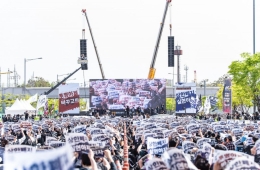
"Working at Samsung Electronics, I was the pride of my parents and the envy of my friends."
This single remark from a Samsung Electronics labor union executive at a recent rally goes beyond a simple recollection; it reveals a sobering reality the company now faces. Once a symbol of the highest pride, the company is now witnessing its union declare the introduction of payroll deduction (check-off) for union dues as the next step in a large-scale struggle, fueling momentum toward a general strike in May. Collective action is a right guaranteed by the Constitution. However, it is worth reconsidering whether there has been a thorough reflection on the potential ripple effects such actions may cause.
The semiconductor industry is the epitome of a "continuous process" that does not stop for even a second, 24 hours a day. If collective union action leads to the occupation of major production facilities, making normal operations impossible, the situation could quickly spiral out of control. The moment the cleanroom environment collapses, every wafer in process immediately turns into waste. In fact, a power outage at the Pyeongtaek plant in 2018 that lasted just 28 minutes caused losses of approximately 50 billion won. When calculated on a daily basis, this amounts to about 2.6 trillion won; if the union’s planned 18-day strike materializes, the losses could reach an astronomical 20 to 30 trillion won.
The greater concern is that the collateral damage from this general strike will extend beyond the boundaries of Samsung Electronics and impact the entire semiconductor ecosystem. If semiconductor production comes to a halt, those pushed to the brink first are the partner companies whose delivery volumes are cut off, as well as the non-regular, dispatched, and contract workers who work diligently at those firms. According to the 2024 Sustainability Report, Samsung Electronics is connected to about 1,700 partner companies (including first, second, and third tiers). What was once considered an internal labor-management conflict at Samsung now holds the fate of the broader semiconductor ecosystem.
The decline in trust in the global market is even more painful. For global heavyweights like Nvidia, who prioritize supply chain resilience above all else, disruptions in promised deliveries represent a fatal risk that may prompt them to consider ending business relationships. The moment a strike is perceived as a structural flaw, the brand reputation that Samsung Electronics has built over decades could vanish like a mirage.
Let us return to the confession at the beginning. If one loved and took pride in their company so much, logical consistency is needed even when engaging in actions that could inflict critical damage on that beloved workplace. If union members claim that the multi-trillion-won performance bonuses they demand are fair compensation for their labor, they must also be prepared to bear responsibility for the multi-trillion-won losses that could result from their choices. The logic that profits should be shared, but losses must be borne entirely by the company, is difficult to justify within a market economy system.
Hot Picks Today
 "I Wish I Could Get Some Sleep" Frozen Meals an...
- The Quoted 800,000 Won, the Bill Was 5 Million... Bereaved Families of 'No-Funer...
- Samsung Electronics Faces Production Disruption: Foundry Output Plunges 58% on D...
- "You Can Only Have This in Korea": Which National Museum Cafe Menu Is Captivatin...
- "Never Hike Alone as a Woman" "Even Two Are at Risk"... Growing Fear of Crime on...
The union has defined this struggle as "a fight to right the future of Korea’s science and engineering fields." If the genuine aim is to advance the future of science and engineering and the company’s development, the methods of struggle must be far more sophisticated and rational than they are now. If all that remains at the end of the strike is devastation, then neither the "pride of parents" nor the "envy of friends" will remain there.
![[Reporter’s Notebook] Pride of Parents, Envy of Friends... What Remains After the Samsung Workers’ Strike](http://www.asiae.co.kr/news/img_view.htm?img=2026042409121138918_1776989530.jpg)
© The Asia Business Daily(www.asiae.co.kr). All rights reserved.