Steel Supply Remains 'Stable' Despite Prolonged Middle East Conflict... Deputy Minister Moon Sin-hak: "Full Efforts to Manage Prices"
Low Dependence on Middle Eastern Steel Limits Direct Impact
Rising Energy and Logistics Costs Remain a Burden

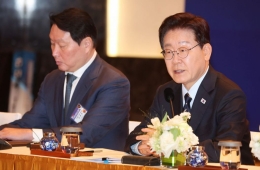
Moon Sinhak, Vice Minister of Trade, Industry and Energy, is delivering opening remarks at the 'Steel Industry Meeting' held at the Korea Chamber of Commerce and Industry on the morning of the 23rd. Ministry of Trade, Industry and Energy.
View original imageMoon Sin-hak, Deputy Minister of Trade, Industry and Energy, reviewed the steel supply and demand situation in response to the prolonged Middle East conflict and requested the industry's cooperation in stabilizing prices.
According to the Ministry of Trade, Industry and Energy, a 'Steel Industry Meeting' was held on the morning of the 23rd at the Korea Chamber of Commerce and Industry, presided over by Deputy Minister Moon, where participants discussed the supply and demand trends of major steel products and countermeasures.
This meeting was organized to assess the impact of prolonged instability in the Middle East on the basic materials supply chain and to strengthen the response system.
At the meeting, the Korea Iron & Steel Association evaluated that the domestic steel industry has a low dependence on steel products and raw materials from the Middle East, and therefore direct supply disruptions are limited. However, it explained that there are some indirect cost burdens due to rising international energy prices and increased maritime logistics costs.
Deputy Minister Moon emphasized, "Even minor instability in the steel supply chain can spread throughout the entire industry," adding, "Active cooperation from the industry is necessary to ensure a stable supply of steel materials and alleviate price burdens."
Hot Picks Today
 Chilling Timing "Did They Know Again?"... $640 ...
- [Exclusive] SK hynix Becomes First Korean Semiconductor Firm to Win IEEE Innovat...
- "If You Have This at Home, Remove It Immediately"... 'This Item' Is as Harmful a...
- "Why Are They Doing This?" Bizarre 'Streetlight Challenge' Involving Leg-Wrappin...
- Foreign Vessels Once Swept Up the Seas Every Season... Now Face Fines of Up to 1...
Furthermore, the government plans to fully support industrial restructuring and enhance competitiveness based on the 'Steel Industry Act', which is scheduled to take effect in June, in order to respond to changes in internal and external environments such as global oversupply, the transition to carbon neutrality, and the spread of protectionism.
© The Asia Business Daily(www.asiae.co.kr). All rights reserved.