KIET: "High Exchange Rate Shock Reveals Clear 'Import Polarization' by Industry...Differentiated Policy Needed"
Semiconductors and Batteries Face Direct Cost Impact
Automobiles Gain Import Substitution Opportunities

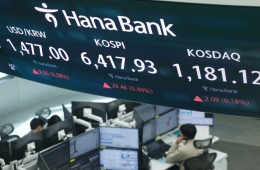
On April 16, amid expectations for a second round of negotiations between the U.S. and Iran that pushed the New York stock market's S&P 500 index to an all-time high, the domestic stock market also started nearly 1% higher. At the dealing room of Hana Bank's headquarters in Jung-gu, Seoul, an employee is monitoring the stock market and exchange rates. On this day, the KOSPI opened at 6,149.49, up 58.10 points (0.95%) from the previous trading day. Photo by Cho Yongjun
View original imageA state-run research institute has analyzed that, amid a period of high exchange rates, the import structures of different industries are responding differently, underscoring the need for customized policy responses. With the won-dollar exchange rate surpassing the 1,500-won mark—its highest level since the global financial crisis—the combined impact of high exchange rates and elevated oil prices is simultaneously increasing operating costs for companies.
On April 16, the Korea Institute for Industrial Economics & Trade (KIET) stated in its report, "Asymmetry in Industrial Import Structures and Policy Directions During Periods of High Exchange Rates," that exchange rate increases affect industries in distinct ways. Generally, a rising exchange rate increases import costs while improving export price competitiveness. However, in Korea’s case, the high dependence on imported intermediate goods means that rising import costs are transferred into production costs, thereby largely offsetting the improvements in export competitiveness.
The report specifically classified industries’ responses to exchange rate shocks as either ‘import-adjusting’ or ‘import-maintaining.’ Industries such as home appliances, automobiles, and auto parts, which are classified as import-adjusting, tend to flexibly decrease or increase import volumes in response to exchange rate fluctuations. This is because there are alternative suppliers available or it is feasible to shift to domestic production. In such cases, exchange rate increases could result in an ‘import substitution effect,’ weakening the price competitiveness of imported goods while boosting the competitiveness of domestically produced goods.
However, a decrease in imports does not always yield positive effects. The rise in prices for imported raw materials also increases production costs, which can simultaneously undermine the manufacturing base. Ultimately, whether a decline in imports leads to stronger industrial competitiveness or to a contraction in production depends on the structure of imported items in each industry.
In contrast, industries such as semiconductors, crude oil, and secondary batteries, which are categorized as import-maintaining, show inelastic import structures where import volumes do not decrease—or may even increase—despite rising exchange rates. In particular, for semiconductor materials and equipment, the global supply chain is highly limited, making substitution difficult, and exchange rate hikes immediately translate into higher procurement costs.
Under these circumstances, exchange rate increases are highly likely to directly lead to deteriorating corporate profitability. KIET pointed out that if high exchange rates persist, the cumulative burden of increased costs may result in reduced facility investment and lower productivity, which in turn could weaken industrial competitiveness in a negative cycle. The report especially highlighted the risk that, in strategic industries where global technological competition is intense—such as semiconductors and secondary batteries—the continuity of investment could be disrupted.
Accordingly, the report recommended differentiated policy responses tailored to the characteristics of each industry. For import-adjusting industries, policies should both link the import substitution effect to the expansion of domestic production and ease the burden of core intermediate goods costs. Conversely, for import-maintaining industries, where exchange rate shocks are directly translated into higher costs, investment continuity should be protected by measures such as making exchange rate fluctuation insurance more practical, expanding tax support, and increasing policy-based financing.
Hot Picks Today
![[Exclusive] "What? I Used It for Fried Eggs and Kimchi Pancakes, but It Wasn't Edible?"... Raw Pork Lard Supplied to Department Stores, Causing Stir](https://cwcontent.asiae.co.kr/asiaresize/93/2026042216151436513_1776842114.png) [Exclusive] "What? I Used It for Fried Eggs and...
[Exclusive] "What? I Used It for Fried Eggs and...
- "Chairman Chey Tae-won's Warning Comes True"... Laptop Prices Already Up 1 Milli...
- SK hynix to Pay 265.8 Billion Won Cash Dividend... 375 Won Per Share
- Israeli Military Chief of Staff: "Prepared to Return to Combat on All Fronts"
- "From 8,000 Won to 730,000 Won: The Toy Everyone Wants but Can't Get"
Additionally, KIET emphasized the importance of a common response to strengthen exchange rate risk management across all industries. The report suggested establishing an early warning system to monitor import prices and volumes by industry in real time, expanding access to hedging instruments for small and medium-sized enterprises, and providing effective consulting services.
© The Asia Business Daily(www.asiae.co.kr). All rights reserved.