"Land Over Buildings": The New Standard for Luxury Housing... Why Low-Density "Le Rel Upper House" Is in the Spotlight
![[Seoul Yeouido Apartment Complex]](http://www.asiae.co.kr/news/img_view.htm?img=2026031813290680187_1773808146.jpg)
The standards for what constitutes luxury housing in the domestic real estate market are gradually changing. Traditionally, luxury residences were symbolized by high-rise apartment buildings that offered impressive views, carried strong brand value, and featured expansive community amenities. Recently, however, perspectives have shifted from focusing solely on height or scale to also considering residential density and land structure.
The real estate industry is paying close attention to the structural limitations of high-rise apartments. Many apartments currently supplied with more than 35 floors have already utilized nearly all legally permitted floor area ratios. As a result, there have been ongoing concerns about the practical constraints involved in rebuilding or modifying these buildings as they age. In reality, high-rise and high-density complexes often face high construction costs and low business viability, making it difficult to pursue redevelopment projects.
The issue becomes even more significant looking ahead. While high-rise apartments are currently highly valued for their symbolism and rarity, in 30 to 40 years, they may become buildings that are difficult to demolish or reconstruct. This is because, with the floor area ratio already maximized, there is little additional value to be gained from redevelopment. In such cases, asset value tends to decline in line with the building’s aging process, and it is difficult to offset this solely with the underlying land, according to industry analysis.
The differences become even clearer when examining real estate asset structures. Real estate value is largely divided into land and buildings. Over time, the value of buildings decreases, whereas land often maintains or increases its value due to its scarcity. High-rise apartments are structured such that many households share a single plot of land, resulting in smaller land shares per household. As buildings age, the ability of the land to support asset value weakens.
In contrast, low-density residences have fewer households and larger land shares per household. In such structures, the land plays a central role in asset value even as buildings age. This allows for a wider range of future options, such as redevelopment, land consolidation, or sale. Industry experts explain, "The higher the quality of the residence, the more important the proportion of value attributable to land becomes, compared to the building itself."
This trend is also reflected in changing residential preferences. In the past, it was considered efficient to supply as many units as possible at a given location, but recently, more buyers are prioritizing privacy, comfort, and manageable maintenance responsibilities. While maintenance and management costs tend to rise over time in high-rise complexes, low-density residences are considered to have relatively stable cost structures.

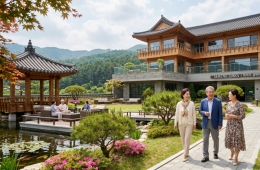
Amid these changes, "Le Rel Upper House," currently under development in Heonin Village, Seocho District, Gangnam, is cited as an example that embodies the characteristics of low-density housing. This complex, though a multi-family residence, has adopted a structure where each household holds land shares equivalent to approximately 100% of the site area, a rare approach in typical apartment buildings and characteristic of individual houses.
The design of the complex also focuses on lowering residential density. Only 222 units are arranged on a site of about 56,000 pyeong (approximately 185,000 square meters), with the building area restricted to around 20% of the total site. Instead of maximizing the number of units, the plan prioritized securing ample green space and open areas to ensure a quality residential environment is maintained over time.
Industry experts believe that the luxury housing market is moving away from emphasizing short-term convenience or symbolism and is instead focusing on structures that offer a range of options even as time passes. While high-rise apartments may be optimized for current living standards, land-centric, low-density residences are regaining attention as assets that can be passed down to the next generation.
Hot Picks Today
![[Exclusive] "What? I Used It for Fried Eggs and Kimchi Pancakes, but It Wasn't Edible?"... Raw Pork Lard Supplied to Department Stores, Causing Stir](https://cwcontent.asiae.co.kr/asiaresize/93/2026042216151436513_1776842114.png) [Exclusive] "What? I Used It for Fried Eggs and...
[Exclusive] "What? I Used It for Fried Eggs and...
- "Chairman Chey Tae-won's Warning Comes True"... Laptop Prices Already Up 1 Milli...
- SK hynix to Pay 265.8 Billion Won Cash Dividend... 375 Won Per Share
- Samsung Biologics Union Holds First Rally: "Strike Set for May 1 if Disputes Per...
- "From 8,000 Won to 730,000 Won: The Toy Everyone Wants but Can't Get"
Meanwhile, Le Rel Upper House operates an on-site observatory, where visitors can directly check the landscaping and construction progress. There is also a "Le Rel Upper House Gallery" in Ttukseom Park along the Han River, where people can experience the brand philosophy and residential concepts. Both facilities are open for visits through advance reservation.
© The Asia Business Daily(www.asiae.co.kr). All rights reserved.