Pessimists Cheer the 'Circuit Breaker'... This Time, Warnings of "Ominous Signs" for KOSPI
Concerns Continue Amid Wild Swings in the Stock Market
Michael Burry, the real-life protagonist of the film "The Big Short" and the American short-seller who predicted the 2008 financial crisis, recently commented that the sharp fluctuations in the KOSPI could be an ominous sign.
Burry of "The Big Short" Issues Warning over KOSPI Volatility

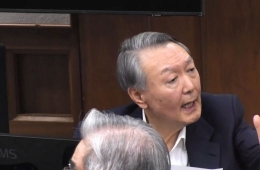
Following the decline of the three major U.S. stock indices in New York, the domestic stock market also opened lower, but the KOSDAQ continued its upward trend as a sell-side car was triggered. On the 6th, at the Seoul Hana Bank headquarters dealing room, employees were monitoring the stock market and exchange rates. On this day, the KOSPI fell by 92.88 points (1.66%) from the previous trading day to 5,491.02, while the KOSDAQ index rose by 1.08 points (0.10%) from the previous session to 1,117.49. The won/dollar exchange rate opened at 1,479.0 won, up 10.9 won from the previous day. Photo by Jo Yongjun
View original imageOn March 5 (local time), Burry wrote on the online newsletter platform Substack, "The Korean stock market has historically been difficult for individual investors outside Korea to access and has been neglected for years, but has recently started to gain momentum." He added, "Over the past month or so, it was institutional investors who were driving the KOSPI. Such volatility is a definitive sign that momentum traders have entered the market."

In the stock market, momentum refers to the tendency of a stock price to continue moving in a particular direction. Momentum traders are investors who engage in short-term speculative trading by following these trends. Burry raised the possibility that speculative trading by foreign institutional investors has played a role in increasing the KOSPI's volatility following the outbreak of war between the United States and Israel and Iran.
Burry wrote, "What does it mean for institutions to day-trade the KOSPI? That is one of the four horsemen of the apocalypse—an omen of doom—appearing."

Burry amassed great wealth by predicting the collapse of the U.S. subprime mortgage market in 2008 and betting against related assets using short-selling strategies. His story was adapted into the 2015 film "The Big Short." More recently, he has argued that there is a bubble forming in the artificial intelligence (AI) industry and that its collapse is imminent.
However, on Wall Street, Burry's comments are often not given much weight, as he gained fame from his single outstanding prediction of the 2008 financial crisis, but his subsequent pessimistic forecasts have repeatedly proven incorrect. In 2021, when Burry criticized Tesla's stock as being in a bubble, Elon Musk, CEO of Tesla, mocked him as a "broken clock."
Wall Street Veteran Also Warns: "The KOSPI Is Not for the Fainthearted"

On the 6th, a video related to the Middle East situation is being displayed in the dealing room at the Seoul headquarters of Hana Bank as the KOSPI dropped more than 2% intraday and the won/dollar exchange rate rose by more than 10 won. On this day, the KOSPI closed at 5,491.02, down 92.88 points (1.66%) from the previous trading day, the KOSDAQ index rose 1.08 points (0.10%) to 1,117.49, and the won/dollar exchange rate started the session at 1,479.0 won, up 10.9 won from the previous day. Photo by Jo Yongjun
View original imageConcerns over the Korean stock market continue to mount. Jim Bianco, CEO of Bianco Research and often referred to as a "Wall Street veteran," issued a warning that the Korean stock market is not a place for the fainthearted.
On March 4, he commented on the activation of the KOSPI circuit breaker through his X account, stating, "The Korean market is led by individual investors. While individual investors account for about 20% of the New York Stock Exchange, it is estimated that up to 70% of the Korean market consists of individual investors." He went on to explain, "In a market dominated by individual investors, prices don't just rise simply—they can double, and when prices fall, it's not just a correction but a crash."
He also noted, "Korea imports 94% of its oil, and 75% of that comes from the Middle East. It's easy to see why the 'speculative investors (degens)' in the Korean stock market are gripped by fear."
Marco Kolanovic, a well-known Wall Street pessimist and former chief strategist at JPMorgan, also raised his voice, saying his crash prediction had come true. On March 3 (local time), he posted a screenshot of the KOSPI crash on his X (formerly Twitter) account, writing, "I told you, NKY (Nikkei) and KOSPI would crash."
Hot Picks Today
 The Quoted 800,000 Won, the Bill Was 5 Million....
- "How Do Six People Sleep in a 44㎡ Apartment?" Subscription Point System Controv...
- They Say They'd Rather Go to Japan Than Travel Domestically... But a 'Surprising...
- Came to Shop for Clothes, Ended Up Singing and Getting an Eye Exam... Inside Mus...
- "Never Hike Alone as a Woman" "Even Two Are at Risk"... Growing Fear of Crime on...
Kolanovic, who called for a bull market during the S&P 500's sharp drop in 2022 and stuck to a bearish outlook during the rallies of 2023 and 2024, suffered a blow to his reputation. After stubbornly sticking to his off-target investment strategy for over two years, he stepped down from JPMorgan in July 2024.
© The Asia Business Daily(www.asiae.co.kr). All rights reserved.
![The 'Epic' 1,500 Trillion Won Bill... In the End, the Poor Pay the Price [Data Pick]](https://cwcontent.asiae.co.kr/asiaresize/307/2026042310001637425_1776906017.jpg)