"It Could Be an Opportunity to Take a Break After a Fall"... President Lee Calls for Accelerating Energy Transition and Capital Market Reform Amid Middle East Instability
President Lee Presides over Emergency Cabinet Meeting
Reviews Response to Middle East Crisis
Calls for Accelerating Energy Structure Reform
Promotes Renewable Energy and Local Production-Consumption Principles
Sees Market Instability as Opport
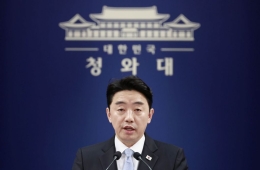
On March 5, President Lee Jaemyung stated that the Middle East-induced crisis should not be viewed merely as a short-term shock but should serve as an opportunity to accelerate the transition of Korea's energy structure and reform the capital markets. Although volatility in international oil prices and financial markets has increased, President Lee urged that policy responses should be broadened to address the structural vulnerabilities of the Korean economy.

Presiding over an extraordinary Cabinet meeting at the main building of the Presidential Office on this day, President Lee remarked, "Just as the saying goes, 'when you fall, take a break,' this could be a good opportunity. We must not leave the crisis as a crisis but turn it into an opportunity." He continued, "The stock market had risen unilaterally without much adjustment, resulting in instability. This situation could instead strengthen its foundations. With the necessary adjustments, the market can become even more robust."
President Lee first mentioned energy issues as a structural reform task. He stated, "Problems related to international oil prices and crude oil procurement will continue to recur in the future. Isn't this an opportunity to push for a much faster and more extensive transition to renewable energy?" He called for accelerating the energy transition in response to the Middle East situation, noting that high dependence on fossil fuels inevitably makes the country more vulnerable to external instability.
President Lee also raised the issue of power transmission networks and easing concentration in the Seoul metropolitan area. He said, "The fundamental task is to establish a structure in which energy is produced and consumed locally, following the principle of 'local production for local consumption.' Producing electricity in the provinces and transmitting it to the metropolitan area incurs enormous costs." He emphasized the need to ease metropolitan concentration and promote industrial relocation, stating, "Industries must also move quickly and on a large scale to areas abundant in energy."
He also addressed the need to reform the electricity pricing system. President Lee said, "Currently, electricity rates are uniform nationwide, causing losses for production areas and benefits for areas with concentrated usage. We must set prices appropriately—lower where production costs are cheaper and higher where transmission costs are significant." This is interpreted as a call to elevate the government's proposed electricity rate differentiation system to a more practical policy agenda.
Regarding the capital market, President Lee stressed that the increased volatility following the Middle East instability should be used as an opportunity to improve the market's structure. Concerning the government's "100 trillion won plus alpha (α) market stabilization program," he stated, "It must not be misunderstood as direct support for stock prices. The purpose is to correct temporary abnormalities when there are no structural problems." Kim Yongbeom, policy chief at the Presidential Office, added, "It is about the money and bond markets, which is different from the concept of stabilizing the stock market." They clarified that the program is a liquidity safety net to ease market anxiety, not a tool for artificially propping up stock prices.
Hot Picks Today
 Frozen Meals, Two Hours of Sleep... "I Wish I C...
- The Quoted 800,000 Won, the Bill Was 5 Million... Bereaved Families of 'No-Funer...
- "You Can Only Have This in Korea": Which National Museum Cafe Menu Is Captivatin...
- Tragedy in Luxury Apartment: Woman in Her 20s Found Dead, Suspect Identified
- "Never Hike Alone as a Woman" "Even Two Are at Risk"... Growing Fear of Crime on...
President Lee also called for swift action to address the chronic undervaluation of Korea's stock market. "Everyone knows that our stock market is undervalued," he said. "We must quickly resolve issues such as corporate governance, abuse of control, market opacity, and unfairness." Citing market-disrupting practices such as insider trading, collusive trading, and the spread of false information, he stated, "These must be thoroughly eliminated."

President Lee also mentioned additional legislative tasks related to the capital market. "It would be good to push even more actively for legislation to correct abnormal market conditions," he said, "including legislation to address the practice of intentionally suppressing stock prices for purposes such as inheritance. We must accelerate policy and legislative measures to create a more reasonable, fair, transparent, and predictable market." The so-called "anti-stock price suppression law" refers to a proposed amendment to the inheritance and gift tax law designed to prohibit listed companies from deliberately depressing share prices to reduce tax burdens.
© The Asia Business Daily(www.asiae.co.kr). All rights reserved.