Ruling Party to Push Various Reforms Including Prosecution and Judicial Overhaul After Lunar New Year...Concerns Over Livelihood Bills Being Held Hostage (Comprehensive)
Judicial reform bills raising "concerns over unconstitutionality" to be handled at the February National Assembly session
Re-legislation bills on prosecution reform to be handled after party-government coordination
The Democratic Party of Korea plans to handle the so-called "three major judicial reform bills" (the Constitutional Complaint Act, the Supreme Court Justice Expansion Act, and the Crime of Distorting the Law) as scheduled at the plenary session to be held after the Lunar New Year holiday. However, there are concerns that if the party pushes ahead with the reform bills, livelihood-related bills necessary for state affairs could be held hostage.
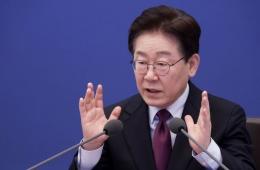
On Feb. 13 at the Supreme Council meeting held at the National Assembly, Democratic Party leader Chung Cheongrae said, "As previously announced, we will ensure that judicial reform is carried out without setbacks and without compromise during the provisional National Assembly session in February."

Jeong Cheongrae, leader of the Democratic Party, is speaking at the Supreme Council meeting held at the National Assembly on Feb. 13, 2026. Photo by Kim Hyunmin
View original imageThe previous day, the People Power Party protested the fact that, under the leadership of the Democratic Party, the Constitutional Complaint Act (the amendment to the Constitutional Court Act) and the Supreme Court Justice Expansion Act (the amendment to the Court Organization Act) had passed the threshold of the standing committee. In response, it canceled the luncheon meeting between the ruling and opposition party leaders and the president and boycotted the plenary session. The first meeting of the special committee to deal with the Special Act on Investment in the United States also broke down after about 40 minutes.
Chung said, "The current Chief Justice of the Supreme Court is openly opposing judicial reform, claiming that it will cause enormous harm to the people. The judicial reform bills have gone through a sufficiently thorough process of public discussion for more than a year through various public hearings and debates," and, targeting Chief Justice Cho Hee-dae, added, "I think this is an all-time belated response and an all-time tantrum."
However, the judicial reform package being pursued by the Democratic Party has sparked controversy over its unconstitutionality not only within the People Power Party but also in the legal community. The essence of the Constitutional Complaint Act is to allow constitutional complaints to be filed against court rulings as well, but it is criticized as effectively introducing a "four-tier court system." Critics argue that there is a risk of unconstitutionality because the final adjudicating body would shift from the Supreme Court (third instance) to the Constitutional Court.
The Supreme Court Justice Expansion Act, which would increase the number of Supreme Court justices from 14 to 26, has drawn criticism that an increase in justices would pull human and material resources toward the Supreme Court, thereby weakening the lower courts.
The Crime of Distorting the Law (the amendment to the Criminal Act), which passed the standing committee at the end of last year, stipulates that judges, prosecutors, and investigators who intentionally misapply the law will face suspension of qualification and imprisonment. However, concerns have been raised that it is difficult to determine whether "distortion of the law" has occurred, and that political power could undermine the independence of the judiciary.
Furthermore, if the Democratic Party forces through reform bills opposed by the opposition People Power Party, it will be difficult to handle livelihood-related bills necessary for state governance in a timely manner. At the plenary session the previous day, the ruling and opposition parties had originally agreed to pass 82 livelihood-related bills, but due to the People Power Party's boycott of the National Assembly, only 63 bills were passed under the leadership of the ruling camp.
For this reason, if the Democratic Party proceeds after the holiday with various reform bills, including prosecution reform and judicial reform, clashes will be inevitable. Even if the bills are designated as fast-track agenda items, the process can take up to 330 days, which could disrupt the governance of the Lee Jaemyung administration.
Nevertheless, Democratic Party chief spokesperson Park Soo-hyun said, "After the Lunar New Year, we will calmly proceed with the procedures to pass the Public Prosecution Office Act and the Serious Crimes Investigation Agency Act," adding, "Before the re-legislation notice comes out after the holiday, we will do our best, through coordination between the party and the government, to produce better bills."
Hot Picks Today
 "If Your Age and Years of Service Total Over 70...
- "Did Trump Anticipate This?" Export Orders Surge Amid War... Record-High Export ...
- "Be Quiet, Pig": Jimmy Kimmel Live! Wins 'Broadcasting Pulitzer' After Sharp Sat...
- "Using Company Funds Like a Personal Piggy Bank"... Musk Turned to SpaceX Whenev...
- "Surviving 17 Days on Rainwater Without Food"... Ukraine Shocked by Photos of Ma...
Meanwhile, on this day the Democratic Party changed the name of the existing three special counsels (rebellion, Kim Keon-hee, and the Marine who died in the line of duty) special committee to the "Second Comprehensive Special Counsel Response Committee" and replaced its chair from lawmaker Junghyun Hee to Supreme Council member Kang Deukgu. The chair of the Special Committee for Responding to Manipulated Prosecutions by Political Prosecutors was changed from lawmaker Han Junho to Supreme Council member Lee Sungyun. This is because Junghyun Hee and Han Junho are running for mayor of Seoul and governor of Gyeonggi Province, respectively.
© The Asia Business Daily(www.asiae.co.kr). All rights reserved.