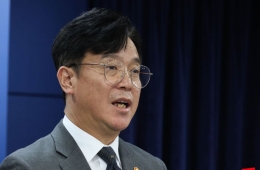
Min Kyungseon: "Breaking Gridlocked Public Transit Requires Dismantling Operator Vested Interests and Introducing Tok Buses"
Strong Route Overhaul Needed Early in the Term
Citizen-Centered Green Transit Network
Including a Goyang-Style Transportation Pass
Ahead of the Goyang mayoral election in Gyeonggi Province, Min Kyungseon, former president of Gyeonggi Transportation Corporation (currently Deputy Chair of the Policy Committee of the Democratic Party of Korea), who is regarded as a "transportation policy brain," attended a "Public Transportation Users Listening Session" at Taeyoung Plaza Hangang Hall on the 11th and presented practical, bold, implementation-focused policy alternatives to resolve Goyang City's long-standing transportation challenges.

Min Kyungseon, former president of the Gyeonggi Transportation Corporation and currently Deputy Chair of the Policy Committee of the Democratic Party of Korea, attended a "Listening Session with Public Transport Users" at Taeyoung Plaza Hangang Hall on the 11th and presented practical, bold policy proposals to resolve Goyang City's long-standing traffic problems. Provided by candidate Min Kyungseon.
View original imageThis session was organized to diagnose the poor state of Goyang City's internal transportation network, which has been relatively neglected due to Seoul-centric metropolitan transportation policies, and to seek sustainable public transportation solutions based on citizens' real-life experiences of inconvenience.
Demonstrating his expertise as a transportation specialist, former Gyeonggi Transportation Corporation president Min Kyungseon directly identified the fundamental ills of Goyang's transportation as "a lack of connectivity between hub-based infrastructure such as railways and metropolitan buses" and "a route structure biased toward Seoul," and presented three major policy alternatives.
Citizens participating in the session had already highlighted the urgency of a policy shift by sharing vivid on-the-ground accounts.
Nam Dongjin, a reporter at the Goyang Newspaper, noted that "carbon emissions from the transportation sector account for 30% of the city's total," and called for "a transition to an effective, partially public bus system and demand-responsive models such as public shuttles to reduce dependence on private cars and alleviate transportation exclusion and inconvenience."
Han Kisik, head of the Goyang Bicycle School, said that "it is necessary to create a green transportation-friendly environment, including the '1010 Policy,' which makes everyday living areas accessible within 10 minutes by bicycle, and expanded support for electric bicycles."
University student Kim Minjae said that "university students in Goyang City spend one-quarter of their time on the road," and proposed "dense connectivity between GTX-A and village buses, and the establishment of a youth policy governance framework."
Myung Hoyoung, a resident of Daejang-dong and Naegok-dong, said that "areas suffering from transportation exclusion are becoming even more isolated under profit-driven logic," and appealed that "transportation welfare is desperately needed, including the introduction of 'public shuttle buses' that guarantee convenience for transportation-vulnerable groups such as students, low-income residents, and the elderly."
After listening to citizens' opinions, Min first strongly advocated the "full-scale introduction of demand-responsive Tok Bus (DRT)." He pointed out that "existing village buses are operated under a profit-oriented privatized system, which makes route changes difficult and ties them to entrenched operator interests, resulting in low efficiency," and stressed that "in transportation-isolated areas, we must introduce call-based Tok Buses instead of supplier-centered route buses to drastically reduce headways."
Min went on to advise that "because transportation system reform faces strong resistance, it must be carried out with determination in the early part of the term, when it is possible to withstand three to six months of civil complaints in order to secure momentum." He also proposed concrete welfare models, such as introducing a "Goyang-style transportation pass" to guarantee mobility rights for young people and students, and operating "student-only school buses" based on the Gyeonggi Transportation Corporation model.
Hot Picks Today
 "Stocks Are Not Taxed, but Annual Crypto Gains Over 2.5 Million Won to Be Taxed Next Year... Investors Push Back"
- "Don't Throw Away Coffee Grounds" Transformed into 'High-Grade Fuel' in Just 90 Seconds [Reading Science]
- Signed Without Viewing for 1.6 Billion Won... Jamsil and Seongbuk Jeonse Prices Jump 200 Million Won in a Month [Real Estate AtoZ]
- "Groups of 5 or More Now Restricted"... Unrelenting Running Craze Leaves Citizens and Police Exhausted
- "Even With a 90 Million Won Salary and Bonuses, It Doesn’t Feel Like Much"... A Latecomer Rookie Who Beat 70 to 1 Odds [Scientists Are Disappearing] ③
Kim Beomsu, head of the Urban Autonomy Research Institute, defined transportation as "not merely a means of getting around, but welfare and a basic right that supports citizens' daily lives." He added that "we must strengthen the public nature of transportation, with the public sector bearing ultimate responsibility, to build a Goyang City where young people settle down and can dream of new challenges."
© The Asia Business Daily(www.asiae.co.kr). All rights reserved.