Will North Korean POWs in Ukraine Be Allowed to Go to South Korea? [Yang Nak-gyu's Defence Club]
Three-way ceasefire talks among the United States, Russia, and Ukraine
The handling of North Korean prisoners of war emerges as a key agenda item
The fate of North Korean prisoners of war who were deployed to Russia and then captured is expected to become a full-fledged topic of discussion. A three-party ceasefire meeting involving the United States, Russia, and Ukraine is scheduled to begin on February 4 (local time), and it is highly likely that the handling of these prisoners will also be discussed.

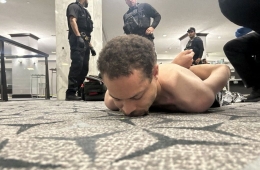
On the 24th, the North Korean defector group Gyeoreol Tongil Yeondae made public handwritten letters in which two North Korean prisoners of war captured by Ukrainian forces expressed their intention to defect to South Korea. (Photo by Gyeoreol Tongil Yeondae) Yonhap News
View original imageAccording to foreign media, the ceasefire talks in Abu Dhabi, United Arab Emirates (UAE), are being held about two weeks after the first round of ceasefire talks on January 23–24. Given the rapid pace of negotiations, the issue could extend to the cases of Mr. Baek and Mr. Ri, North Korean prisoners of war held at a POW camp near Kyiv, Ukraine.
They were deployed to Russia and sent into the Battle of Kursk, then captured this year by Ukrainian forces. The Ukrainian authorities used X (formerly Twitter) to inform the international community of their existence, publicly releasing their personal details and interrogation videos at the time.
North Korea, on the other hand, did not disclose their existence. Under international law, for them to be recognized as prisoners of war, North Korea must officially acknowledge its participation in the war. At that time, the South Korean government could still argue that, under international law, their status was that of defectors, not prisoners of war, and could therefore request their humanitarian repatriation to South Korea from Ukraine. Then, North Korea abruptly changed its stance and belatedly gave official recognition to its participation in the war in Ukraine. As a result, the status of the North Korean prisoners shifted to that of "prisoners of war."
Is it possible for the North Korean POWs to come to South Korea?
Prisoners of war are subject to the Geneva Conventions. Article 118 of the Geneva Convention stipulates that prisoners of war must be released and repatriated without delay after the cessation of active hostilities. This means that although the North Korean prisoners of war have long expressed a desire to come to South Korea, they could be sent back to North Korea under the provisions of the law.
However, there is no explicit provision that repatriation must be carried out by force. On the contrary, the United Nations (UN) General Assembly resolution of December 3, 1952, specifies that "no force shall be used to prevent or effect the repatriation of prisoners of war to their homeland, and prisoners shall at all times be treated humanely in accordance with the spirit of the Geneva Conventions."
The South Korean government also bases its position on these conditions. Because North Korean prisoners of war are clearly citizens of the Republic of Korea under the Constitution, the government maintains that it will accept all of them if their intention to defect is confirmed. At a regular briefing on January 22, the Ministry of Foreign Affairs stated, "North Korean prisoners of war are our citizens under the Constitution," and added, "In line with the basic principle that all will be accepted if they request to come to South Korea, we will provide protection and support." However, in the process of repatriating the prisoners of war, the government must consult not only with the Ukrainian authorities, but also with various international organizations, including the United Nations and the International Committee of the Red Cross (ICRC). If it is decided that they will come to South Korea, the government will also have to coordinate step by step to ensure their safety during transit, including via a third country.
Negotiations with Ukraine are key
Even as they stand as "our citizens under the Constitution," it cannot be ruled out that, as prisoners of war refusing repatriation to their home country, they could be sent to a neutral state instead. Highlighting the issue of the North Korean prisoners of war could affect South Korea's diplomatic relations with Ukraine and Russia, as well as the negotiation environment in the post-war phase. This is why the government has not been able to spell out concrete follow-up measures.
Yoo Yongwon, a lawmaker of the People Power Party who sits on the National Assembly Defense Committee, suggested at a policy seminar held at the National Assembly the previous day under the theme "North Korean Prisoners of War in Ukraine: How Should We Bring Them to South Korea?" that the issue of the two North Korean prisoners of war deployed to Russia and seeking to defect to South Korea should be resolved "through direct communication between President Lee Jaemyung and Ukrainian President Volodymyr Zelensky."
Possibility of using the issue as a bargaining chip in talks on South Korea's support
On the same day, Sung Jaeho, head of the Future Policy Research Institute at Sungkyunkwan University, argued that because the two North Korean prisoners of war have publicly expressed their intention to defect to South Korea, their voluntary wishes must be respected. He said, "Under Articles 4 and 12 of the Geneva Convention, North Korean prisoners of war fall under the category of 'prisoners of war,' and the detaining power (Ukraine) may transfer them only to a contracting party to the Convention after verifying that the receiving state is willing and able to apply the Convention," adding, "The principle of the Geneva Convention is that prisoners must not be transferred to a country where there is a real risk of torture, other inhumane treatment, or persecution."
Hot Picks Today
!["What Should I Eat? Cooking at Home Is a Hassle... 10,000~20,000 Won 'Hotel-Level Catering' Spreads in Ultra-Luxury Apartments [Luxury World]"](https://cwcontent.asiae.co.kr/asiaresize/93/2026042610544940447_1777168490.png) "What Should I Eat? Cooking at Home Is a Hassle...
"What Should I Eat? Cooking at Home Is a Hassle...
- Even with KOSPI at 6,500..."Selling Samsung and SK hynix for Cash," Individuals ...
- "Up to 600,000 Won Per Person, Finally Available"... Be Careful: Filling Up at Y...
- "Survived Thanks to Korean Choco Pie"...How a Vietnamese University Student Endu...
- No Work, No Inheritance for the Eldest... 30 Billion KRW in Shares Gifted to Sec...
The remaining task is diplomatic dialogue with the Ukrainian government. The Ukrainian government has repeatedly stated that "it is possible" for the North Korean prisoners of war deployed to Russia to come to South Korea, yet has not shown any proactive moves. There are also concerns that the Ukrainian government may try to use the North Korean prisoners as a "bargaining chip" in ceasefire negotiations and in discussions over South Korea's participation in Ukraine's reconstruction projects and weapons support. Since President Zelensky has repeatedly and publicly called for South Korea's support in weapons and reconstruction projects, there is a possibility that he will withhold approval for the prisoners' transfer to South Korea until he receives a clear commitment of support from the South Korean government.
© The Asia Business Daily(www.asiae.co.kr). All rights reserved.