Over 80 Gwangju Leaders Hold Emergency Meeting
Expressing Deep Concern Over the Government's "Lack of a National AI Strategy"
Urging Fulfillment of the "National AI Computing Center Establishment Pledge"

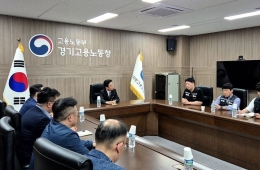
Kang Gijeong, mayor of Gwangju, held the "Gwangju Future Industry Emergency Meeting" on the afternoon of the 21st in the city hall's medium conference room with representatives from various sectors of the Gwangju area. Provided by Gwangju City
View original imageAs controversy over the location of the National AI Computing Center intensifies, more than 80 representatives from Gwangju's political, civic, and business sectors held an emergency meeting on the night of the 21st to express serious concerns over the government's lack of a national AI strategy. This was triggered by the revelation that Samsung SDS, which had previously discussed the project on the premise of bringing it to Gwangju, had changed the proposed location to South Jeolla Province and applied for the government bid accordingly. In response, Mayor Kang Gijeong convened the "Gwangju Future Industry Emergency Meeting" at city hall.
The attendees criticized, "Attracting the National AI Computing Center is not merely a matter of regional interest, but a key project that will determine the future competitiveness of South Korea." They further stated, "The government's lack of strategy and its shortsighted economic logic are undermining the consistency and direction of national industry." In particular, they expressed deep disappointment at the current moves to judge the project solely on immediate economic factors such as land prices and electricity rates, despite President Lee Jaemyung's campaign pledge to bring the center to Gwangju and its inclusion in the government's five-year national policy plan.
Mayor Kang explained that Gwangju City had engaged in long-term negotiations with Samsung SDS and had proposed unprecedented terms, including the immediate deployment of GPUs, reduced land prices, special legislation for electricity rates, and investment support of up to 100 billion won. He emphasized that Gwangju, with its already concentrated infrastructure, businesses, and talent-including the National AI Data Center-was the optimal location for the computing center. He strongly stated, "It is difficult to accept that the company suddenly reversed its position just ten days before the government bid deadline."
During the emergency meeting, participants voiced criticism that "for Gwangju citizens, who defended democracy even during periods of illegal martial law and impeachment, having such a promise overturned again is a serious issue of national trust and policy fairness." Oh Sangjin, head of the Artificial Intelligence Industry Convergence Project Group, stressed, "In today's fierce global competition for AI supremacy, investing in Gwangju, where infrastructure and talent are already concentrated, is the most efficient way to maximize the impact of the budget."
On this day, the attendees agreed to deliver a statement, in the name of the "Emergency Meeting," to the leadership of the Democratic Party, urging the fulfillment of President Lee Jaemyung's first campaign pledge: the establishment of the National AI Computing Center in Gwangju. They requested that the government and the Democratic Party reconsider, stating, "A project explicitly promised as a presidential pledge should not be overturned by the decision of a single company."
Mayor Kang declared, "Gwangju's AI dream cannot be stopped," and added, "The National AI Computing Center is a core infrastructure for South Korea to become one of the top three AI powers, and Gwangju will never give up on building a 'public AI' industry for all citizens."
Hot Picks Today
!["It Has Now Crossed Borders": No Vaccine or Treatment as Bundibugyo Ebola Variant Spreads [Reading Science]](https://cwcontent.asiae.co.kr/asiaresize/93/2026052019230771274_1779272587.jpg) "It Has Now Crossed Borders": No Vaccine or Treatment as Bundibugyo Ebola Variant Spreads [Reading Science]
"It Has Now Crossed Borders": No Vaccine or Treatment as Bundibugyo Ebola Variant Spreads [Reading Science]
- [Breaking] Samsung Labor Union to Hold Vote on Tentative Agreement from 22nd to 27th
- [Report] "I Think Twice Before Going to a Store"... Starbucks '5/18 Tank Day' Controversy Grows
- "Stocks Are Not Taxed, but Annual Crypto Gains Over 2.5 Million Won to Be Taxed Next Year... Investors Push Back"
- "Who Is Visiting Japan These Days?" The Once-Crowded Tourist Spots Empty Out... What's Happening?
Meanwhile, since July, Gwangju City has been conducting a citywide petition campaign to attract the National AI Computing Center. The campaign, which involved citizens, businesses, universities, religious groups, and social organizations, saw 170,829 participants, demonstrating the high level of public interest and aspiration among Gwangju citizens and the wider public.
© The Asia Business Daily(www.asiae.co.kr). All rights reserved.