Global Times: "Deterioration of South Korea-China Relations Blamed on External Forces"
"Returning to the Original Spirit of Diplomatic Normalization
Key to Advancing Bilateral Relations"
On August 25, the Chinese state-run Global Times published an editorial marking the 33rd anniversary of the establishment of diplomatic ties between South Korea and China (August 24), stating, "The relationship between South Korea and China can move forward stably and over the long term if it returns to the original spirit of diplomatic normalization."
The Global Times reported that a South Korean special envoy delegation led by former National Assembly Speaker Park Byeongseok visited China on this day to deliver a personal letter from President Lee Jaemyung. It also mentioned that National Assembly Speaker Woo Wonshik will attend the 80th anniversary of Victory Day on September 3. The newspaper added, "The Korean media has evaluated these developments as evidence that the Lee Jaemyung administration places great importance on relations with China."

A presidential special envoy delegation led by former National Assembly Speaker Park Byungseok (fourth from left) took a commemorative photo with Wang Yi, Director of the Central Foreign Affairs Office of the Chinese Communist Party and Minister of Foreign Affairs (fourth from right), in Beijing, China, on the 24th. Photo by Yonhap News
View original imageThe newspaper stated, "The development of South Korea-China relations is rooted in the two countries' shared historical memories and strategic interests," noting that the two nations formed solidarity in response to Japanese militarist aggression in modern times. It further explained, "In practical terms, peace on the Korean Peninsula and long-term stability in Northeast Asia align with the common interests of both countries, and in the process of ending the armistice regime and establishing a permanent peace system, South Korea and China are natural partners for cooperation." The editorial also emphasized that "over the 33 years since diplomatic normalization, South Korea and China have closely cooperated amid the trends of global economic integration and regional unification," and assessed that the two countries have become each other's largest trading partners. It added that their geographical and cultural proximity has led to expanded cultural exchanges through tourism and mutual visa-free policies.
The newspaper noted that in recent years, South Korea-China relations have reached their lowest point since diplomatic normalization, stating that during the Yoon Sukyeol administration, South Korea's diplomatic stance changed and Seoul adopted different positions from previous governments on issues related to China's core interests, leading to a deterioration of political trust between the two countries. As reasons for this, the editorial pointed to the structural influence of external forces and a divergence in South Korean perceptions of China.
It went on to say that since the inauguration of the Lee Jaemyung administration, the relationship between the two countries has entered a new phase, and stated, "It is normal for the two countries to have differences, given their different social systems and stages of development. The important thing is to respect each other's core interests and major concerns." The editorial further emphasized, "South Korea-China relations are based on the common interests of both sides, benefit the peoples of both countries, are not aimed at any third party, and should not be constrained by any third party."
Recently, tensions between the United States and China have been rising over the Taiwan Strait. China regards the Taiwan issue as a core interest and emphasizes respect for the 'One China' principle. However, amid discussions on the modernization of the South Korea-U.S. alliance at the recent South Korea-U.S. summit, there is speculation that the role of U.S. Forces Korea in the event of a Taiwan contingency could be discussed.
Hot Picks Today
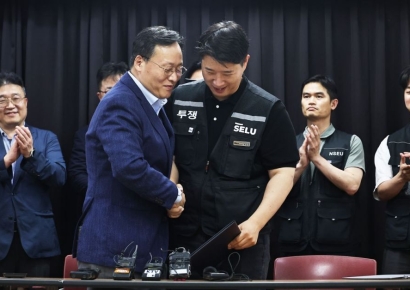 Up to 600 Million Won for Semiconductors, 160 Million Won Bonus for Loss-Making Non-Memory… Samsung Electronics Labor and Management Reach Tentative Deal on Unprecedented Performance Compensation (Comprehensive)
- "Could I Also Receive 370 Billion Won?"... No Limit on 'Stock Manipulation Whistleblower Rewards' Starting the 26th
- "From a 70 Million Won Loss to a 350 Million Won Profit with Samsung and SK hynix"... 'Stock Jackpot' Grandfather Gains Attention
- [Current State of Foreigner K-Finance]③"The Essence Is Ultimately Communication... Lending and Financial Education Must Go Hand-in-Hand"
- "Who Is Visiting Japan These Days?" The Once-Crowded Tourist Spots Empty Out... What's Happening?
The newspaper stated, "Thirty-three years ago, the leaders of both countries made a strategic decision that transcended ideological differences, broke the Cold War structure in Northeast Asia, and created the conditions to begin East Asian integration." It continued, "South Korea and China are inseparable neighbors. We hope that the new South Korean government will demonstrate political wisdom and strategic insight, return to the original spirit of diplomatic normalization, and restore bilateral relations to a healthy and stable path of development."
© The Asia Business Daily(www.asiae.co.kr). All rights reserved.
!["Please Help": How Much Do Those Bowing 90 Degrees Really Earn? [Data Pick]](https://cwcontent.asiae.co.kr/asiaresize/307/2026052010120870131_1779239528.png)