Mayor Jung Jangsun of Pyeongtaek: "Improving Lake Pyeongtaek's Water Quality to Create an Eco-Friendly Waterfront City"
Designated as a 'Priority Management Reservoir'...
"Improve water quality from Grade 4 to Grade 3 by 2030"
"Expand waterfront areas to 21% and develop as an eco-friendly waterfront ecological tourism destination"
Pyeongtaek City in Gyeonggi Province is launching a large-scale eco-friendly waterfront development project by improving the water quality of Lake Pyeongtaek.
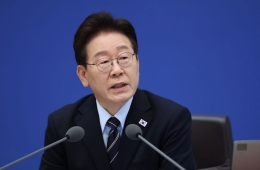
On the 24th, Mayor Jung Jangsun of Pyeongtaek City held an online briefing and stated, "Starting with the designation of Lake Pyeongtaek as a priority management reservoir, we will move forward with the creation of a sustainable waterfront city."

Jeong Jangseon, mayor of Pyeongtaek, is explaining the water quality improvement plan for Pyeongtaekho, designated as a 'priority management reservoir,' at an online briefing held on the 24th. Provided by Pyeongtaek City
View original imageEarlier this month, the Ministry of Environment designated Lake Pyeongtaek as a priority management reservoir. Under the Water Environment Conservation Act, a 'priority management reservoir' is a system in which the Ministry of Environment legally designates reservoirs to improve water quality, restore aquatic ecosystems, and strengthen waterfront recreation functions. Designated reservoirs receive national funding and are managed systematically at the national level.
Lake Pyeongtaek, created in 1973, has a storage capacity of approximately 100 million tons and is connected to 51 rivers, including Hwanggujicheon, Osancheon, Jinwicheon, and Anseongcheon. It has served roles such as providing agricultural water, flood control, and ecological preservation. However, due to the development of large-scale industrial complexes and population growth, water quality has deteriorated and is currently barely maintaining Grade 4, the minimum standard for agricultural water.
Mayor Jung also presented specific plans and goals for water quality improvement. He explained, "By 2030, we will improve the water quality to Grade 3, suitable for waterfront recreation, while simultaneously restoring ecological streams, blocking external pollution sources, and expanding eco-friendly waterfront spaces." He added, "We will restructure water environment governance to create a system in which citizens and experts can participate together in water quality improvement."
During the briefing, Mayor Jung also introduced plans to expand large-scale waterfront spaces in connection with the Pyeongtaek Lake Tourism Complex, Noeul Ecological Park, Oseong Nuri Plaza, and Changnae Wetland. He said, "Our ultimate goal with this designation is to transform Pyeongtaek City into an eco-friendly waterfront ecological tourism destination by expanding the current 13.8% of waterfront areas to up to 21.3%."
Hot Picks Today
 "Stocks Are Not Taxed, but Annual Crypto Gains Over 2.5 Million Won to Be Taxed Next Year... Investors Push Back"
- "Don't Throw Away Coffee Grounds" Transformed into 'High-Grade Fuel' in Just 90 Seconds [Reading Science]
- Signed Without Viewing for 1.6 Billion Won... Jamsil and Seongbuk Jeonse Prices Jump 200 Million Won in a Month [Real Estate AtoZ]
- "Groups of 5 or More Now Restricted"... Unrelenting Running Craze Leaves Citizens and Police Exhausted
- "Even With a 90 Million Won Salary and Bonuses, It Doesn’t Feel Like Much"... A Latecomer Rookie Who Beat 70 to 1 Odds [Scientists Are Disappearing] ③
Mayor Jung emphasized, "We will do our utmost to ensure that Lake Pyeongtaek becomes a clean waterfront space that can be passed down to future generations."
© The Asia Business Daily(www.asiae.co.kr). All rights reserved.