Incheon Achieves 102.9% Compliance with Social Welfare Facility Wage Guideline, Ranks Second Nationwide
Incheon City announced on May 22 that its compliance rate with the wage guideline for social welfare facility workers ranked second nationwide.
According to the "2024 Compliance Status of Local Transfer Social Welfare Facility Worker Wage Guidelines" released by the Ministry of Health and Welfare in March, Incheon recorded a compliance rate of 102.9%, ranking second in the country after Seoul and achieving the highest level among the 16 metropolitan cities and provinces.
Since the management of social welfare facilities was transferred to local governments in 2005, the Ministry of Health and Welfare has issued annual wage guidelines to address pay disparities among local governments. Since 2013, the ministry has also surveyed and published each local government's compliance rate to encourage their engagement.
In 2019, Incheon ranked ninth nationwide with a compliance rate of 99.3%, showing a significant gap with Seoul, which recorded 106.1% at the time. However, in the 2024 survey, Incheon narrowed the gap with Seoul to 0.6 percentage points and ranked first among the 16 metropolitan cities and provinces in 2021, 2023, and 2024.
Incheon has not only raised wages but also actively implemented a variety of welfare and treatment improvement initiatives, becoming the first in the country to do so. In 2018, Incheon was the first in the nation to provide special area work allowances. In 2020, it also introduced a step-based pay system for nationally funded social welfare facilities without wage standards, another first in the country.
Additionally, Incheon increased wage compensation by 3% annually for nationally funded facilities with lower wage levels. As a result, since 2023, both nationally and city-funded facilities have achieved 100% compliance with the Ministry of Health and Welfare’s wage guideline.

Incheon City is implementing new and expanded projects every year as part of its "Three-Year Plan for Improving Treatment of Social Welfare Facility Workers (2024?2026)."
Last year, the city carried out various initiatives, including increasing the fixed meal allowance by 30,000 won per month, expanding the application of child care leave to nationally funded facilities, extending the range of paid long-service leave for employees with more than five years of service, recognizing continuous service for annual leave and severance pay when transferring between facilities operated by the same corporation, and expanding the choice of training institutions for mandatory continuing education for social workers.
This year, the city raised the annual welfare points by 50 points (50,000 won), doubled the continuing education fee for social workers, and supported overseas training for workers. In addition, it plans to improve the wage system for lower-level workers with lower pay and raise their wages to 101% of the Ministry of Health and Welfare’s wage guideline.
Hot Picks Today
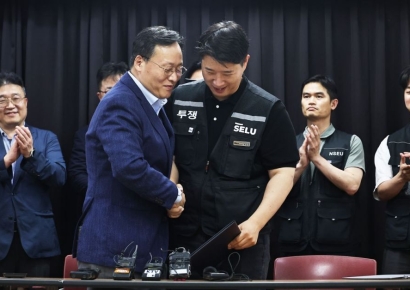 Up to 600 Million Won for Semiconductors, 160 Million Won Bonus for Loss-Making Non-Memory… Samsung Electronics Labor and Management Reach Tentative Deal on Unprecedented Performance Compensation (Comprehensive)
- "Could I Also Receive 370 Billion Won?"... No Limit on 'Stock Manipulation Whistleblower Rewards' Starting the 26th
- "From a 70 Million Won Loss to a 350 Million Won Profit with Samsung and SK hynix"... 'Stock Jackpot' Grandfather Gains Attention
- [Scientists Are Disappearing]④A Shaky Regional Research Ecosystem... "Professors Now Take the Initiative"
- "Who Is Visiting Japan These Days?" The Once-Crowded Tourist Spots Empty Out... What's Happening?
Next year, the city plans to further improve working conditions for employees through top-level welfare programs in the country, including increasing management allowances for facility heads and comprehensive health checkup expenses, special area work allowances, preferential promotion for lower-level employees, paid sick leave, Incheon-style substitute workforce support, awards for exemplary workers, and public-private cooperation workshops in social welfare.
© The Asia Business Daily(www.asiae.co.kr). All rights reserved.
!["Please Help": How Much Do Those Bowing 90 Degrees Really Earn? [Data Pick]](https://cwcontent.asiae.co.kr/asiaresize/307/2026052010120870131_1779239528.png)