Pension Reform Stalls Over 'Bipartisan Agreement' Clause; Passage at Plenary Session on the 20th Uncertain
Ruling Party: "Committee Formation Agreement Is a Prerequisite"
Opposition: "Considering Unilateral Passage of Parametric Reform Plan"
Unlikely to Pass This Week... Concerns Over Prolonged Stalemate
Although the ruling and opposition parties have reached a tentative agreement on a parametric reform of the National Pension-essentially, "pay more, receive more"-they failed to narrow their differences over whether to include the phrase "bipartisan agreement" in the proposal to establish a special committee on pension reform. With the National Assembly's plenary session on March 20, 2025, now unlikely to address the parametric reform plan, pension reform discussions are at risk of stalling for the foreseeable future.
According to political sources on March 19, 2025, momentum for pension reform, which seemed to accelerate after the Democratic Party abruptly accepted the "43% income replacement rate," has been halted. This is due to difficulties in launching a special committee to discuss future structural reforms. In order to meet the initial goal of passing the reform at the plenary session on March 20, a subcommittee meeting of the Health and Welfare Committee should have been scheduled for this day, but no such meeting was arranged.

Speaker Woo Wonsik is meeting with the floor leaders of the ruling and opposition parties at the National Assembly on the 18th. From the left, Kim Sanghoon, Policy Committee Chair of the People Power Party; Kwon Seongdong, Floor Leader; Speaker Woo; Park Chandae, Floor Leader of the Democratic Party of Korea; Jin Seongjun, Policy Committee Chair. 2025.3.18 Photo by Kim Hyunmin
View original imageThe previous day, during a government policy consultation chaired by Speaker Woo Wonsik, both parties agreed to handle the parametric reform plan in the Welfare Committee. The plan involves raising the insurance premium rate (the amount paid) and the income replacement rate (the amount received) to 13% and 43%, respectively. Detailed issues such as expanding credits for childbirth and military service, as well as increasing support for low-income groups, were left for further discussion.
However, the two sides remained at odds over the formation of the special pension reform committee. The People Power Party insists that the phrase "bipartisan agreement" must be included in order to process the parametric reform plan. This stems from concerns that, with the committee composed of six members from the People Power Party, six from the Democratic Party, and one from a minority party, the opposition could push through structural reforms unilaterally. Kim Sanghoon, Policy Committee Chair of the People Power Party, stated, "There has never been a case where the phrase 'matters will be handled by bipartisan agreement' was omitted when launching a National Assembly special committee," adding, "If we leave out this phrase only this time, does that mean you intend to push things through unilaterally?"
The Democratic Party immediately pushed back. They oppose including the phrase, arguing that "the government and the ruling party have repeatedly exercised their right to request reconsideration (veto) on the grounds of a lack of bipartisan agreement." The Democratic Party has even warned that if discussions continue to stall, they may consider unilaterally passing the agreement. Jin Sungjun, Policy Committee Chair of the Democratic Party, said, "If you completely overturn what was agreed upon, how are we supposed to negotiate? I have doubts about your commitment to pension reform," adding, "I am concerned about whether we will be able to fulfill the agreement to table and pass the pension reform bill at the plenary session on the 20th."
Hot Picks Today
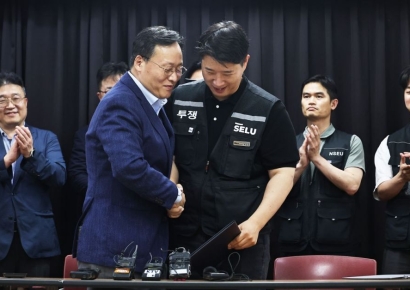 Up to 600 Million Won for Semiconductors, 160 Million Won Bonus for Loss-Making Non-Memory… Samsung Electronics Labor and Management Reach Tentative Deal on Unprecedented Performance Compensation (Comprehensive)
- "Could I Also Receive 370 Billion Won?"... No Limit on 'Stock Manipulation Whistleblower Rewards' Starting the 26th
- "From a 70 Million Won Loss to a 350 Million Won Profit with Samsung and SK hynix"... 'Stock Jackpot' Grandfather Gains Attention
- Opening a Bank Account in Korea Is Too Difficult..."It Costs 150,000 Won Just to Open a Child's Account or Check Card" [Foreigner K-Finance Status]②
- "Who Is Visiting Japan These Days?" The Once-Crowded Tourist Spots Empty Out... What's Happening?
There are concerns that the People Power Party may attempt to block the Democratic Party from unilaterally pushing through pension reform by bringing unrelated issues, such as a supplementary budget, into the discussions. If this happens, the special committee's deliberations could be overshadowed by political disputes and become protracted. There are also worries that, with a ruling on President Yoon Suk Yeol's impeachment trial expected soon, the pension reform debate itself could lose momentum and fade away.
© The Asia Business Daily(www.asiae.co.kr). All rights reserved.
!["Please Help": How Much Do Those Bowing 90 Degrees Really Earn? [Data Pick]](https://cwcontent.asiae.co.kr/asiaresize/307/2026052010120870131_1779239528.png)